Topography of Terror: Berlin’s Hardest and Most Important Museum
Free, open on Mondays, and the most rigorous history museum in Berlin. What is on the site of the Gestapo headquarters, how long to allow, and how to handle a genuinely draining visit.
There is nowhere to sit. That sounds like a trivial complaint about a museum and it is not: two hours of standing, reading dense wall panels about the administration of mass murder, in a building with almost no benches, is a physical experience as much as an intellectual one, and it is entirely deliberate. The topography of terror berlin is the hardest museum in a city with a great many hard museums, it is free, and it is the one we would send people to before any of the others.
This guide covers what is on the site, what the indoor and outdoor exhibitions actually contain, how long to give it, why it pairs with the Holocaust Memorial rather than competing with it, and how to handle a visit that is genuinely draining. There is no admission charge and no booking. What follows was checked in September 2026.
The essentials
| Question | Answer |
|---|---|
| Cost | Free. Indoor and outdoor exhibitions, and the audio guide. |
| Booking | None required |
| Opening hours | Documentation centre daily, roughly 10:00–20:00; outdoor trench closes at dusk in winter |
| Open Mondays? | Yes — one of the few major Berlin sites that is |
| Time to allow | Two hours minimum. Three if you read properly. |
| Address | Niederkirchnerstraße 8, Kreuzberg |
| Nearest station | Potsdamer Platz (U2, S1, S2, S25, S26) or Kochstraße (U6) |
| Seating | Almost none. This matters. |
| Accessible? | Yes — the documentation centre is fully step-free; the outdoor trench is gravel and paved paths |
| Suitable for children? | Not really. Older teenagers upwards. |
What this ground was
Between 1933 and 1945 the block bounded by Niederkirchnerstraße, Wilhelmstraße and Anhalter Straße held the headquarters of the machinery of Nazi terror, all within a few hundred metres of each other.
- The Gestapo — the Secret State Police, in the former Prinz-Albrecht-Palais art school on Prinz-Albrecht-Straße, with a house prison in the basement.
- The SS leadership and Himmler’s office, in the Hotel Prinz Albrecht next door.
- The Reich Security Main Office — the RSHA, from 1939, which merged the Gestapo, the criminal police and the SD into one apparatus and which was, administratively, where the machinery of the Holocaust was run from.
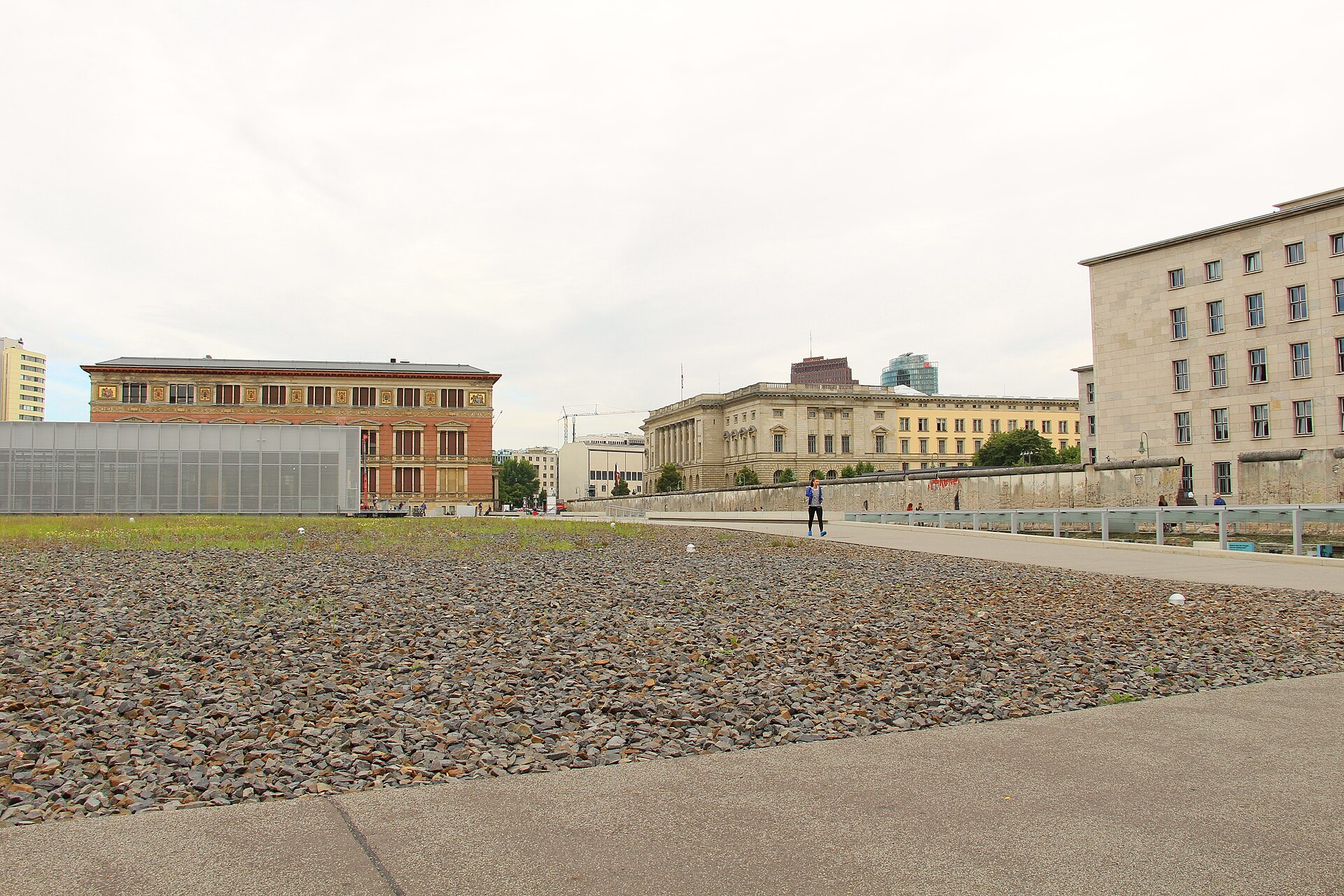
The buildings were bombed and the ruins cleared in the 1950s. Through the division, the land sat empty against the Wall, used for rubble dumping and, at one point, as a site for driving practice. Nobody marked it. That absence became its own scandal: by the 1980s there was a growing argument that the most important perpetrator site in Germany had been quietly paved over, and citizen groups began digging on the plot themselves.
They found the foundations. Cellar walls of the Gestapo house prison, kitchen basements, structures that could be identified against the old plans. A temporary exhibition opened in 1987 for Berlin’s 750th anniversary, and the site has been open ever since. The permanent documentation centre — the low grey box you see today — opened only in 2010, after two decades of argument about what such a building should even look like.
What is actually here
The documentation centre
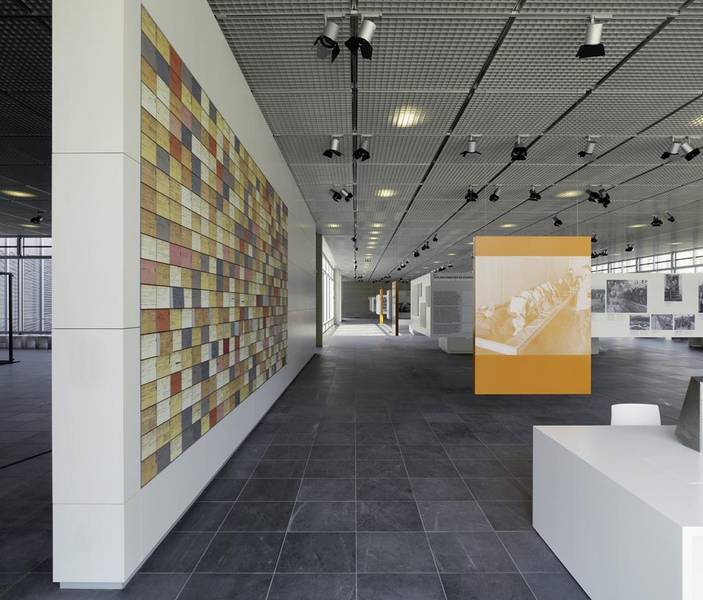
A single-storey grey-and-glass building by Ursula Wilms, deliberately neutral to the point of self-effacement. The main exhibition inside covers the institutions of terror: how the Gestapo, the SS and the RSHA were structured, who staffed them, how they worked, and what they did across occupied Europe.
What distinguishes it from almost every other Holocaust and Nazi-era museum is the angle. This is not primarily about victims — that is what the Holocaust Memorial and the Jewish Museum are for. This is about the perpetrators: the desks, the memos, the career paths, the ordinary bureaucratic ambition. Panels show the individuals, name them, and follow what happened to them after 1945 — which for a great many of them was a comfortable career in the Federal Republic. That last section is arguably the most uncomfortable thing in the building.
The presentation is austere: large photographs, dense text in German and English, documents, very little in the way of interactive display or atmosphere. It is a reading exhibition. That is a deliberate choice and it puts real demands on the visitor.
The outdoor trench exhibition
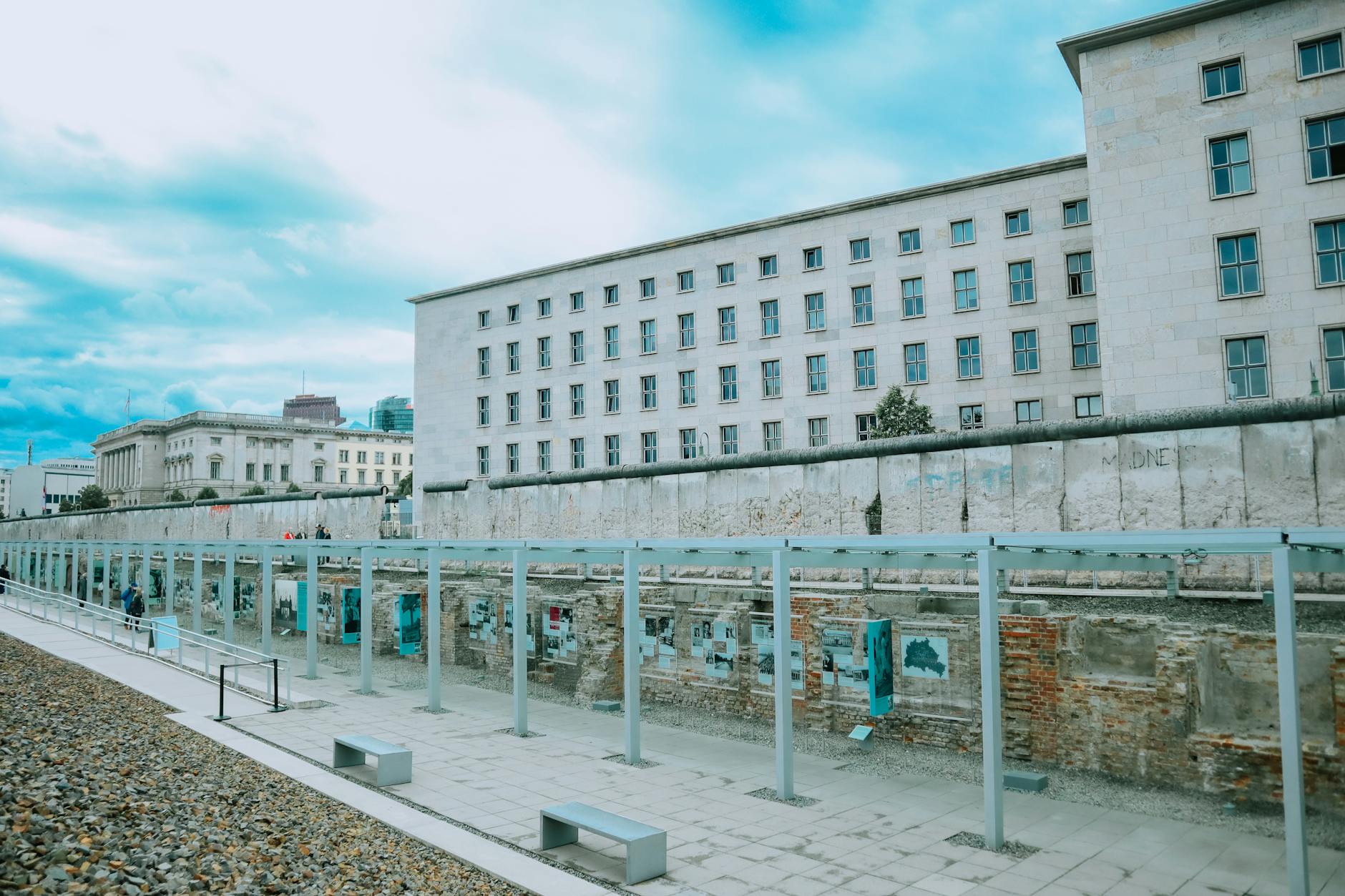
Along the Wall side of the site, an open excavation runs beside a preserved stretch of the Berlin Wall, with a fifteen-station exhibition above the exposed cellar walls of the Gestapo building. This is the part that gets you: you are standing over the actual foundations of the house prison, reading about what happened in the rooms below.
It is roofed but open at the sides and it is genuinely cold in winter. It is also open when the documentation centre is closed, which makes an early-evening or off-hours visit possible.
The Berlin Wall stretch
The Wall along Niederkirchnerstraße is one of the longest surviving sections in the city — around 200 metres — and it is in poor condition, gouged and chipped by souvenir hunters in the years after 1989. It is now protected by a fence. The juxtaposition is the whole argument of the site: the ground where the Gestapo worked, with the border of the next dictatorship running across it.
The historic grounds tour
An outdoor path with fifteen stations covering the wider block, including the Prinz-Albrecht-Palais site and what remains of the excavated structures. Free, with an audio guide.
The library
A specialist research library of around 30,000 volumes on the Nazi period, open to the public. Not a general visitor attraction, but genuinely usable if the subject is yours.
How to handle the visit
This is where honest advice matters more than usual.
- Allow two hours minimum, three if you read. People who allocate forty-five minutes end up skimming panels about the Einsatzgruppen, which is worse than not going.
- Go in the morning, not at the end of the day. You need concentration for this and it is the first thing to go. It also gives you the afternoon to recover.
- Do not stack it with another heavy site on the same day. The Holocaust Memorial in the morning and the Topography in the afternoon is a common plan and it is too much. One serious site per day is the honest maximum for most people.
- Take the audio guide. Free, and it lets you stop reading for a while, which helps more than you would think.
- Plan the hour afterwards. The Tiergarten is fifteen minutes north. Do not come out of here and go straight into a shopping street.
- Eat first. There is a small café, but two hours of standing on an empty stomach makes a hard visit harder.
- Take the outdoor trench first if the weather is fine, then the indoor exhibition. The physical site makes the documents mean more.
Who should not go
We would rather say this plainly than have people find out inside.
The exhibition includes photographs of executions, mass shootings and the aftermath of massacres. They are not sensationalised and they are not hidden. If you are travelling with children under about fourteen, this is not the site for them — the DDR Museum or Museum Island are better uses of a family morning, and our museums for kids guide has alternatives.
If you have a personal connection to this history, take it at your own pace and know that leaving early is a completely reasonable thing to do. Nobody is keeping score, and there is no ticket to have wasted.

What is around it
The Topography sits in the middle of a dense cluster, which is both convenient and a scheduling trap.
- Checkpoint Charlie — 8 minutes east, and the tonal opposite. The guardhouse is a replica and the costumed actors charging for photographs are unaffiliated with anything. Look at the free open-air panels and keep walking; our Checkpoint Charlie guide is blunt about it.
- The Holocaust Memorial — 10 minutes north-west. The natural pairing, on a different day.
- Potsdamer Platz — 8 minutes west, with more Wall segments and the Kulturforum beyond. See our Potsdamer Platz guide.
- The Martin-Gropius-Bau — the ornate nineteenth-century building next door, now a major temporary exhibition hall. Worth checking what is on.
- The Detlev-Rohwedder-Haus — the enormous grey block across the street was Göring’s Reich Aviation Ministry, later the East German House of Ministries, and is now the Federal Ministry of Finance. It is one of the largest surviving Nazi-era buildings in Berlin and you can walk past it. Look for the East German mural on the Leipziger Straße side.
- The Jewish Museum — 15 minutes south in Kreuzberg, free permanent exhibition. See our Jewish Museum guide.
Our Nazi history sites guide covers the wider geography, and the history itinerary spaces these out over several days rather than stacking them.
Getting there
Potsdamer Platz station (U2, S1, S2, S25, S26) is about eight minutes’ walk; Kochstraße on the U6 and Anhalter Bahnhof on the S-Bahn are both close. The M41 bus stops nearby. See our U-Bahn and S-Bahn guide and the BVG tickets guide.
The documentation centre is new-build and fully step-free, with lift access and accessible toilets. The outdoor exhibition runs on paved paths, though the wider site is gravel. Our accessible transport guide covers the journey.
Why it is free, and why that matters
The Topography of Terror charges nothing, takes no booking, and opens on Mondays when much of Berlin’s museum sector does not. Around a million people a year come through it, which makes it one of the most visited sites in the city.
The free admission is a policy position rather than a budget accident. A documentation centre about the perpetrators of the Nazi state, run by a German public foundation on the ground where those crimes were administered, does not sell tickets to that history. Whatever you think of the exhibition design, that decision is worth noticing — particularly standing in a city where a lift to a viewing platform costs €25. Our attractions and tickets guide makes the same point at greater length, and the free attractions guide collects the rest.
What the exhibition covers, room by room
Knowing the shape of it in advance helps, because two hours of dense panels is easier to pace when you know where you are in the argument.
The seizure of power
1933, and the speed of it. The Reichstag fire on 27 February and the emergency decree that followed within twenty-four hours, suspending civil liberties; the first improvised concentration camps set up within weeks; the elimination of political opponents by the summer. The section is a study in how quickly a legal order can be dismantled from inside itself, which is why it is the part visitors most often say they think about afterwards.
The institutions
Who the Gestapo actually were, and how few of them there were relative to the population — the apparatus depended heavily on denunciations from ordinary citizens, which the exhibition documents without editorialising. The SS as a parallel state. The 1939 creation of the Reich Security Main Office, and what centralisation made possible.
The people who ran it
The section that distinguishes this museum. Photographs and biographies of the officials — their education, their career progression, their professional ambitions. A great many were lawyers and academics with doctorates. The banality is the point and the exhibition does not have to say so.
Terror across occupied Europe
The apparatus exported: the Einsatzgruppen, the occupation administrations, the shooting operations in the east, the deportation machinery. This is where the photographs are hardest.
After 1945
What happened to the perpetrators. A small number tried; a great many not; a striking number in senior positions in West German public life well into the 1960s and 1970s. Read this section even if you are flagging by the time you reach it, because it is the part that connects the history to a country that still exists.
Guided tours and the audio guide
Free guided tours run at set times in German and English, typically at weekends and on some weekdays, covering either the indoor exhibition or the historic grounds. They are worth taking if the timing works — a guide gives the material a shape that self-guided reading does not, and it means an hour of listening rather than an hour of standing and reading.
The audio guide is free and available in several languages, and covers both the documentation centre and the fifteen outdoor stations. Take it even if you normally do not: relieving your eyes for part of the visit meaningfully changes how much you absorb.
Check the current tour schedule on the foundation’s own site before you go, as it changes seasonally.
Practical notes
- Seating. There is almost none in the main hall. If standing for two hours is difficult, the audio guide and the outdoor trench let you break the visit into shorter stretches, and there is a café with chairs.
- The outdoor trench is not heated and is open at the sides. In January it is genuinely cold; dress for standing still outdoors. See our weather and packing guide.
- Photography is permitted in the exhibition without flash.
- Bags — lockers are available and large rucksacks are not allowed in the exhibition.
- Toilets are in the documentation centre, free, and accessible.
- The café is small and does the basics. There is much better food eight minutes away — see our cheap eats guide.
- Books. The shop carries a serious selection on the period rather than souvenirs, and the exhibition catalogue is genuinely worth buying.
- Everything is bilingual, German and English, throughout. Other languages are covered by the audio guide.
Frequently Asked Questions
Is the Topography of Terror free?
Yes — the indoor documentation centre, the outdoor trench exhibition, the historic grounds tour and the audio guide are all free of charge, and no booking is required. Guided tours are also free at set times.
How long do you need at the Topography of Terror?
Two hours as an absolute minimum, three if you intend to read the panels properly. It is a text-heavy exhibition with almost nowhere to sit, so plan the visit as a physically demanding two hours rather than a museum stroll.
Is the Topography of Terror open on Mondays?
Yes, which makes it unusual and useful — a great many Berlin museums close on Mondays. The documentation centre generally runs 10:00 to 20:00 daily, and the outdoor exhibition closes earlier in winter, at dusk.
Is the Topography of Terror suitable for children?
Not for younger children. The exhibition includes photographs of executions and massacres, presented without softening, and the material is dense text aimed at adults. Older teenagers with some background will get a great deal from it.
What is the difference between the Topography of Terror and the Holocaust Memorial?
The Holocaust Memorial commemorates the victims; the Topography of Terror documents the perpetrators — the institutions, the individuals and the administration that carried the crimes out. They are ten minutes apart and complement each other, but doing both in one day is more than most people can absorb.
Is the Topography of Terror worth visiting?
It is the most rigorous history museum in Berlin and, in our view, the most important single site in the city for understanding how the Nazi state worked. It is also genuinely exhausting. Go in the morning, allow two hours, and plan something gentle afterwards.
Where is the Topography of Terror?
Niederkirchnerstraße 8, on the Kreuzberg edge of Mitte, about eight minutes’ walk from Potsdamer Platz and eight from Checkpoint Charlie. Kochstraße on the U6 and Anhalter Bahnhof on the S-Bahn are also close.
Can you see the Berlin Wall at the Topography of Terror?
Yes. A roughly 200-metre stretch runs along Niederkirchnerstraße at the northern edge of the site — one of the longest surviving sections anywhere in the city. It is heavily damaged from souvenir chipping in the years after 1989 and is now protected by a fence.
The documentation centre also runs free public tours at the weekend, including a 60-minute tour in English at 15:30 on Saturdays and Sundays; gather at the visitors’ service counter in the foyer 15 minutes before, as you cannot register in advance. Our guide to Third Reich and WWII tours in Berlin explains how to combine it with a walking tour of the old government quarter.
Related Berlin Guides
- Berlin Attractions & Tickets
- Holocaust Memorial Berlin
- Nazi History Sites in Berlin
- Berlin Wall Sites & Memorials
- Checkpoint Charlie Berlin
- Berlin History Itinerary
Final Word
For forty years this was the most significant piece of ground in Germany that nobody had marked. The buildings had been cleared, the Wall ran across it, and the plot was used for rubble and driving practice — and the reason it is a museum now is that citizens turned up with shovels in the 1980s and dug until they hit the cellar walls of the Gestapo house prison.
That is why the exhibition is austere. It is not trying to move you; it is trying to document, name and account for the people who did this, including the ones who were still holding public office in West Germany in 1970. Two hours of that, standing up, with nowhere to sit, is not a pleasant morning and is not meant to be.
Go early. Take the audio guide. Walk the trench above the foundations before you go inside. And when you come out, go north into the Tiergarten and give yourself an hour before you do anything else — you will need it, and there is no ticket price to feel guilty about.
Photo Credits
The site and the Wall: Berlin – Topographie des Terrors (4) by Fred Romero, CC BY 2.0, via Wikimedia Commons.
The exhibition hall: Berlin Topographie des Terrors Ausstellungshalle by Stiftung Topographie des Terrors, CC BY-SA 3.0 de, via Wikimedia Commons.