Memorial to the Murdered Jews of Europe: Visiting the Holocaust Memorial
How to visit Berlin's Holocaust Memorial properly: the field of stelae, the free underground exhibition most visitors miss, the argument behind the design, and the three memorials nearby.
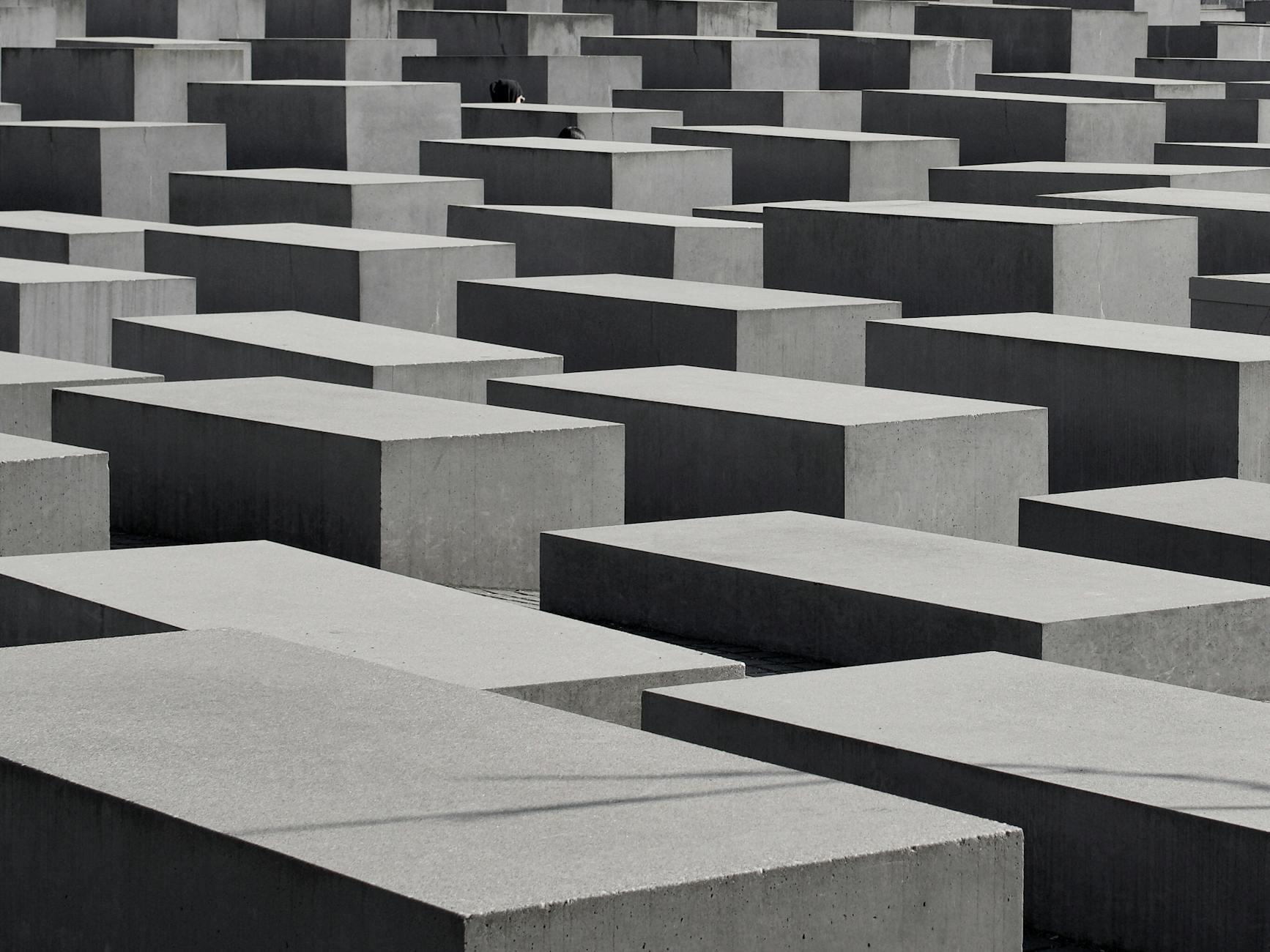
The ground looks flat from the pavement. That is the first thing to know, and it is deliberate: from Ebertstraße the field of grey blocks appears to be an even grid of low slabs, something you could walk across without breaking stride. Then you step in between two of them and the paving begins to fall away beneath you, and within thirty seconds the concrete is above your head and you cannot see the street, the sky is a strip, and the sound of the traffic has gone. The holocaust memorial berlin does not announce what it is doing. It simply does it, to everyone who walks in.
This guide covers what the memorial is, how to visit it properly, the underground Ort der Information that most visitors miss entirely, the long argument about what it means and how people behave there, and the other sites of Jewish memory within walking distance. Everything here is free and open to anyone. What follows was checked in September 2026; the field is always open, but the underground exhibition keeps its own hours, so confirm those before you plan around them.
The essentials
| Question | Answer |
|---|---|
| Full name | Denkmal für die ermordeten Juden Europas — Memorial to the Murdered Jews of Europe |
| Cost | Free, both the field and the underground exhibition |
| Field opening hours | Open at all times, unlit paths but publicly accessible |
| Ort der Information | Separate hours, closed Mondays — check before travelling |
| Time to allow | 20 minutes for the field, 60–90 with the exhibition |
| Nearest station | Brandenburger Tor (U5, S1, S2, S25, S26) or Potsdamer Platz |
| Address | Cora-Berliner-Straße 1, between Ebertstraße and Wilhelmstraße |
| Architect | Peter Eisenman, opened 2005 |
| Accessible? | The field is paved and step-free; the exhibition has lift access |
What is above ground
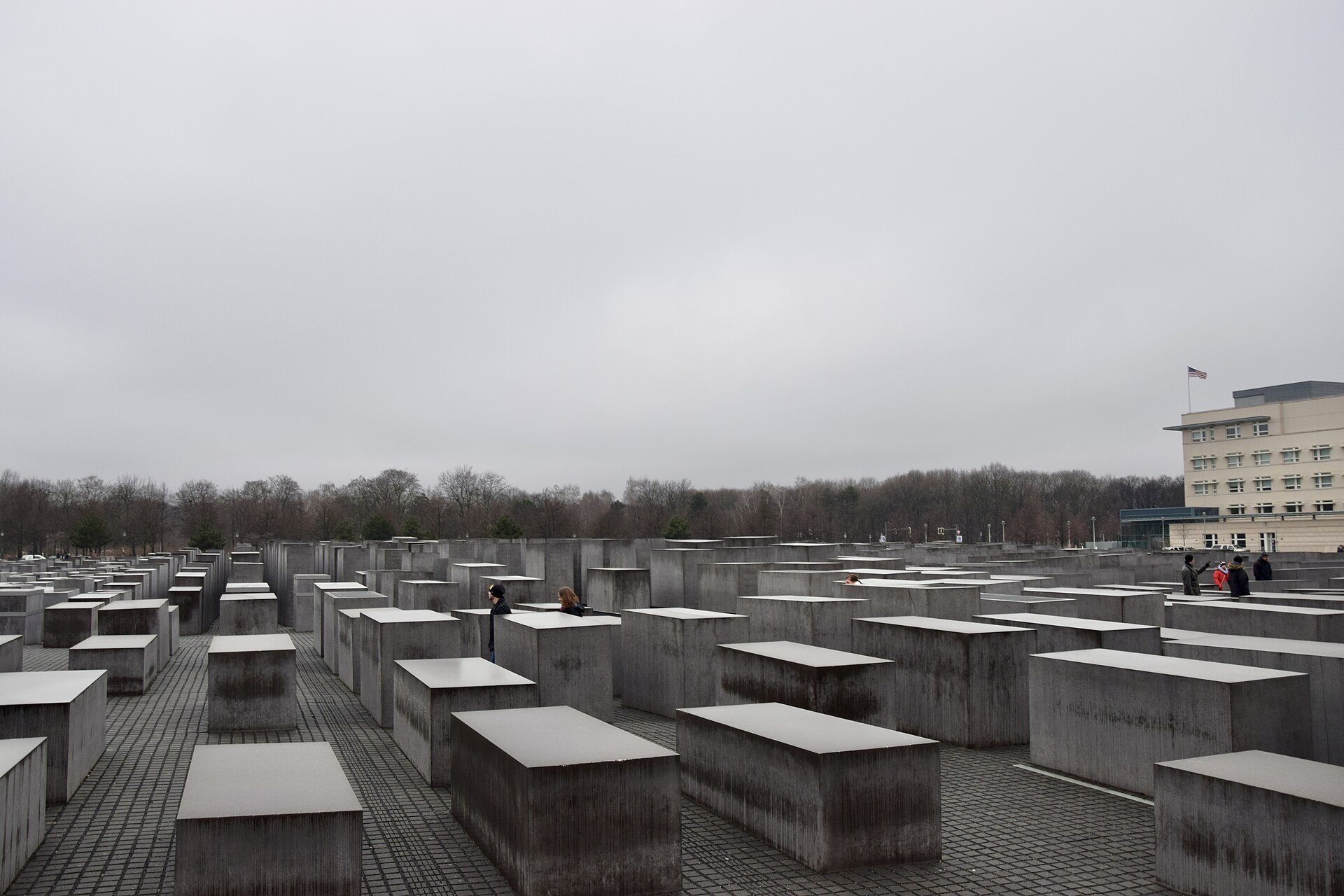
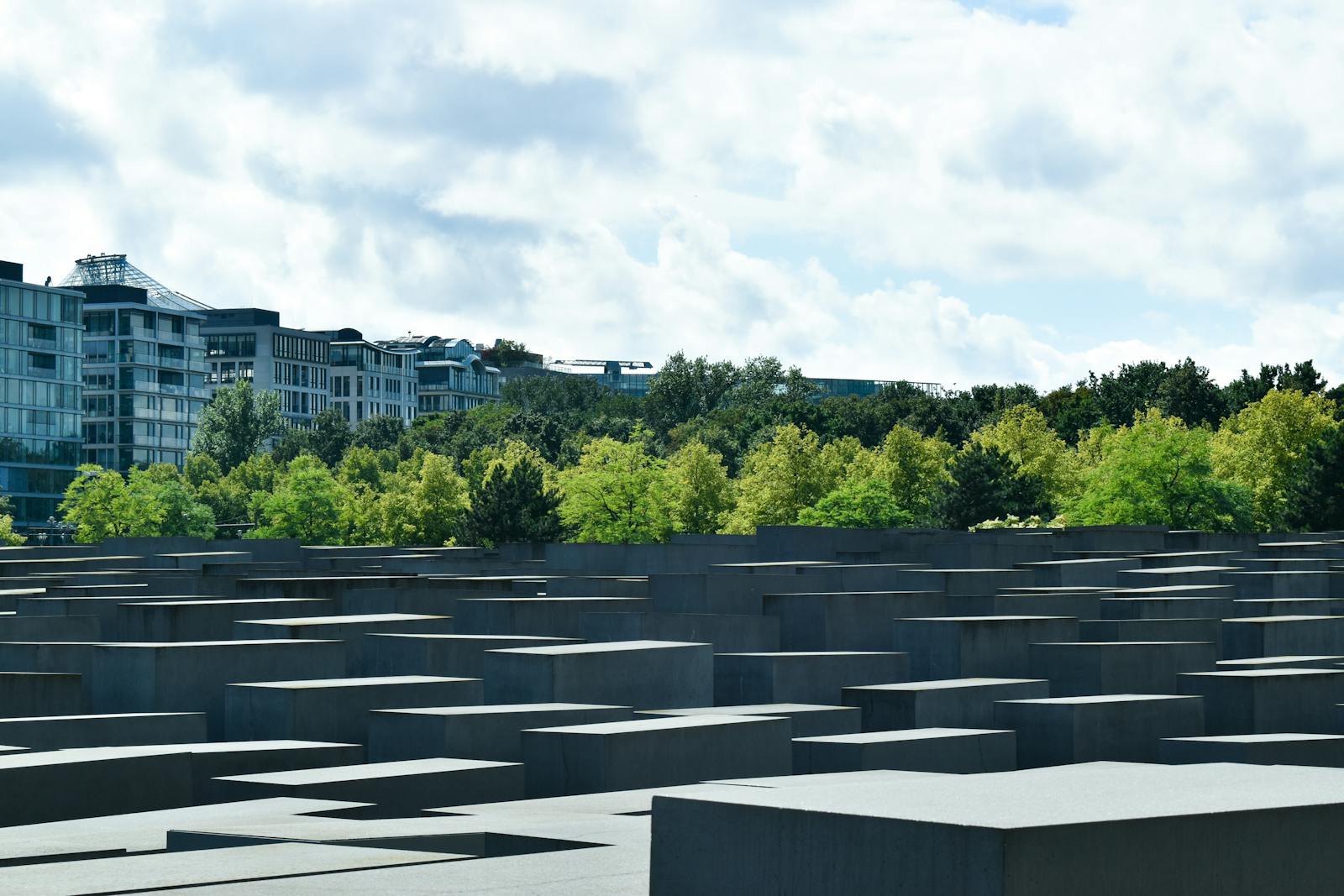
2,711 concrete stelae, arranged in a grid on a 19,000-square-metre site one block south of the Brandenburg Gate. Each one is 2.38 metres long and 0.95 metres wide; the heights vary from almost nothing to more than four metres. The ground beneath them undulates, and the tops of the blocks follow a different, shallower undulation, so the two surfaces are never parallel.
The result is that the experience changes completely depending on where you are standing. At the edges the blocks are ankle-height and children run across them. Twenty paces in, they are at your shoulder. In the middle they are well above your head and the paths between them are just wide enough for one person, sloping unevenly underfoot, with the light narrowing to a strip overhead. You lose sight of everyone you came with. Other people appear and disappear at the ends of corridors. It is genuinely disorienting, and that is the whole architecture.
Eisenman refused to explain it. There is no plaque on the field, no key, no interpretive panel, no list of names above ground. Asked what the stelae represented, he consistently declined to say they represented anything, which frustrated a great many people at the time and is arguably the strongest decision in the entire design. The most common reading — that the blocks resemble coffins or gravestones — was one he explicitly rejected.
The Ort der Information, which is the part you came for
Under the south-east corner of the field, reached by a staircase and a lift, is the Place of Information. It is free, and it is the part that does the work the field deliberately does not.
It is not large — four rooms — and it is not designed to be comprehensive. It is designed to be specific, which is much harder and much more effective.
The Room of Dimensions
Fragments of diaries, letters and last messages, projected onto illuminated panels set into the floor in the shape of the stelae above. A postcard thrown from a deportation train. A note pushed through a fence. Each one is a few sentences long, with a name and a date and what is known of what happened afterwards. You read them standing, looking down.
The Room of Families
Fifteen Jewish families from across Europe, followed from before the war through to what became of each member. It is the room that most directly refuses abstraction: the same photographs of the same people at weddings, on holidays, in gardens, and then the record of the ghetto, the camp, the date.
The Room of Names
The names and, where known, short biographies of murdered Jews are read aloud continuously while being projected on the walls. Reading the complete list of known victims aloud in this way would take, by the memorial’s own reckoning, close to seven years. The room runs on a loop and most people stand in it for a long time.
The Room of Sites
A map of the killing sites across Europe, with film and photographs. This is the room that establishes scale — how far the machinery reached, and how many places were involved.
There is also a portal to the Yad Vashem database, where visitors can search for individual names. Allow at least forty-five minutes down here, and understand that the exhibition is closed on Mondays and keeps its own seasonal hours. Turning up to the field on a Monday and leaving without going underground is the single most common way visitors miss the point of the site.
How to visit it properly
There is no correct way to walk through a memorial and we are not going to pretend otherwise. But there are a few things that make a real difference to what you get out of the hour.
- Go into the middle. Walking round the edge and photographing the grid from outside is not the same experience at all. The design only works from the inside, and the deepest part of the field is where it works hardest.
- Go alone, or separate. If you are with someone, walk in on different rows. The isolation is part of what is being built and it does not happen if you are chatting.
- Do the exhibition. The field without the Ort der Information is an abstract sculpture. With it, it is a memorial. If you only have time for one, do the underground.
- Go early or late. Before nine in the morning the field is nearly empty and the difference is considerable. In the evening the site is unlit and much quieter, though the exhibition is shut.
- Give it enough time. Twenty minutes in the field and forty-five below is the minimum that does it justice. People who allow fifteen minutes for the whole thing walk out without having read a single name.
- Go on a grey day if you can. It sounds facile and it is not. The concrete in flat light is much more affecting than the concrete in sunshine, and the site was clearly designed by someone who had thought about a Berlin November.
The behaviour question
This has to be addressed, because it is the thing visitors notice within a minute of arriving and it is a fair question.
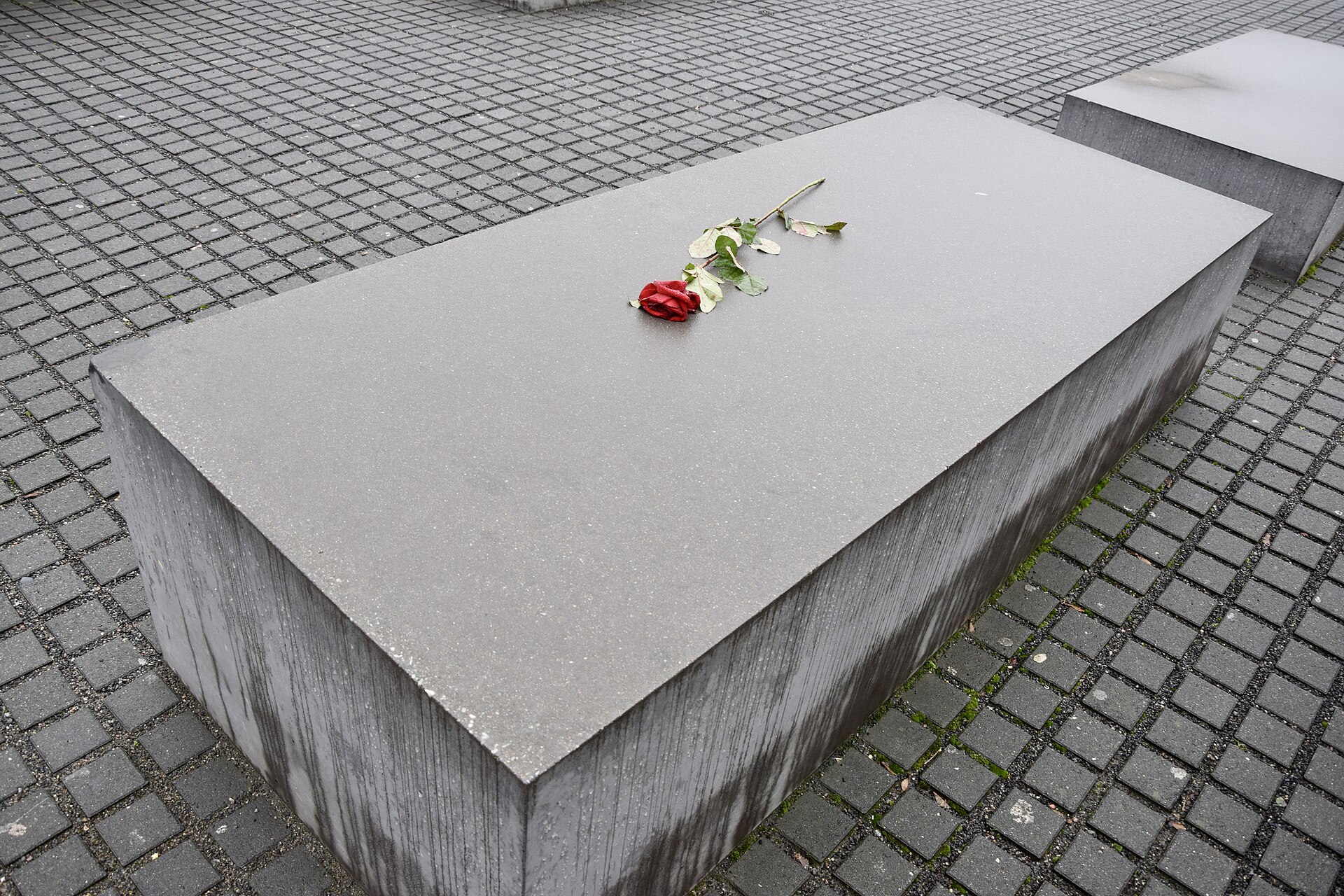
People climb on the stelae. People sit on them, eat lunch on them, jump between them, take smiling photographs on them, and — this became a well-known controversy — pose for the sort of pictures that end up on social media in poses no one would strike in a cemetery. In 2017 an Israeli artist based in Berlin ran a project that placed such photographs against archive images of the camps, and it drew enormous attention precisely because the images were so easy to collect.
The foundation’s own position has been notably restrained. There is no fence, no prohibition on entering the field at night, no ban on stepping onto the blocks at the low edges, and the memorial’s staff have historically declined to police it hard. The argument for that restraint is coherent: a memorial that has to be guarded into solemnity is not being taken seriously, it is being obeyed, and the sight of children playing on a Holocaust memorial in the middle of Berlin is itself a fact about how the city has changed.
Whatever you make of that argument, it is a reasonable thing to ask of yourself: whether the photograph you are about to take is one you would want attached to your name next to the room where they read the names aloud. Go downstairs first, then decide.
The argument behind the building
The memorial took seventeen years to get built and almost none of that was construction.
The campaign began in 1988, led by the journalist Lea Rosh and the historian Eberhard Jäckel, and ran through two design competitions, a change of government, a parliamentary debate and a very public national argument. The Bundestag finally voted for Eisenman’s design in June 1999. Construction started in 2003 and the memorial opened on 10 May 2005, sixty years after the end of the war in Europe.
Almost every element was contested. Whether Germany should build a central Holocaust memorial at all, or whether the authentic sites — the camps, the deportation stations — were the proper places for it. Whether it should commemorate all victims of Nazism or Jewish victims specifically; the decision to dedicate it to murdered Jews led directly to the later, separate memorials to Sinti and Roma, to homosexuals persecuted under the regime, and to the victims of the “euthanasia” murders, all of which are within a few minutes’ walk. Whether an abstract field could carry any meaning without text. And, notoriously, an anti-graffiti coating supplied by a company with a historical connection to the manufacture of Zyklon B, which nearly stopped the project outright.
The site itself carries a great deal. It sits on ground that was part of the government quarter of the Third Reich; the bunker complex beneath the area, including Hitler’s, was a few hundred metres away, and is unmarked except for a small information board in a car park in a nearby residential street. Berlin’s decision not to memorialise that spot is as considered as the decision to memorialise this one. Our Nazi history sites guide covers the geography of the whole quarter.
The memorials within walking distance
The Holocaust Memorial is the largest of a cluster, and visiting only the biggest one gives an incomplete picture of what Berlin has chosen to mark.
Memorial to the Sinti and Roma victims
On the Tiergarten side of Ebertstraße, a few minutes north: a circular dark pool with a single stone at its centre, on which a fresh flower is placed each day. Dani Karavan designed it and it opened in 2012. It is quiet, small and extremely effective, and most visitors to the stelae never cross the road to see it.
Memorial to Homosexuals Persecuted Under Nazism
Directly opposite the stelae field, on the Tiergarten side: a single concrete block with a window in it, through which a short film loops. Opened in 2008.
Memorial to the Victims of the “Euthanasia” Murders
At Tiergartenstraße 4, the address that gave the T4 programme its name, a few minutes west by the Philharmonie: a long blue glass wall and an information display. This one is genuinely obscure and worth the detour.
Stolpersteine
The brass “stumbling stones” set into pavements outside the last freely chosen homes of victims, each carrying a name, a birth year and a fate. There are thousands across Berlin and tens of thousands across Europe. Once you know to look down, you see them everywhere — outside apartment doors in Prenzlauer Berg, Schöneberg, Kreuzberg. Our history and culture guide explains how the project works.
The wider Jewish Berlin
The Jewish Museum in Kreuzberg — free permanent exhibition, Libeskind building — is the essential companion visit and covers two thousand years of German-Jewish life rather than only its destruction. The New Synagogue on Oranienburger Straße, the Neue Wache on Unter den Linden, and the Gleis 17 deportation memorial at Grunewald station all belong in the same picture. Our Jewish history in Berlin guide maps them.
Where it fits in a day
The memorial is two minutes’ walk south of the Brandenburg Gate and about eight from the Reichstag, which puts it in the densest cluster of sights in the city. The Topography of Terror is a further ten minutes south, and it is the natural pairing: the memorial is about the victims, the Topography is about the perpetrators and the machinery, and the two together are considerably more than the sum of their parts. Both are free.
The sequence we would walk: Reichstag dome if you have a slot, then the Brandenburg Gate, then the memorial and its exhibition, then lunch, then the Topography of Terror. That is a heavy day and you should plan something light afterwards — the Tiergarten is right there and our outdoor activities guide covers it. Our history itinerary sequences the whole thing and the attractions and tickets guide covers what else in the area needs booking.
Practical notes
- The field is uneven. The paving slopes and the surfaces are not always level. Sensible shoes, and be careful in rain or ice — wet concrete on a slope is genuinely slippery.
- There are no toilets on the field. The information centre has them.
- Bag checks apply at the entrance to the Ort der Information.
- Audio guides are available at the information centre in several languages and are worth taking.
- Guided tours of the field and the exhibition run free of charge at set times, in German and English. Check the current schedule on the foundation’s own site.
- Photography is permitted in the field. Consider the section above before you use it.
Frequently Asked Questions
Is the Holocaust Memorial in Berlin free?
Yes. Both the stelae field and the underground Ort der Information are free of charge, as are the regular guided tours. The field is accessible at any hour; the exhibition keeps its own hours and closes on Mondays.
How long does it take to visit the Holocaust Memorial?
Twenty minutes for the field alone, but that is not really a visit. Allow sixty to ninety minutes so you can walk into the middle of the stelae and then spend proper time in the underground exhibition, which is where the names and the individual stories are.
What do the 2,711 stelae represent?
Nothing specified. Peter Eisenman consistently declined to assign them a meaning and explicitly rejected the common reading that they resemble coffins or gravestones. The number itself has no stated significance — it is the number that fitted the site. The refusal to explain is deliberate and is why there is no plaque on the field.
Can you walk on the Holocaust Memorial stones?
There is no formal prohibition, and the foundation has chosen not to police the field heavily. That is a considered decision rather than an oversight. Whether to climb on them is left to visitors, which is arguably the more demanding arrangement — and worth thinking about after you have been downstairs rather than before.
What is the Ort der Information?
The free underground exhibition beneath the south-east corner of the field: four rooms covering personal documents, fifteen individual families, the continuously read list of names, and a map of the killing sites across Europe. It is small, specific and much more affecting than its size suggests. It is closed on Mondays.
Where is the Holocaust Memorial in Berlin?
Cora-Berliner-Straße 1, between Ebertstraße and Wilhelmstraße, one block south of the Brandenburg Gate. The nearest stations are Brandenburger Tor and Potsdamer Platz, both a few minutes’ walk. Our U-Bahn and S-Bahn guide covers the network, and the free attractions guide collects the rest of what costs nothing nearby.
Is the Holocaust Memorial suitable for children?
The field is, and young children often experience it as a maze, which is not a scandal. The underground exhibition is explicit in places and is better suited to older children and teenagers. Judge it on the individual child, and be prepared to talk about it afterwards.
What other memorials are nearby?
Three, all within a few minutes and all free: the Memorial to the Sinti and Roma victims in the Tiergarten, the Memorial to Homosexuals Persecuted Under Nazism directly across Ebertstraße, and the Memorial to the Victims of the “Euthanasia” Murders at Tiergartenstraße 4. The Topography of Terror is ten minutes south.
Related Berlin Guides
- Berlin Attractions & Tickets
- Jewish History in Berlin
- Jewish Museum Berlin
- Nazi History Sites in Berlin
- Brandenburg Gate Berlin
- Berlin History Itinerary
Final Word
It is worth stating plainly what is unusual here. This is a memorial built by the perpetrator nation, to the victims of the crime it committed, on the most valuable land in its capital city, a hundred metres from its parliament and its main tourist landmark. There is no admission charge, no fence and no closing time. Very few countries have done anything comparable.
Walk into the middle of the field and let it do what it does. Then go down the stairs, because the field alone is architecture and the exhibition is the memorial. Stand in the Room of Names long enough to hear a few of them read out, and remember that the loop takes almost seven years to complete. Then cross Ebertstraße to the small dark pool with a flower on the stone at its centre, which almost nobody visits, and which is for the Sinti and Roma.
And if there is a fifth hour in your day, walk ten minutes south to the Topography of Terror. The memorial tells you who was killed. That one tells you who did it, from which desks, with which paperwork. Berlin has arranged them within walking distance of each other, and that arrangement is not an accident.
Photo Credits
The stelae field: Memorial to the Murdered Jews of Europe, Berlin, Germany 02 by Ank Kumar, CC BY-SA 4.0, via Wikimedia Commons.
A rose on a stele: Memorial to the Murdered Jews of Europe, Berlin, Germany 06 by Ank Kumar, CC BY-SA 4.0, via Wikimedia Commons.