Jewish History in Berlin: Museums, Memorials & Heritage Guide (2026)
Discover 750 years of Jewish history in Berlin — from Moses Mendelssohn to the Holocaust Memorial. Complete guide to museums, memorials, hours and tours.
I’ve walked the streets around Hackescher Markt more times than I can count, and every time I find something new — a small brass square underfoot, a plaque tucked into a courtyard wall, a name carved into stone that wasn’t there the last time I looked. Jewish history in Berlin isn’t confined to a single museum or memorial. It’s scattered through the whole city in fragments you can stumble across by accident, and gathered into a handful of extraordinary sites that demand a full day each. This is the guide I wish I’d had on my first visit — the museums, the memorials, the cemeteries, and the lesser-known places that tell the longer, stranger, more human version of a 750-year story most travelers only know from its darkest chapter.
Before we get into the practical bits, a small piece of orientation. Berlin once held roughly 170,000 Jewish residents — about a third of all the Jews in Germany. The community today is much smaller (around 10,000 to 11,000 registered members, with a wider unaffiliated population estimated at 30,000-plus, including some 15,000 Israelis who’ve moved here in the last two decades), but Jewish life is genuinely active again. You’ll see it in the synagogues, the kosher restaurants in Charlottenburg, the annual Jüdische Kulturtage festival, the Chabad houses, and the Abraham Geiger College, the only rabbinical seminary in continental Europe to ordain rabbis since World War II. Knowing that helps. The story you’re about to walk through isn’t only one of loss.
A 750-Year Story: Jewish Berlin Through the Centuries
If you want any of the memorials in this guide to land properly, you need the long version of the story — not just the twelve years between 1933 and 1945. Berlin’s Jewish history begins in 1295, when Jews are first documented in the city, and arguably hits its modern stride in 1671, when the Great Elector Friedrich Wilhelm invited 50 Jewish families displaced from Vienna to settle in Brandenburg. The first synagogue was consecrated on Heidereutergasse in 1714. By the late 18th century, Berlin had become the unlikely capital of the Jewish Enlightenment.
From Moses Mendelssohn to the Golden Age
The single most important figure of that era is Moses Mendelssohn, the philosopher who arrived in Berlin in 1743 through the Rosenthaler Tor — the only city gate Jews and cattle were permitted to use — and who became the father of the Haskalah, the Jewish Enlightenment. By the 1860s, Berlin’s Jewish community had grown wealthy and ambitious enough to build the New Synagogue on Oranienburger Strasse, a 3,200-seat Moorish revival cathedral of a building that was, briefly, the largest synagogue in Germany. Walk past it today — the golden dome is unmissable — and you’re looking at the stone confidence of a community that thought it had finally arrived.
By the 1920s, Berlin had roughly 170,000 Jewish residents. They were physicists (Einstein), philosophers (Hannah Arendt, Walter Benjamin), painters (Max Liebermann), composers (Kurt Weill), filmmakers (Billy Wilder), poets (Else Lasker-Schüler), and — in a detail almost no other Berlin guide includes — the world’s first ordained female rabbi: Regina Jonas, ordained privately in Berlin in 1935 and later murdered at Auschwitz. The Weimar-era community wasn’t a single bloc. It contained Orthodox, Reform, Zionist, assimilated, secular, Yiddish-speaking immigrants from the East, and German-Jewish patricians who’d been in Prussia for centuries. All of that diversity matters when you stand in front of the memorials later.
Persecution, Kristallnacht, and the Shoah
The collapse came fast. From the 1933 boycotts and the Nuremberg Laws (1935) to the November 1938 pogrom — Kristallnacht, the Night of Broken Glass — the legal architecture of exclusion was built brick by brick. Berlin’s Jewish population dropped from 160,000 in 1933 to about 75,000 by 1939, then to roughly 7,000 survivors by 1945. Deportations from Berlin began in October 1941, mostly through the freight station at Grunewald (Gleis 17). More than 50,000 Berlin Jews were murdered. For a more detailed timeline on the Wall era that followed, see our Berlin Wall History Timeline — the two stories overlap geographically in surprising ways.
From Rubble to Renaissance
For most of the postwar era, Jewish Berlin was tiny and quiet. The community shrank further during the Cold War — most surviving Jews ended up in West Berlin, with a small remnant in the East. Real revival began only after reunification in 1990, accelerated by the arrival of tens of thousands of Russian-speaking Jews from the former Soviet Union and, in the last twenty years, by a striking wave of young Israelis. Today the community supports 13 active synagogues, a kosher supermarket, a Jewish high school, a Jewish hospital, and that aforementioned rabbinical seminary. The story didn’t end in 1945, and you’ll feel that if you spend a Saturday at Rykestrasse or stop into the kosher festival in Bayerischer Platz.
The Major Museums of Jewish Berlin
If you only have a day, the museums below are the spine of any Jewish Berlin itinerary. I’d start with the Jewish Museum because the architecture alone reframes everything that follows.
Jewish Museum Berlin (Jüdisches Museum)
Lindenstrasse 9–14, 10969 Berlin · Tuesday–Sunday 10:00–19:00, closed Monday · Core exhibition: free; temporary exhibitions €10 (reduced €4.50); under 18 free.
The first thing to know about Daniel Libeskind’s building, opened in 2001, is that it was already a piece of art before any exhibitions went inside. The zigzag floor plan, the sharp metal-clad walls, and the three “axes” that cut through the basement — the Axis of Exile, the Axis of the Holocaust, the Axis of Continuity — turn the act of walking through into the exhibit itself. The Holocaust Tower, an unheated 24-metre concrete shaft lit only by a slit at the top, is one of the most physically affecting spaces I’ve ever stood in. Don’t rush it.
The permanent exhibition, fully reopened in 2020, traces two millennia of German-Jewish life across thirteen chapters. Allow three hours minimum. There’s also a children’s museum called ANOHA — a Noah’s Ark designed by Olson Kundig — next door, which is excellent if you’re traveling with kids. Security is airport-style; bring photo ID and arrive at least 15 minutes before your timed entry.
Centrum Judaicum at the New Synagogue
Oranienburger Strasse 28–30, 10117 Berlin · April–September Mon–Fri 10:00–18:00, Sun 10:00–19:00; October–March Sun–Thu 10:00–18:00, Fri 10:00–15:00 · €7 / reduced €4.50.
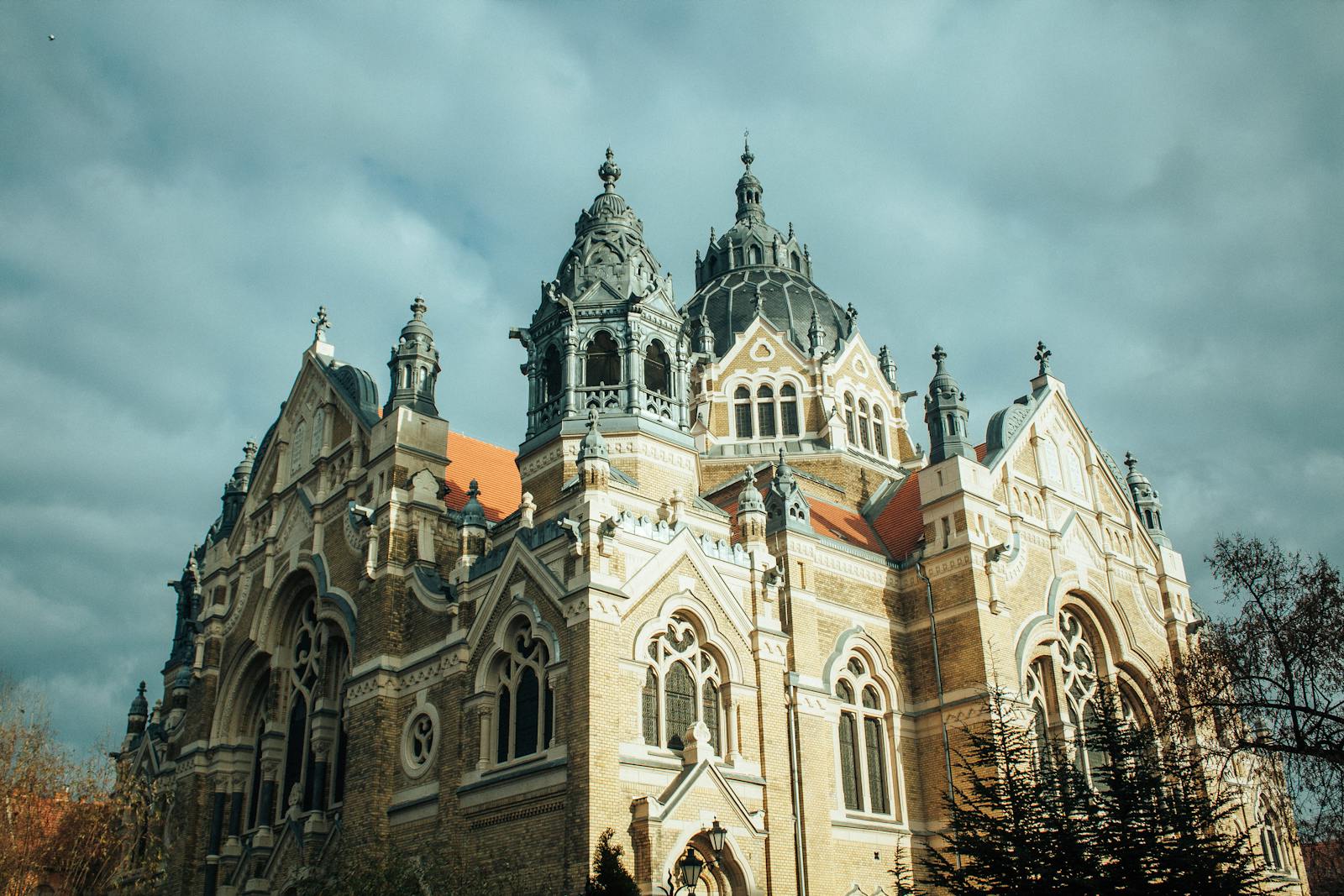
The New Synagogue is the most photographed Jewish building in Berlin, and the gold-and-blue dome is a landmark you’ll notice from Hackescher Markt. The building you see is partly authentic, partly reconstruction. The main sanctuary was destroyed in the November 1943 Allied bombing raid that hollowed out most of central Berlin — not in Kristallnacht, as a lot of tour guides incorrectly tell you, although Kristallnacht damage to the building was real and the building was saved on that night by a single police officer, Wilhelm Krützfeld, who turned the SA away. The front section, including the famous dome, was painstakingly rebuilt and reopened in 1995 as a museum and cultural centre. The rear, where the main sanctuary stood, is now a flat memorial garden where you can stand and trace the original footprint. Climb the dome in summer for a view of Mitte you don’t get from anywhere else.
Otto Weidt’s Workshop for the Blind
Rosenthaler Strasse 39, 10178 Berlin (first courtyard on the left, ground floor) · Mon–Fri 9:00–18:00, Sat/Sun/holidays 10:00–18:00 · Free admission.
You walk past it without noticing. Step through the gate of the Haus Schwarzenberg courtyard — the one with the graffiti and the Anne Frank Centre — turn left, and you’re in a small set of rooms that have been preserved almost exactly as Otto Weidt left them in 1945. Weidt, himself nearly blind, ran a brush and broom workshop that employed mostly deaf and blind Jewish workers. Throughout the war he hid Jewish employees in a back room behind a wardrobe, forged papers, bribed Gestapo officers, and helped families escape. He was honoured as Righteous Among the Nations in 1971. The museum is small, but the back room is, in my opinion, one of the most quietly powerful places in Berlin. Free. Go.
Anne Frank Zentrum
Rosenthaler Strasse 39, 10178 Berlin · Tuesday–Sunday 10:00–18:00 · Modest fee, free for under 10s.
The same courtyard as Otto Weidt’s, and a sensible second stop. The Anne Frank Zentrum focuses specifically on Anne’s family — the Franks lived in Berlin until 1933, when they fled to Amsterdam — and pairs the personal story with broader exhibitions on antisemitism and intolerance aimed at school groups. If you’re traveling with teenagers, this is where they’ll get the most. Allow an hour.
House of the Wannsee Conference
Am Grossen Wannsee 56–58, 14109 Berlin · Daily 10:00–18:00 · Free admission; audio guides in eight languages.
The villa where, on January 20, 1942, fifteen senior Nazi officials met under Reinhard Heydrich to coordinate the “Final Solution to the Jewish Question.” The bureaucratic banality of the place is the point: a beautiful lakeside mansion in Berlin’s wealthy southwest, where genocide was logged into the administrative machinery of the Reich over the course of about ninety minutes. The exhibition reproduces the original meeting protocol, identifies each participant, and traces the implementation that followed. Getting there is a journey — S-Bahn S1 or S7 to Wannsee, then bus 114 — but it’s worth the half day. The lakeside garden, ironically gorgeous, will stay with you longer than you expect.
Topography of Terror
Niederkirchnerstrasse 8, 10963 Berlin · Daily 10:00–20:00 · Free admission.
Built on the site of the former Gestapo headquarters and SS Reich Security Main Office, the Topography of Terror is an open-air and indoor exhibition tracing the structure of Nazi state terror. While it’s not exclusively Jewish history — it covers the apparatus of persecution as a whole — the exhibitions on Berlin’s deportations, the Reichssicherheitshauptamt, and the bureaucratic management of genocide are essential. The site runs along a preserved section of the Berlin Wall, which adds an extra layer of historical compression: two regimes of state terror, separated by a few decades and a few metres of concrete. We’ve covered this site in more depth in our guide to Nazi history sites in Berlin.
Memorials That Stop You in Your Tracks
The museums tell the story explicitly. The memorials work differently. Some of them are deliberately abstract, some are accidentally easy to miss, and a few are so quiet you’ll be the only person there.
Memorial to the Murdered Jews of Europe
Cora-Berliner-Strasse 1, 10117 Berlin · Field: open 24/7. Information Centre: Tuesday–Sunday 10:00–18:00 · Free.
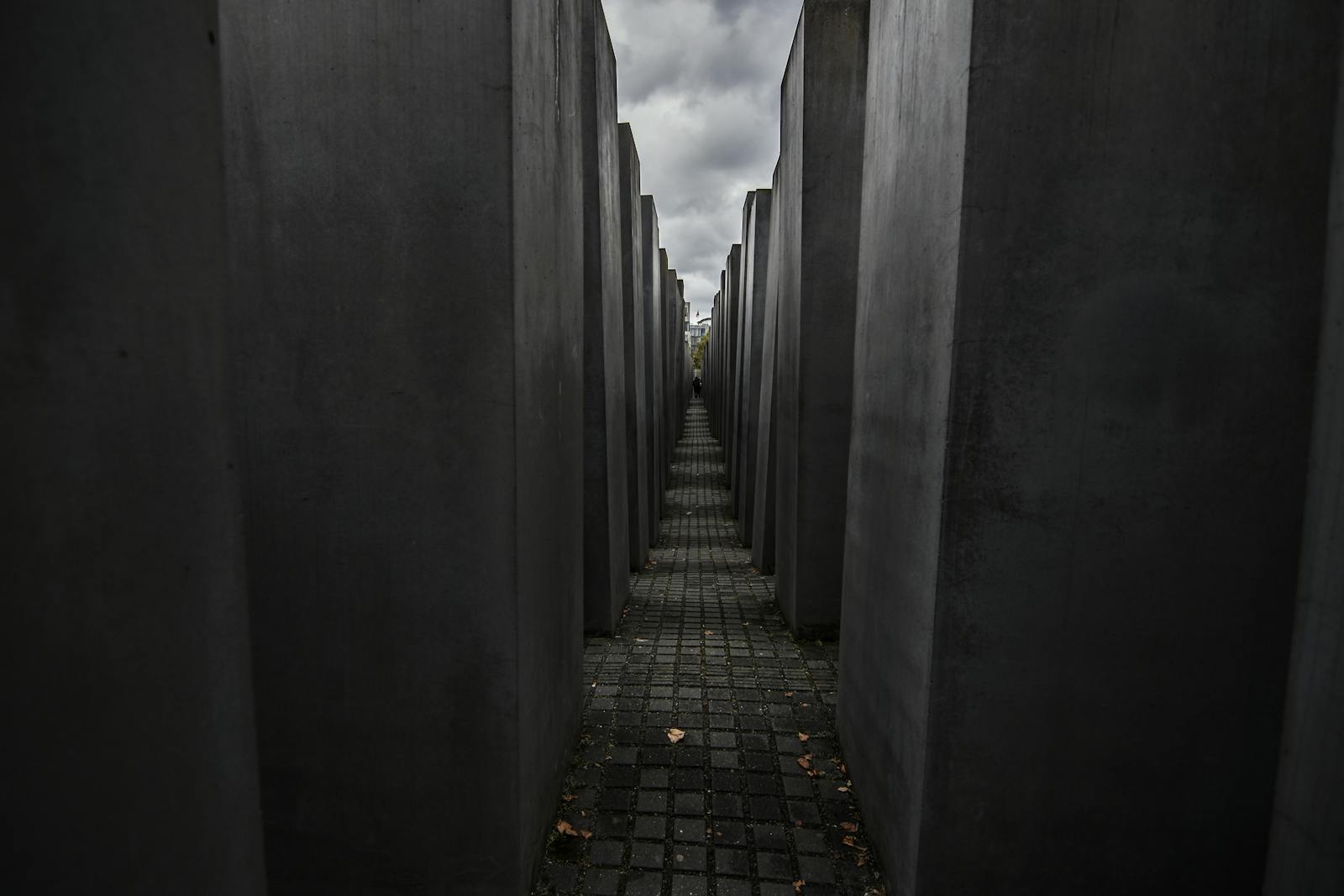
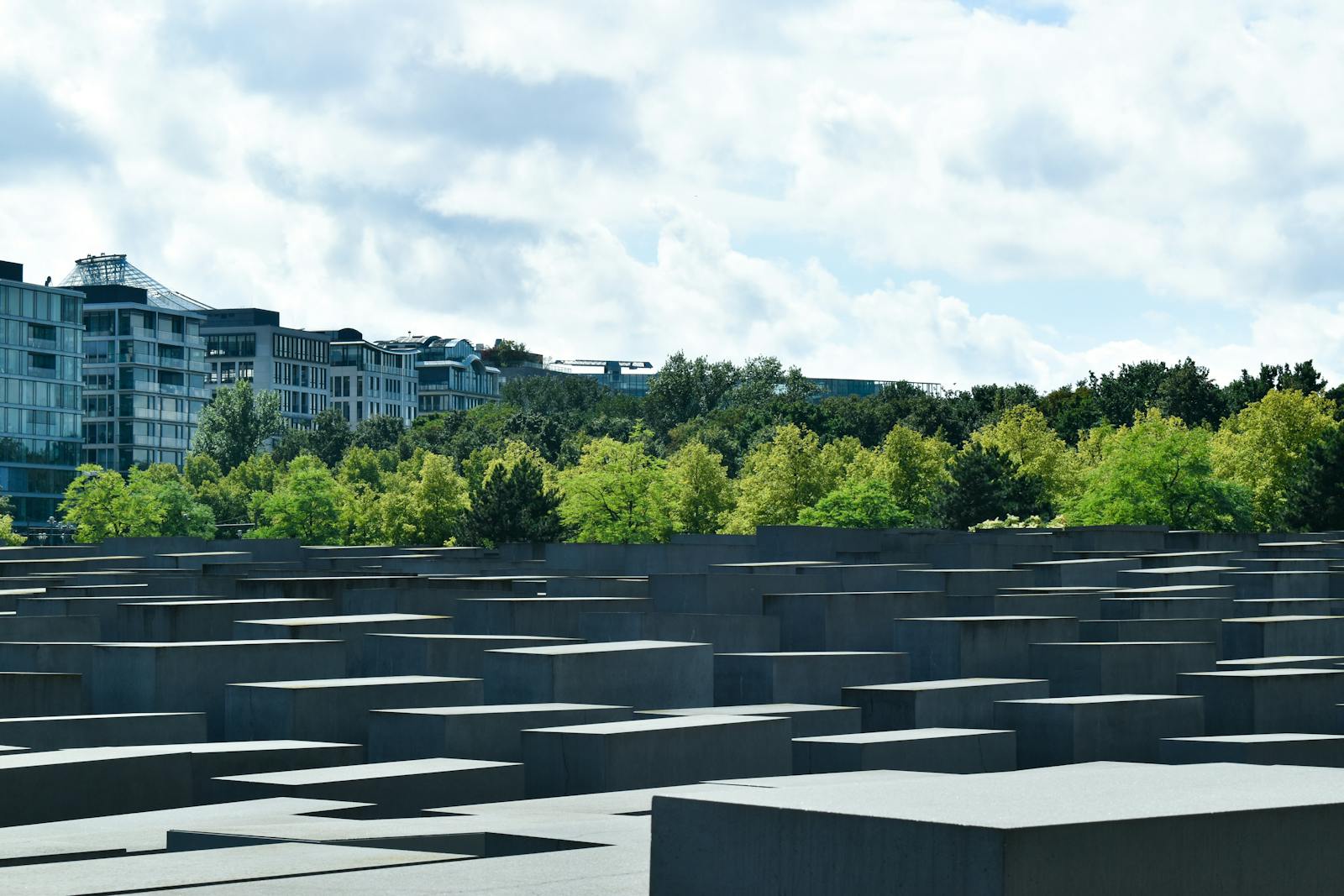
Peter Eisenman’s 2,711 concrete stelae, inaugurated in May 2005, occupy a sloping site between the Brandenburg Gate and Potsdamer Platz. It is the central national Holocaust memorial of Germany. There’s a deliberate refusal of explicit symbolism — the slabs are simply slabs, the ground undulates, and as you walk in deeper, the stelae grow taller until they tower above you. Disagreements over what the memorial “means” are part of what it means. The underground Information Centre (the Ort der Information) is where the explicit history lives: a Room of Names, a Room of Families, a Room of Sites. Most visitors skip the Information Centre and just walk the field. Don’t skip it. Allow at least an hour and a half if you include the indoor part.
Stolpersteine — The Stumbling Stones
All over Berlin, especially Mitte, Charlottenburg, Schöneberg, Prenzlauer Berg · 24/7 · Free.
These are the brass squares set into the pavement outside the last freely chosen homes of victims of Nazi persecution. Each one carries a name, a date of birth, and a fate — “deported,” “murdered,” “took her own life.” The artist Gunter Demnig laid the first stones in Berlin Kreuzberg in 1996, and there are now more than 100,000 across Europe, with several thousand in Berlin alone. They’re cleaned and maintained by neighbours and school groups; if you see someone polishing one, it usually means a relative has come to visit.
The Stolpersteine network is searchable — stolpersteine-berlin.de has an interactive map — and walking a single block in Schöneberg or Bayerisches Viertel will give you a more intimate sense of the demographic scale of the deportations than any museum can. The deliberate design choice is that you have to look down, which puts the victim’s name physically above you. It’s the inverse of a monument.
Gleis 17 (Track 17) at Grunewald
S-Bahn Grunewald · 24/7 · Free.
From October 18, 1941 until February 27, 1945, more than 50,000 Berlin Jews were deported from this freight platform on the edge of the Grunewald forest. The memorial, designed by Nicolaus Hirsch and unveiled in 1998, consists of 186 steel plates set into the platform edge, each engraved with the date, the number of deportees, and the destination — Riga, Kaunas, Łódź, Theresienstadt, Auschwitz. The platform is preserved exactly as it was. The tracks lead nowhere now, ending in shrubbery. It’s a 20-minute S-Bahn ride from central Berlin (S7 to Grunewald), and most visitors I see there are crying quietly. Bring tissues.
The Block of Women — Rosenstrasse
Rosenstrasse, near Hackescher Markt, 10178 Berlin · 24/7 · Free.
One of the lesser-known but most extraordinary moments of Jewish resistance happened here in late February and early March 1943. After the Gestapo rounded up roughly 1,800 men in mixed marriages and held them in a building on Rosenstrasse pending deportation, their non-Jewish German wives gathered in the street and refused to leave. They stood there in the cold for over a week, chanting “give us back our husbands.” Joseph Goebbels, sensing the optics, ordered the men released. Almost all survived. Ingeborg Hunzinger’s sculpture group Block der Frauen, installed in 1995, marks the site. Almost nobody comes here. Stand for a few minutes and read the inscription.
Levetzowstrasse Deportation Memorial
Levetzowstrasse 7–8, 10555 Berlin (Moabit) · 24/7 · Free.
The synagogue that once stood here was burned during Kristallnacht, then used as a Sammellager — an assembly camp — from 1941 onwards, where thousands of Berlin Jews were held in degrading conditions before being marched to the nearby Putlitzstrasse freight station and deported. Theseus Bappert’s stark 1988 memorial — a black metal goods wagon on rails leading nowhere — is one of the more direct visual statements in Berlin’s memorial landscape. Moabit isn’t on most tourist itineraries, which makes the silence around this site feel right.
Places of Remembrance — Bayerisches Viertel
Bavarian Quarter, Schöneberg · 24/7 · Free.
This is my favourite memorial in Berlin, and almost no first-time visitor finds it. Stih and Schnock’s Orte des Erinnerns, installed in 1993, consists of 80 small signs hung on lampposts throughout the leafy Bavarian Quarter — a neighbourhood that was once home to a large, prosperous Jewish community including Hannah Arendt, Albert Einstein, and Walter Benjamin. Each sign bears a simple image on one side (a cat, a bench, a pair of children’s shoes) and on the other a quoted Nazi law: “Jews may no longer keep pets. 15.5.1942.” “Jewish children may no longer attend German schools. 1938.” Walk a few blocks and you read the law-by-law dismantling of a community, in the streets where it lived. The U-Bahn stop is Bayerischer Platz (U4 or U7). Allow an hour to wander.
The Old Jewish Quarter: Walking Spandauer Vorstadt and Scheunenviertel
A note before the walking tour: most travel guides treat “Scheunenviertel” and “Spandauer Vorstadt” as synonyms, and they’re not. Spandauer Vorstadt is the older, more respectable neighborhood — roughly around the New Synagogue and Hackescher Markt — that became the heart of bourgeois German-Jewish life in the 19th century. Scheunenviertel is the smaller, poorer quarter just to the northeast (around Rosa-Luxemburg-Platz and Hirtenstrasse) that absorbed Yiddish-speaking refugees from the East after WWI and was deliberately smeared by the Nazis as the symbol of “Eastern Jewish degeneracy.” Today both are gentrified and atmospheric. Knowing the distinction will help you read the layered story on the ground.
Hackesche Höfe and Haus Schwarzenberg
The eight interconnected courtyards of the Hackesche Höfe are restored Art Nouveau perfection — too restored, some argue, but lovely to walk through. Slip next door into Haus Schwarzenberg (Rosenthaler 39), where the courtyard graffiti and the Otto Weidt workshop and the Anne Frank Centre cluster, and you get the un-renovated version of what this area used to feel like.
Old Jewish Cemetery on Grosse Hamburger Strasse
Grosse Hamburger Strasse 26, 10115 Berlin · Daylight hours · Free; men cover heads.
Berlin’s oldest Jewish cemetery, in use from 1672 to 1827, contained roughly 12,000 graves. In 1943 the Gestapo destroyed it: gravestones were smashed, the grounds were dug up, and the site was used to construct anti-aircraft positions. Only one stone remains in place — a symbolic stand-in for the philosopher Moses Mendelssohn, who is buried somewhere on the site. The flattened, almost empty enclosure is bordered by a fragment of restored wall. Next to the cemetery is a sculpture by Will Lammert depicting deported Jews — a Holocaust memorial that doubles as a marker for the assembly camp that operated in the adjacent former Jewish boys’ school during 1942–43, the Grosse Hamburger Strasse Sammellager. Roughly 55,000 Berlin Jews passed through it on their way to deportation.
Beyond Mitte: Cemeteries, Villas, and the Western Districts
Weissensee Jewish Cemetery
Herbert-Baum-Strasse 45, 13088 Berlin (Weissensee) · Sunday–Thursday 8:00–17:00 (winter shorter), Friday 8:00–14:30; closed Saturday and Jewish holidays · Free; men cover heads.
Europe’s largest Jewish cemetery and possibly its most moving. Forty-two hectares, over 115,000 graves, ivied paths, fallen stones, magnificent mausoleums. Opened in 1880, it was largely spared during the Nazi era because the SS couldn’t quite figure out what to do with it. Walking through the older sections in late afternoon, with light cutting through the trees, is one of the quietest hours you can spend in Berlin. The graves of Berlin’s pre-war elite are here — bankers, scientists, the philosopher Hermann Cohen, members of the Mendelssohn family. Take tram M4 to Albertinenstrasse from Hackescher Markt. Allow at least two hours.
Schönhauser Allee Cemetery
Schönhauser Allee 23–25, 10435 Berlin · Sunday–Thursday 8:00–17:00 · Free; men cover heads.
The smaller and earlier (1827–1880) successor to the destroyed Grosse Hamburger Strasse cemetery, and the resting place of Max Liebermann, the painter Lesser Ury, and others. It’s right by the U2 Senefelderplatz station and an easy add-on to any Prenzlauer Berg walk.
Liebermann Villa at Wannsee
Colomierstrasse 3, 14109 Berlin · Wednesday–Monday 10:00–18:00 (varies seasonally), closed Tuesday · €10 / reduced €6.
The summer house of Max Liebermann, the Impressionist painter and last truly grand figure of Jewish Berlin’s golden age, sits on the Wannsee lakeshore — just a kilometre or so from the House of the Wannsee Conference, which is the macabre coincidence that hits you when you visit both in the same day. The villa and its garden, lovingly restored, give you a glimpse of the social and artistic world that was destroyed. Pair with the Wannsee Conference House for a deeply uncomfortable but essential afternoon.
Rykestrasse Synagogue
Rykestrasse 53, 10405 Berlin (Prenzlauer Berg) · Tours typically Thursday afternoons; check current schedule.
The largest active synagogue in Germany, with around 1,000 seats. Built in 1904 in a courtyard (which protected it from total destruction on Kristallnacht — the SA didn’t want to burn down the surrounding buildings), it was returned to use after the war and beautifully restored in 2007. Sabbath and festival services happen here every week. If you want to see Jewish life in Berlin today rather than only its history, this is the building to visit.
Jewish Berlin Today: A Living Community
One of the genuinely surprising things about Berlin in 2026 is how visible Jewish life has become again. The community is split, roughly, between the older Russian-speaking population that arrived from the former Soviet Union in the 1990s, the established German-Jewish core, and a young Israeli wave who’ve moved here for the affordable rents, the techno scene, and (depending on who you ask) a complicated relationship with home. You’ll hear Hebrew in cafés in Neukölln and Prenzlauer Berg. You’ll find a kosher restaurant (Beth Café) right by the New Synagogue, kosher bakeries in Charlottenburg, and Chabad outposts across the city.
The annual Jüdische Kulturtage Berlin festival (Jewish Culture Days), running for over three decades, brings dozens of events to venues across the city each autumn. The Jewish Film Festival Berlin & Brandenburg happens each June. Klezmer concerts are regular. The Abraham Geiger College, attached to the University of Potsdam, ordains Reform rabbis — a continuation, in a sense, of the work begun in Berlin in the 19th century.
I’ll be honest with you: visiting Jewish sites in Berlin in 2026 carries a heaviness that the rebound from 1990 has not erased. Antisemitic incidents in the city are recorded in the thousands annually, and security around Jewish institutions is real and visible. Don’t be surprised by the police presence at synagogues, the bag checks at museums, or the careful conversations community members have about safety. It’s worth knowing this going in, and worth being respectful when you visit. The flip side is that Jewish Berlin is genuinely back — neither as it was, nor frozen in mourning, but as something new.
Practical Visitor Tips for Jewish Berlin
Suggested Two-Day Itinerary
Day 1 (Mitte focus): Start at the New Synagogue and Centrum Judaicum (open by 10:00). Walk south to Haus Schwarzenberg for Otto Weidt’s Workshop and the Anne Frank Zentrum. Lunch around Hackescher Markt. Continue to the Old Jewish Cemetery on Grosse Hamburger Strasse, then Rosenstrasse for the Block of Women. Walk down to the Memorial to the Murdered Jews of Europe — ideally arriving in late afternoon for atmospheric light. Visit the Ort der Information underneath. End the day at the Topography of Terror, ten minutes’ walk south.
Day 2 (Wider city): Jewish Museum Berlin first thing (allow three hours). Lunch in Kreuzberg or Mitte. Take the S-Bahn out to Grunewald for Track 17. From there, the S7 continues to Wannsee — combine the House of the Wannsee Conference and the Liebermann Villa for a long, heavy afternoon. If you have a third day or just an hour to spare, walk Bayerisches Viertel for the Places of Remembrance signs.
Guided Tours Worth Booking
Several excellent operators run Jewish-Berlin themed walking tours. Berlin Perspectives, Original Berlin Walks, and the tour service run by the Centrum Judaicum offer thoughtful three- to four-hour walks of the old Jewish quarter. For a deeper experience, look for the multi-day Jewish Berlin in Depth programmes offered seasonally by some operators. A guide will pull together the historical layers in a way that’s hard to do alone, especially if it’s your first time. For broader Berlin walking suggestions, see our guide to walking tours in Berlin.
Etiquette You Should Know
Men should cover their heads at Jewish cemeteries (Weissensee provides kippot at the entrance; otherwise a cap is fine). Bring photo ID to the New Synagogue and the Jewish Museum — security is strict. Many sites observe Shabbat closures (Friday afternoon through Saturday); the New Synagogue and Centrum Judaicum, for example, are closed Saturdays. Be quiet at cemeteries and memorials. Photography is generally fine outdoors but check signage at exhibitions.
Much of this history is walkable in a single afternoon, because it is concentrated in the old Scheunenviertel north of the Spree — the New Synagogue, the destroyed cemetery on Große Hamburger Straße, Boltanski’s Missing House, and the free Otto Weidt museum tucked behind a graffitied courtyard on Rosenthaler Straße. Our Mitte guide maps that quarter street by street.
Frequently Asked Questions
Is the Jewish Museum Berlin free?
The core permanent exhibition is free as of the 2020 reopening. Special temporary exhibitions cost €10 (€4.50 reduced); under 18 is free. The building and Libeskind architecture are accessible during all opening hours.
How long do you need at the Holocaust Memorial?
Twenty minutes to walk through the field of stelae; an additional hour to ninety minutes for the underground Information Centre. Don’t skip the indoor part — it’s where the names live.
Where was the Jewish quarter in Berlin?
Two adjacent neighbourhoods in Mitte: the more established Spandauer Vorstadt (around Hackescher Markt and the New Synagogue) and the smaller, poorer Scheunenviertel (around Rosa-Luxemburg-Platz). They’re often conflated but historically distinct. The Bavarian Quarter in Schöneberg was the other major centre of Jewish life, particularly for the secular middle class.
How many Stolpersteine are there in Berlin?
Several thousand, with new stones laid regularly. The total across Europe exceeds 100,000. The interactive map at stolpersteine-berlin.de lets you search by neighbourhood or name.
Is the New Synagogue still an active synagogue?
Partially. The grand front section is now a museum and cultural centre. A small egalitarian congregation, Oranienburger Strasse, holds services in an adjacent restored prayer room. The largest active congregation in Berlin meets at the Rykestrasse Synagogue in Prenzlauer Berg.
Can you visit the Wannsee Conference House?
Yes, daily 10:00 to 18:00, free admission. Take S1 or S7 to Wannsee, then bus 114. The journey from central Berlin takes about 45 minutes. Allow two hours on site.
How many Jews live in Berlin today?
Roughly 10,000 to 11,000 registered community members, with the broader unaffiliated Jewish population estimated at 30,000-plus, including around 15,000 Israelis who’ve moved to the city in the last two decades. Compare with 170,000 in the 1920s.
Are Jewish sites in Berlin open on Saturday?
Most Jewish-run sites observe Shabbat and are closed Saturday. The New Synagogue / Centrum Judaicum closes Saturday. The Jewish Museum (run as a state-funded foundation, not a religious institution) is open Saturday but closed Monday. State-run memorials (Holocaust Memorial, Wannsee Conference House, Topography of Terror, Track 17) are open daily.
Continuing the Story
If you’ve walked the sites in this guide, you’ve covered the densest concentration of Jewish memorial space anywhere in Europe — and you’ve also seen, in the active synagogues and kosher cafés and graffitied Hebrew on building walls, the proof that the story didn’t end. The Cold War history that overlapped with this one, including the East-West divisions of postwar Jewish communities, sits naturally alongside the rest of Berlin’s 20th century. Our guide to Berlin Wall sites and the Checkpoint Charlie guide are good companions if you want to widen the frame. And if you want the longer arc, our main Berlin history and culture guide connects all of these threads.
Take it slowly. Don’t try to do everything in one trip. Many of these places are meant to be sat with, not ticked off.