Brandenburg Gate: History, Best Photo Times & What’s Around It
Berlin's Brandenburg Gate is free and open around the clock, so the only decision that matters is when you go. The history, the best photo hours and what is worth seeing within four hundred metres.
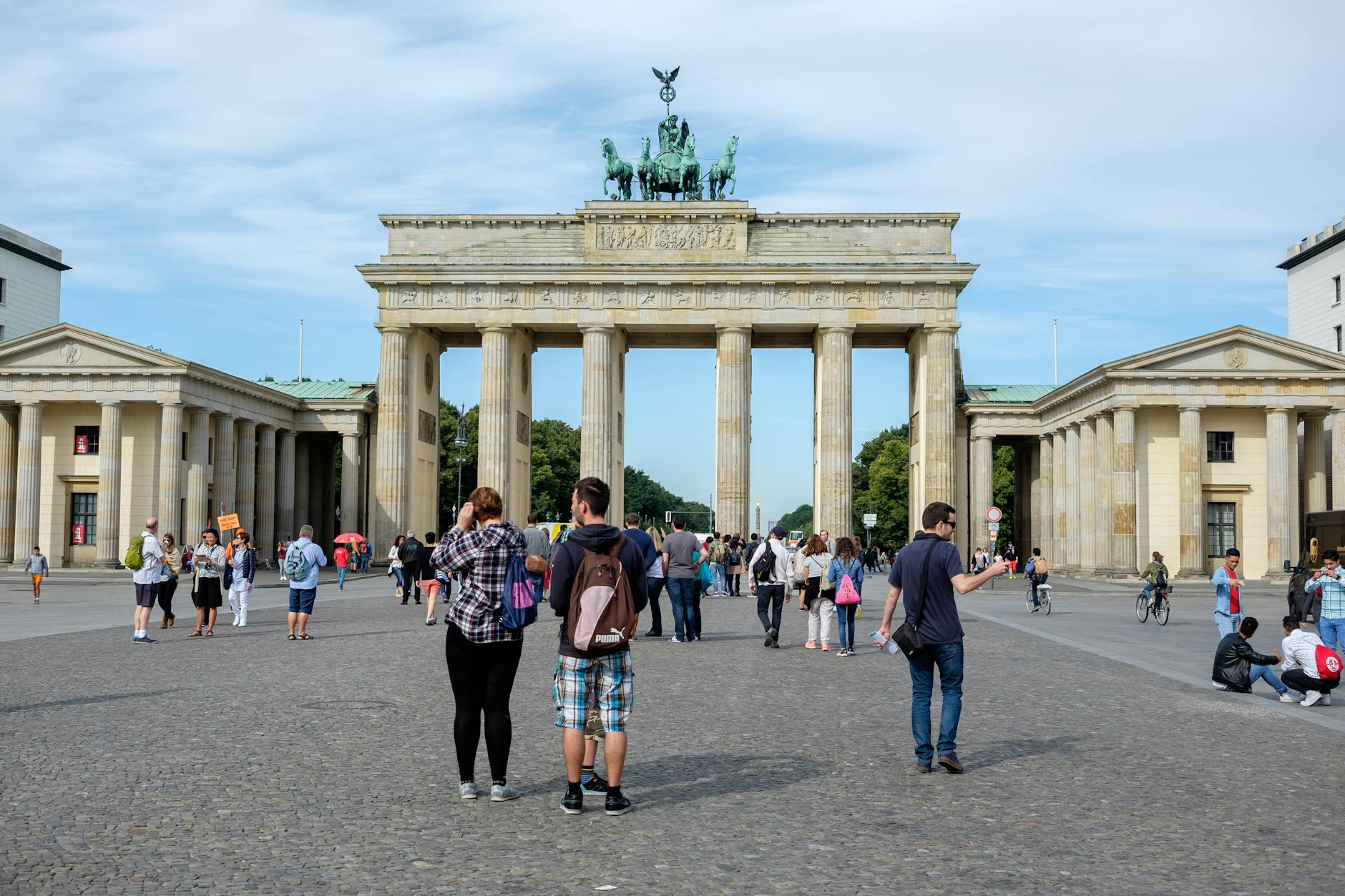
At six in the morning in June, Pariser Platz is empty enough to hear your own footsteps on the cobbles. By half past nine there are four coach parties, a man dressed as a Soviet soldier, three people selling selfie sticks and a queue for the photograph. The brandenburg gate berlin visitors actually experience depends almost entirely on what time they show up — and unlike nearly everything else in this city, that is a decision you get to make for free, at any hour, without a ticket.
This guide covers what the gate is, why it matters more than its looks suggest, exactly when to photograph it, what is genuinely worth seeing in the streets immediately around it, and which of the things being sold to you on that square are a waste of money. There is nothing to book and nothing to pay, so the only currency here is timing. Anything with a price attached in this article was checked in September 2026 and should be treated as the right order of magnitude.
The essentials at a glance
| Question | Answer |
|---|---|
| Cost | Free, always |
| Booking | None. There is no ticket to buy. |
| Opening hours | Open 24 hours. Floodlit at night. |
| Nearest station | Brandenburger Tor (U5, S1, S2, S25, S26) |
| Time to allow | 20 minutes, or an hour with the surrounding streets |
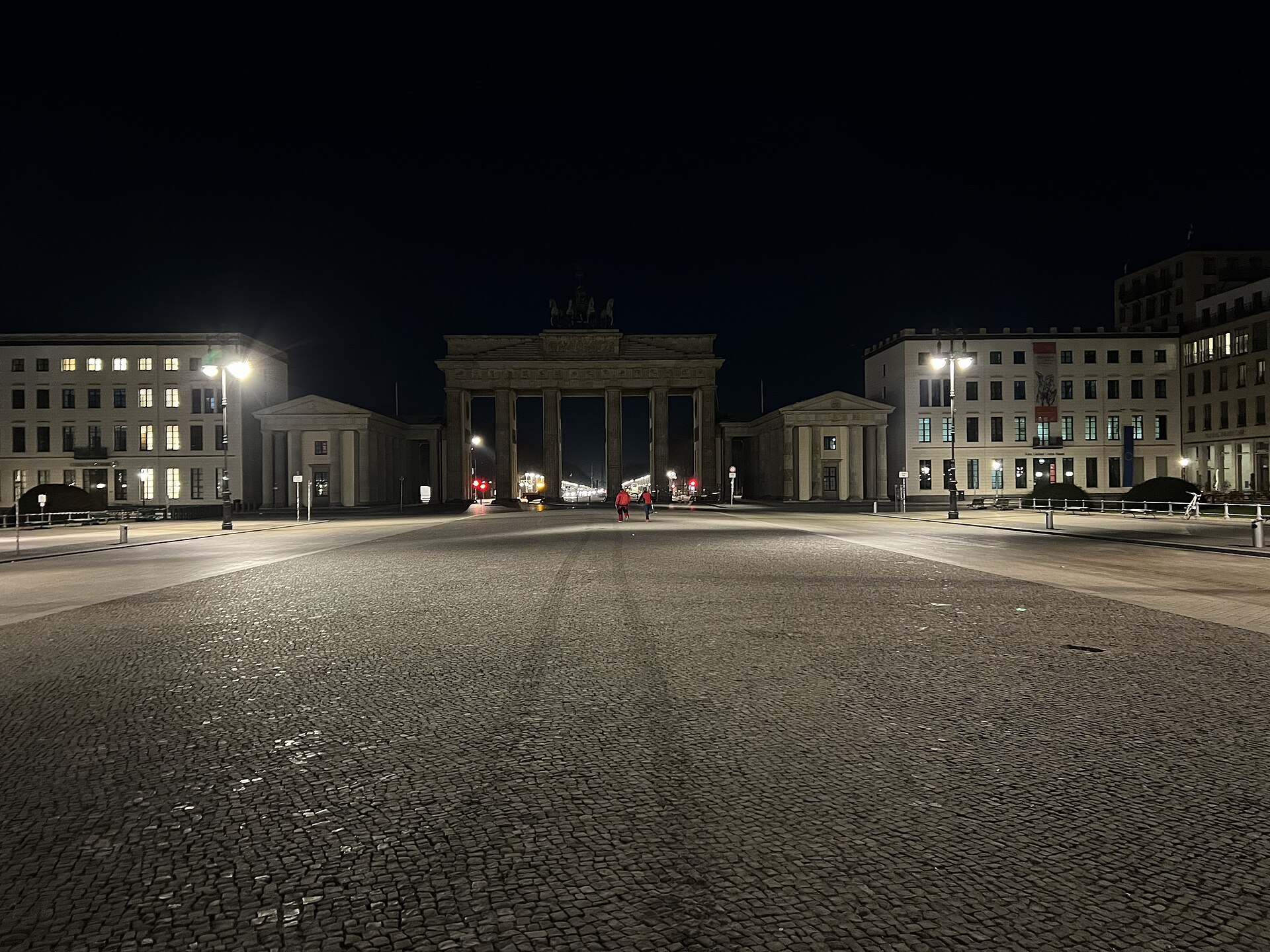
| Best photograph | Sunrise from Pariser Platz, or after 23:00 |
| Worst time | 10:00–16:00 between May and September |
| Accessible? | Yes — flat, paved, step-free from the station |
| Inside? | The Raum der Stille in the north wing, usually 10:00–18:00, free |
That is the whole practical picture. Everything below is about making the twenty minutes better.
What you are actually looking at
Carl Gotthard Langhans built it between 1788 and 1791 for Friedrich Wilhelm II, modelled on the Propylaea, the ceremonial gateway to the Acropolis in Athens. It is sandstone, it is twenty-six metres high, and it has twelve Doric columns arranged in two rows of six, forming five passageways.
Those five passageways matter more than they look. For a century and a half the central one was reserved for the royal family and their guests; ordinary Berliners used the outer four. That restriction is gone and you can walk straight through the middle now, which is a small piece of history you can participate in rather than read about.
The Quadriga
On top sits the Quadriga: a four-horse chariot driven by a winged figure, sculpted by Johann Gottfried Schadow and installed in 1793. She began life as Eirene, the goddess of peace. Napoleon took the whole sculpture to Paris in 1806 after defeating Prussia, and it stayed there until 1814, when Prussian troops brought it back — at which point the figure was quietly redesignated Victoria, goddess of victory, and given an iron cross wreathed in oak leaves and a Prussian eagle. Peace became triumph in a single redesign, which tells you a good deal about nineteenth-century Berlin.
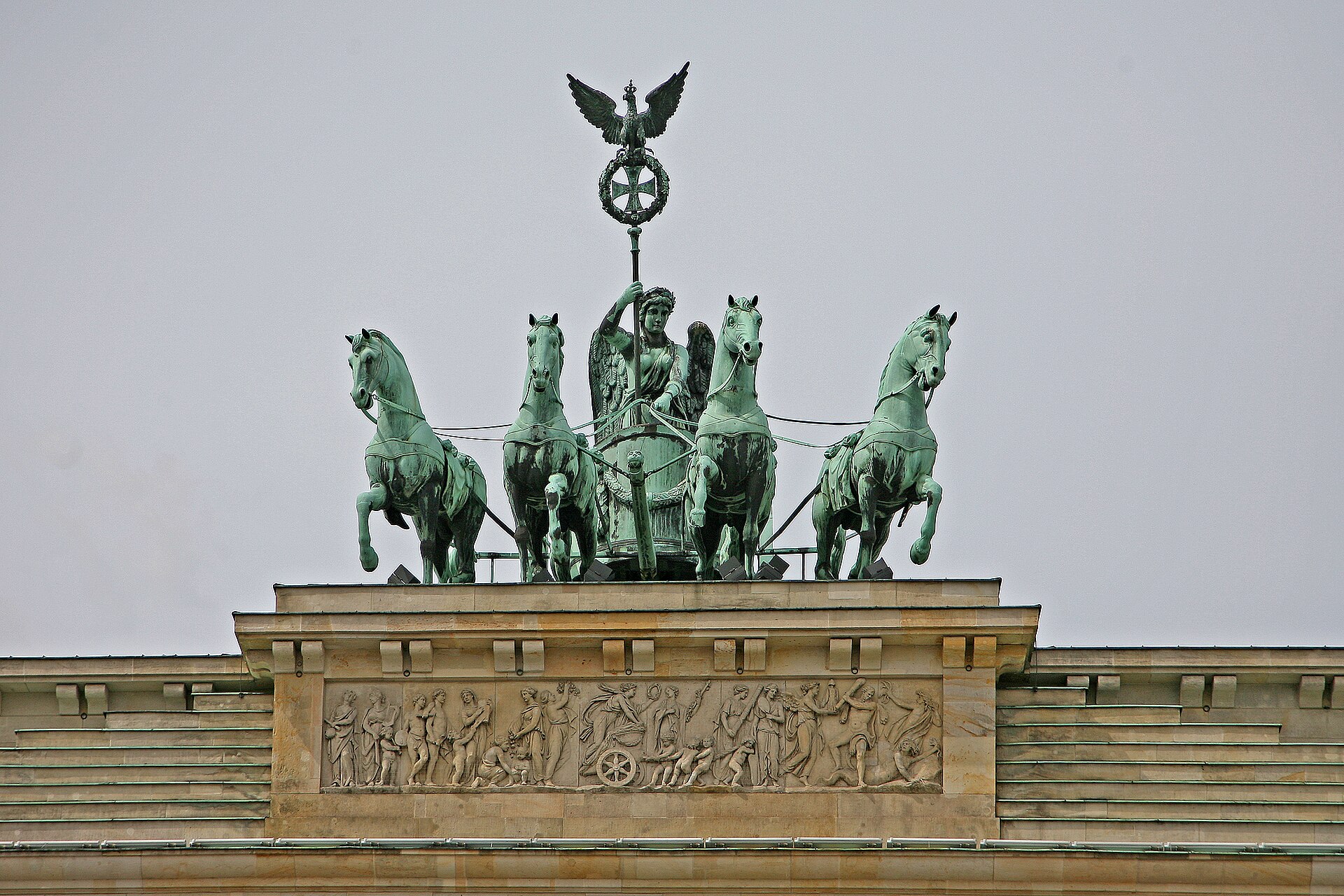
The sculpture you see today is a 1958 replica. The original was destroyed in the war; one surviving horse’s head is in the Märkisches Museum and is worth a detour if you find this sort of thing interesting. After 1945 the East German authorities removed the eagle and the cross as Prussian militarism, and the two Germanies actually collaborated on restoring the gate in the 1950s — one of very few things they managed jointly. The cross and eagle went back on after reunification.
A practical note for photographers: the Quadriga faces east, into the city, down Unter den Linden. From Pariser Platz you are looking at her back. To see the horses head-on you need to stand west of the gate, on the Straße des 17. Juni side, which almost nobody does.
Why it matters: the gate as a political instrument
Most European triumphal arches are decorative by now. This one has been in continuous political use for two hundred years, and every regime that held Berlin used it as a backdrop.
Napoleon marched through it in 1806. The Nazis staged a torchlit procession through it on the night of 30 January 1933 to mark Hitler’s appointment as chancellor — the photographs are among the most reproduced images of the period. By 1945 it stood in ruins in a flattened square.
Then came the part most visitors have some sense of. When the Wall went up in August 1961, it ran directly in front of the gate on the western side, placing the monument inside the death strip. For twenty-eight years nobody could reach it from either direction. It appears in the background of an enormous number of Cold War photographs precisely because it was unreachable — a national symbol locked in a no-man’s-land, visible from both sides and touchable from neither.
Reagan gave the “tear down this wall” speech in front of it in June 1987. The gate crossing itself reopened on 22 December 1989, several weeks after the Wall opened elsewhere, and the footage of Berliners walking through it is the image that ended up standing for the whole thing. If you want the full sequence, our Berlin Wall history timeline lays it out year by year, and the reunification guide covers what happened after.
Knowing this changes what you are looking at. Without it, the gate is a handsome neoclassical arch with a lot of people in front of it. With it, the empty cobbles you are standing on were a fortified border strip inside living memory.
When to go: a genuinely useful timing guide
This is the part that determines whether your visit is good or merely completed.
Sunrise — the best slot, no argument
The sun rises behind the gate when viewed from Pariser Platz, which means the Quadriga is backlit and the sandstone catches the first light. More importantly the square is empty. In summer that means being there around 05:00, which is a genuine ask; in winter sunrise is closer to 08:00 and the trade is much easier. Winter sunrise at the Brandenburg Gate, cold and empty with the sky going orange behind it, is one of the best free things you can do in Berlin — see our Berlin in winter guide for the rest of the cold-season case.
After dark
The gate is floodlit and the crowds thin dramatically after about 22:00. By midnight you can have Pariser Platz more or less to yourself. The warm uplighting against a dark sky is the most flattering the building ever looks, and it is entirely safe — this is one of the most watched squares in Germany. Our Berlin at night guide covers what else is worth doing in the same window.
Midday, May to September — the time to avoid
Coach tours, walking tours, school groups, cycle rickshaws, costumed photo-touts and a persistent scrum in front of the central passageway. You will get your photograph, and it will have forty strangers in it. If this is the only window you have, walk through to the western side where the crowd density drops by half.
Two dates that change everything
On New Year’s Eve, Straße des 17. Juni becomes the largest open-air party in Germany, with the gate as the centrepiece and fireworks over it at midnight. It is enormous, it is fenced, and you should read our Berlin New Year’s Eve guide before deciding whether you want to be inside it.
During the Festival of Lights in October the gate is projection-mapped after dark along with dozens of other buildings, and it is the single most photographed installation of the festival. Details in the Berlin events calendar.

Getting the photograph
Everyone takes the same shot, straight-on from Pariser Platz. Here is how to do better.
- Shoot from the west side. Straße des 17. Juni, looking back east. The Quadriga faces you, the crowd is behind the gate rather than in front of it, and in the late afternoon the front elevation is lit rather than shadowed.
- Use the columns. Standing inside the passageways and shooting through them gives you depth and a frame, and it removes most of the crowd.
- Get the Reichstag in the same frame. Walk north from Pariser Platz along Ebertstraße for two minutes and you can line the two up, which is a more interesting composition than either alone.
- Bring something with a long end. The Quadriga is twenty-six metres up. On a phone at the wide end it is a green smudge.
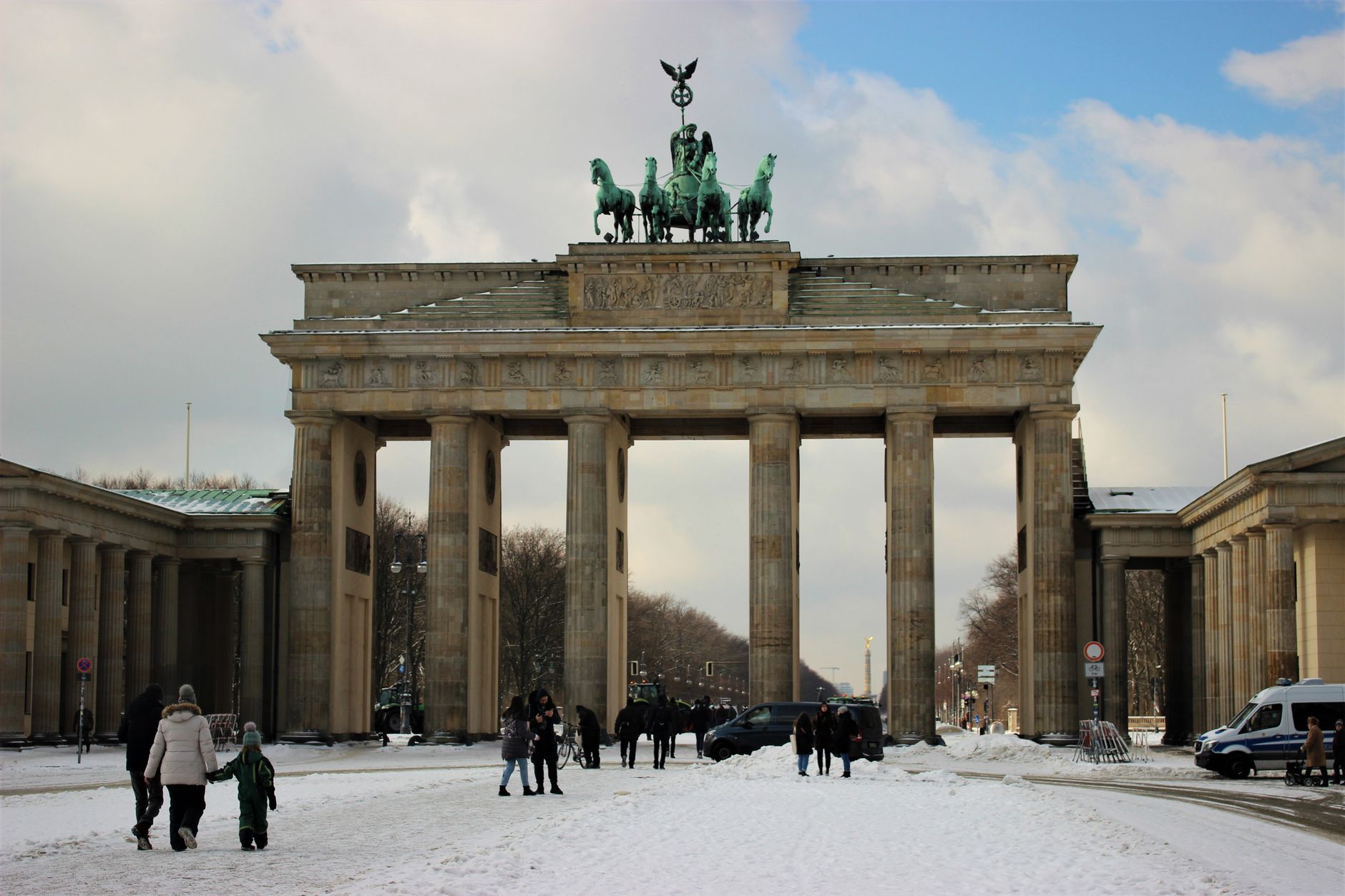
- Winter and rain help. Wet cobbles reflect the floodlights. Snow empties the square. Our weather and packing guide has the seasonal detail.
What is actually around it
The gate takes twenty minutes. The streets around it can take a full morning, and most of the good material is within four hundred metres.
Pariser Platz itself
The square east of the gate is bounded by rebuilt versions of what stood here before 1945. The Hotel Adlon on the south side is the famous one — rebuilt in 1997, and the place from which Michael Jackson dangled a baby out of a window in 2002, which is now genuinely the thing most visitors know about it. The Academy of Arts is the glass-fronted modern intrusion; the French and US embassies close the square. The DZ Bank building at number 3 has a Frank Gehry interior that you can sometimes glimpse from the lobby and which looks nothing at all like the sober facade.
The Raum der Stille
In the northern gatehouse there is a small room of silence, usually open 10:00 to 18:00, free, founded in 1994 as a non-denominational space for reflection. It holds perhaps a dozen people, it is almost always nearly empty, and it is a strange and welcome twenty minutes out of the noise. Almost nobody who visits the gate knows it exists.
The Holocaust Memorial — two minutes south
The Memorial to the Murdered Jews of Europe is one block south along Ebertstraße: 2,711 concrete stelae on a sloping field, free, open at all hours. The underground Ort der Information beneath it is the part that does the real work and is also free. Do not treat the stelae as a photo set; the ground falls away as you walk in and the effect is deliberate.
The Reichstag — five minutes north
Norman Foster’s glass dome on the parliament building is free but has to be registered weeks ahead with the Bundestag visitors’ service, and bookings open only for the current month and the next. It is the best free view in the city and the single thing most worth planning around. Full detail, including the same-day route if you did not book, is in our Berlin attractions and tickets guide.
Unter den Linden — east
The boulevard running east from the gate towards Museum Island. It is a fifteen-minute walk to the Humboldt University, the Staatsoper, the Bebelplatz with its sunken empty-library memorial to the 1933 book burning, and then the cathedral and the museums. This is the natural onward route and it is covered in our Museum Island guide.
The Tiergarten — west
Straight through the gate and you are in a 210-hectare park with the Siegessäule at its centre, about a twenty-minute walk down the axis. In summer this is where Berliners actually are. See outdoor activities in Berlin.
What to avoid on the square
- The costumed photo-touts. People in Soviet, American or Prussian uniform will pose with you and then ask for money. There is no fixed rate and no authority behind them. The same operation runs at Checkpoint Charlie, more aggressively.
- Petition clipboards. The clipboard is a distraction technique. Keep walking.
- The cycle rickshaws. They will quote you a price per person that turns out to be per person per fifteen minutes. Berlin’s public transport is excellent and costs a fraction — see the BVG tickets guide.
- Eating on Pariser Platz. The cafés facing the gate charge a view premium for mediocre food. Walk five minutes in any direction. Our cheap eats guide and the wider Berlin food guide have better options.
- Souvenir stalls on the square. The same fridge magnets and Wall fragments cost noticeably less two streets away. See the best souvenirs from Berlin.
Getting there
Brandenburger Tor station sits directly beneath the square and is served by the U5 and by the S1, S2, S25 and S26. Unter den Linden station on the U6 is a five-minute walk east. The 100 and 300 buses both pass close by, and the 100 in particular — Zoologischer Garten to Alexanderplatz via the Tiergarten, the gate and Unter den Linden — is the cheapest sightseeing tour in Berlin, because it is a normal bus on a normal ticket. Our U-Bahn and S-Bahn guide explains the ticketing.
The square is flat, fully paved and step-free from the station lifts, which makes it one of the more straightforwardly accessible sights in the city. See the accessible transport guide for the wider picture.
How long to give it, honestly
Twenty minutes for the gate itself. An hour if you include the Raum der Stille and a walk round to the western side. Half a day if you use it as the hinge between the Holocaust Memorial, the Reichstag and Unter den Linden, which is the sensible way to plan it and is exactly how our one day in Berlin and three-day itinerary pages sequence the area.
What it does not deserve is a special trip. It is two minutes from three other things you were going to see anyway, and building a separate excursion around a gate you can walk under in ninety seconds is the most common way visitors waste an afternoon here.
The gate through the seasons
Because there is no ticket and no interior to speak of, the weather is the entire experience. Berlin’s climate is more extreme than its latitude suggests, and Pariser Platz is a large open square with nothing to shelter behind.
Summer
The busiest and, for photographs, the worst. Sunrise before 05:00 is the only quiet hour and the light between ten and four is flat and harsh. The compensation is that the Tiergarten immediately west is at its best, and the square hosts open-air events — screenings, concerts, and occasionally the fan mile down Straße des 17. Juni during major football tournaments, which is worth seeing once if the timing falls your way. See Berlin in summer.
Autumn
Our pick. October gives you sunrise around 07:30, low golden light, thinner crowds and the Festival of Lights projections after dark. It is also one of the wettest months, which is not the disadvantage it sounds — wet cobbles double the floodlighting at night. Berlin in autumn covers the rest.
Winter
Cold, dark by four, and the best the gate ever looks. Sunrise is around 08:00, which is a civilised hour to be standing on an empty square. Snow is not guaranteed in any given week but when it comes it empties Pariser Platz completely. Dress for it — an open square in a February wind is genuinely unpleasant if you have underestimated it, and our weather and packing guide is blunt about what that means.
Spring
April and May bring the light back before the crowds arrive in force, and the Tiergarten comes into leaf behind the gate. Late April is arguably the best combination of weather and quiet in the year. Berlin in spring has the detail.
Common misconceptions
A few things visitors routinely believe about this monument that are not true.
- “It was part of the Berlin Wall.” It was not. The Wall ran past it, immediately to the west, placing the gate inside the death strip. The gate is a hundred and seventy years older than the Wall and had nothing to do with its construction.
- “You can go up it.” You cannot. There is no viewing platform, no interior staircase for visitors and no access to the Quadriga. The only interior space open to the public is the Raum der Stille. For height, you want the Reichstag dome or the Berliner Dom walkway.
- “It is Berlin’s city gate.” It was one of eighteen. The customs wall around Berlin had gates all round it; this is simply the only one that survives. Kottbusser Tor, Schlesisches Tor, Oranienburger Tor and Hallesches Tor are all named after gates that no longer exist.
- “The statue is original.” The current Quadriga is a 1958 cast. The original was destroyed in 1945.
- “It is a Nazi building.” A common assumption from the 1933 torchlight photographs. It was built in the 1790s under Friedrich Wilhelm II, a century and a half before the regime that used it as a stage set.
Frequently Asked Questions
Is the Brandenburg Gate free to visit?
Yes, entirely. There is no ticket, no booking and no barrier. It is an open public square, accessible at any hour of the day or night, and the gate is floodlit after dark. The Raum der Stille in the north wing is also free.
Can you walk through the Brandenburg Gate?
Yes, through all five passageways including the central one, which was reserved for the royal family until 1918. Vehicles are excluded; the whole area is pedestrianised.
What is the best time to photograph the Brandenburg Gate?
Sunrise from Pariser Platz, when the sun comes up behind the gate and the square is empty, or after about 22:00 when the floodlights are on and the crowds have gone. Midday between May and September is the worst window. For the Quadriga head-on, shoot from the western side on Straße des 17. Juni.
How long do you need at the Brandenburg Gate?
Twenty minutes for the monument, an hour if you include the room of silence and a circuit of both sides. It works best combined with the Holocaust Memorial two minutes south and the Reichstag five minutes north.
What is on top of the Brandenburg Gate?
The Quadriga — a four-horse chariot driven by a winged goddess. She was Eirene, goddess of peace, until Napoleon carried the sculpture off to Paris in 1806; when Prussia recovered it in 1814 she was reissued as Victoria with an iron cross and a Prussian eagle. The current sculpture is a 1958 replica of the destroyed original.
Which U-Bahn station is the Brandenburg Gate?
Brandenburger Tor, directly under Pariser Platz, on the U5 and the S1, S2, S25 and S26. Unter den Linden on the U6 is five minutes’ walk. The 100 and 300 buses stop nearby.
Was the Brandenburg Gate part of the Berlin Wall?
It stood inside the border strip. The Wall ran immediately west of the gate from 1961, putting the monument in no-man’s-land and out of reach from both sides for twenty-eight years. The crossing reopened on 22 December 1989.
Is the Brandenburg Gate worth visiting?
Yes, but not as a destination in itself. It costs nothing, it takes twenty minutes, and it is surrounded by things you were going to see anyway. Go early or late, know what happened on the ground you are standing on, and it repays the time. Turn up at noon in August expecting a moment and it will not.
The Gate is also the one Berlin landmark almost any long layover can reach: it is about 20 minutes on foot from Hauptbahnhof, which is served directly from the airport. Our BER layover guide sets out how long a connection you need and a short route that takes in the Reichstag and the Holocaust Memorial on the way.
Related Berlin Guides
- Berlin Attractions & Tickets
- Berlin Wall History Timeline
- Free Attractions in Berlin
- Berlin at Night
- One Day in Berlin
- Berlin New Year’s Eve
- Museum Island Berlin
Final Word
The Brandenburg Gate is not Berlin’s most impressive building and it is not the city’s best view. What it is, uniquely, is a piece of architecture that has been standing in the same spot while everything around it was destroyed, divided, walled off and rebuilt — and that still has the marks of all of it. Napoleon’s theft is legible in the iron cross. The war is legible in the fact that the Quadriga is a copy. The Wall is legible in the emptiness of a square that was once a death strip and is now a place where tourists queue for a photograph.
Go at an hour when you can hear it. Stand under the central passageway that ordinary Berliners were barred from for a hundred and fifty years and that nobody at all could reach for twenty-eight. Then walk two minutes south to the stelae and five minutes north to the dome, because the gate is the hinge of that walk rather than the point of it. It costs nothing, which in a city where the tower view runs to €25 is worth saying out loud.
Photo Credits
Pariser Platz at night: Berlin Pariser Platz lub 2023-03-01 Nacht by Lukas Beck, CC BY-SA 4.0, via Wikimedia Commons.
The Quadriga: 00 2486 Quadriga – Brandenburger Tor (Berlin) by W. Bulach, CC BY-SA 4.0, via Wikimedia Commons.