Arriving at BER for the First Time: A Walkthrough
Landing at BER for the first time? Passport control and the Entry/Exit System, missing bags, customs, the arrivals hall and the 23-minute FEX into the city, in the order you meet them.
Most people landing at BER for the first time make the same small mistake within ten minutes of collecting their bags. They walk out through the sliding doors into the flat Brandenburg air, looking around for a railway station, and the railway station is directly underneath them. Berlin’s airport is compact, bilingual and reasonably well signed, and the trip from aircraft door to a city-bound train can take under half an hour — but only if you know the order things happen in. That is what this BER airport arrivals guide is for: a walkthrough of the whole thing, step by step, in the sequence you will actually meet it.
It covers the walk from the gate, passport control and the EU’s new Entry/Exit System, baggage reclaim and what to do when a bag fails to appear, customs allowances, the arrivals hall, and the choice between the FEX, the S-Bahn, a taxi and a hire car. It also deals with the awkward cases: landing close to midnight, arriving at Terminal 2, travelling with small children or a lot of luggage. Prices and timetables were checked in October 2026; treat the prices as the right order of magnitude rather than a guarantee. For the airport as a whole — terminals, lounges, parking and hotels — start with our complete BER airport guide.
Arriving at BER at a Glance
| What | The short answer | Cost (September 2026) |
|---|---|---|
| Passport control | Only if you flew in from outside the Schengen area | Free |
| Entry/Exit System | Fingerprints and a facial image for non-EU visitors on first entry, fully in force since April 2026 | Free |
| ETIAS | Not required yet; no confirmed start date | — |
| Fastest train | FEX to Hauptbahnhof in about 23 minutes; with the RE20, four trains an hour until December 2026 | €5.00 ABC single |
| Most flexible trains | S9 or S85, every 20 minutes, stopping all over the east and centre | €5.00 ABC single |
| Taxi | Ranks outside Terminal 1, about 45 minutes to the centre | Roughly €60–70 |
| Tourist information | Berlin Brandenburg WelcomeCenter, Terminal 1, level E0, daily 08:00–20:00 | Free advice |
| Left luggage | Terminal 1 | Roughly €7–10 per bag per day |
| Food and water at any hour | REWE supermarket in the Terminal 1 public area, open 24 hours | Varies by item |
Before You Land: Three Things Worth Doing on the Plane
None of this is complicated, but all of it is easier at 35,000 feet with nothing else to do than at the bottom of an escalator with a trolley and a tired child.
- Know your terminal. Check your boarding pass or airline app. The station sits directly beneath Terminal 1, and the taxi ranks are outside on its arrivals level, E0. Terminal 2, within walking distance, has its own shops and restaurants but no station. If you land there, you will be walking to Terminal 1 anyway.
- Get the apps ready. Download the BVG app or DB Navigator and set up payment while you still have Wi-Fi or data you trust. You will buy your ticket after landing, not before, but having the app working saves a queue at the machines. Our essential Berlin apps guide covers which ones are worth the storage.
- Write down where you are staying. The full address and the nearest station. Non-EU visitors can be asked at the border where they are sleeping, taxi drivers want a street and a house number, and a hotel name alone is surprisingly useless when your phone battery has just died.
Step 1: From the Aircraft to the Terminal
Depending on where your aircraft parks, you will either walk straight off a jet bridge into one of the long glass piers or climb down the steps onto an apron bus. Low-cost flights in particular are often parked at remote stands, and the bus ride is part of the arrival. Either way, the signs are in German and English, and there are only a handful of German words worth recognising at this stage.
| German | English | Where you will see it |
|---|---|---|
| Ankunft | Arrivals | From the moment you leave the aircraft |
| Gepäckausgabe | Baggage reclaim | After passport control, if you have one |
| Ausgang | Exit | Reclaim hall and customs |
| Bahnhof / Züge | Station / trains | Arrivals hall, pointing down |
| Fundsachen | Lost property | Service desks |
Walking distances inside the piers can be longer than the compact terminal building suggests, so if you are tight on a connection or travelling with someone who struggles with distance, tell the cabin crew before landing. Assistance booked in advance helps you off the plane and on through the terminal.
Step 2: Passport Control, or Not
This is the step that decides whether you are out of the airport in fifteen minutes or queuing for an hour, and it depends entirely on where your flight came from.
Arriving from a Schengen country
If you flew in from Paris, Madrid, Vienna, Copenhagen or anywhere else inside the Schengen area, there is usually no passport control at all. You follow the signs straight to baggage reclaim, and it can feel slightly anticlimactic. Carry your passport or ID card anyway: the airline wanted to see it, police spot checks do happen, and you will need it at your hotel. Bulgaria and Romania have been full Schengen members since January 2025, so flights from Sofia and Bucharest now count as internal. The United Kingdom, Ireland and Cyprus do not, which catches out a surprising number of people who assume London is a domestic-feeling hop.
Arriving from outside Schengen: the Entry/Exit System
Flights from London, Dublin, Istanbul, New York, Dubai and everywhere else outside Schengen go through passport control before baggage reclaim. EU, EEA and Swiss citizens use their own lanes, and automated gates when they are open. Everyone else joins the non-EU queue.
Since 10 April 2026 the EU’s Entry/Exit System (EES) has been fully operational at every external Schengen border, BER included. If you are a non-EU visitor entering for the first time since it started, the officer — or a self-service kiosk, where one is in use — registers your fingerprints and a facial image, alongside your passport details. Children under 12 are not fingerprinted. The registration replaces the old passport stamps and is kept for three years, so on your next trip you should be checked against it rather than registered all over again. The first time adds a few minutes per person, and those minutes stack up when three long-haul flights land together.
Have these ready, not buried in a rucksack:
- A passport issued within the last ten years and valid for at least three months beyond the day you plan to leave the Schengen area.
- Proof of your return or onward journey.
- Your accommodation address.
- For visa nationals, the visa itself.
The questions, when they come, are short: how long are you staying, where, and why. Visa-exempt visitors can spend up to 90 days in any 180 in the Schengen area as a whole, not per country. Our Berlin visa and entry requirements guide goes through the rules nationality by nationality.
ETIAS: not yet
ETIAS is the online travel authorisation that visa-exempt visitors — Americans, Britons, Canadians, Australians and others — will eventually need before they fly to Europe. It still has no start date, and the EU has said it will announce the launch months in advance. Until then, you do not need it, and no airline can refuse to board you for lacking it. Be wary of websites already selling “ETIAS applications” for a fee; there is nothing yet to apply for.
Step 3: Baggage Reclaim
Screens at the entrance to the reclaim hall list each flight against a belt number. Luggage trolleys are waiting near the belts, and they are worth taking even if you think you can manage: they fit in the lifts down to the station, and you can wheel one right onto the platform. Bulky items — bikes, skis, golf bags, some pushchairs and musical instruments — usually come out at a separate oversize-baggage point rather than on the belt, so if yours has not appeared after everything else, ask a member of staff before you panic. Pushchairs checked at the gate are often returned at the aircraft door instead.
If you flew in to Terminal 2, reclaim is in Terminal 2, on the ground floor. Collect your bags there before walking over to Terminal 1.
If your bag does not arrive
Report it before you leave the reclaim hall. This is the one rule that matters: once you walk through customs into the public arrivals hall, you cannot come back, and reporting a missing bag from outside is a far slower business. Go to the baggage services desk in the reclaim area with your boarding pass and baggage tag, and make sure you leave with:
- A written report — usually called a Property Irregularity Report — with a reference number.
- A description of the bag that you have checked, including colour, brand and anything distinctive.
- Your address in Berlin and a phone number that works, so the bag can be delivered to you.
Keep the receipts for anything essential you buy while you wait. Under the Montreal Convention, which covers most international flights, a written claim for a delayed bag has to reach the airline within 21 days of the bag being returned to you, and damage has to be reported within seven days. Travel insurance can help with the rest; see our Berlin travel insurance guide for what a sensible policy covers.
Step 4: Customs
After reclaim comes customs, which for most people is a walk through a set of doors. There are three channels:
- Blue — for passengers on flights from within the EU. No checks as a matter of routine.
- Green — nothing to declare, arriving from outside the EU.
- Red — goods to declare. Use it if you are over your allowances, carrying anything restricted, or holding €10,000 or more in cash or equivalent, which must be declared in writing.
Since Brexit, arrivals from the United Kingdom count as arrivals from outside the EU, with the same allowances as a flight from New York. The allowances for travellers arriving by air from outside the EU are:
| Goods | Duty-free allowance per adult |
|---|---|
| Cigarettes (17 and over) | 200 cigarettes, or 100 cigarillos, or 50 cigars, or 250 g of tobacco |
| Spirits (17 and over) | 1 litre over 22%, or 2 litres at 22% or less such as sparkling or fortified wine |
| Wine and beer (17 and over) | 4 litres of still wine and 16 litres of beer |
| Other goods | Up to €430 in total; €175 for travellers under 15 |
| Cash | No limit, but €10,000 or more must be declared |
Meat and dairy products from outside the EU are effectively banned, even vacuum-packed and even as a gift for a relative. A sandwich finished on the plane is the safest place for it.
Step 5: The Arrivals Hall
The customs doors open into the Terminal 1 arrivals hall on level E0. This is where people meeting you wait, and it holds almost everything a first-time arrival needs:
- The Berlin Brandenburg WelcomeCenter, run by visitBerlin, open daily 08:00–20:00. Staff speak several languages and sell public-transport tickets, the Berlin WelcomeCard, event tickets and maps, and can help with a hotel if your plans have fallen through.
- Cash machines, cafés and a bakery.
- A REWE supermarket in the public area of Terminal 1, open 24 hours, which is where to pick up water and something to eat at any hour.
- Signs for the car rental centre, between the two terminals.
- Escalators and lifts down to the station, and the doors out to the taxi ranks.
Money: do you need euros?
Not to leave the airport. Ticket machines, the apps, taxis and the supermarket all take cards. Berlin is far more card-friendly than it was a decade ago, but it is still a city where a small café, a Späti, a bar in Neukölln or the ticket office at the top of the Siegessäule might want cash. Take out €50–100 from a bank-run cash machine, and when the screen offers to charge you in your home currency, decline and choose euros; that “conversion” is where the fees hide. Do not change notes at an airport exchange counter unless you have no alternative.
Phone data and SIM cards
If your phone plan comes from an EU country, roaming costs nothing extra and you can ignore this section. Everyone else is better off with an eSIM bought before the trip. Prepaid SIM cards are sold in German phone shops and supermarkets, but by law they have to be activated with an identity check, usually a video call, before they work. That is fine for a long stay. On a jet-lagged first evening it is a nuisance you do not need.
The WelcomeCard question
The WelcomeCenter will happily sell you a Berlin WelcomeCard, and the ABC version covers your train from the airport. Whether it saves money depends entirely on how many discounted attractions you will actually visit, and for plenty of visitors it does not. Do the sums first with our honest WelcomeCard review rather than deciding at a counter with your coat still on.
If you landed at Terminal 2
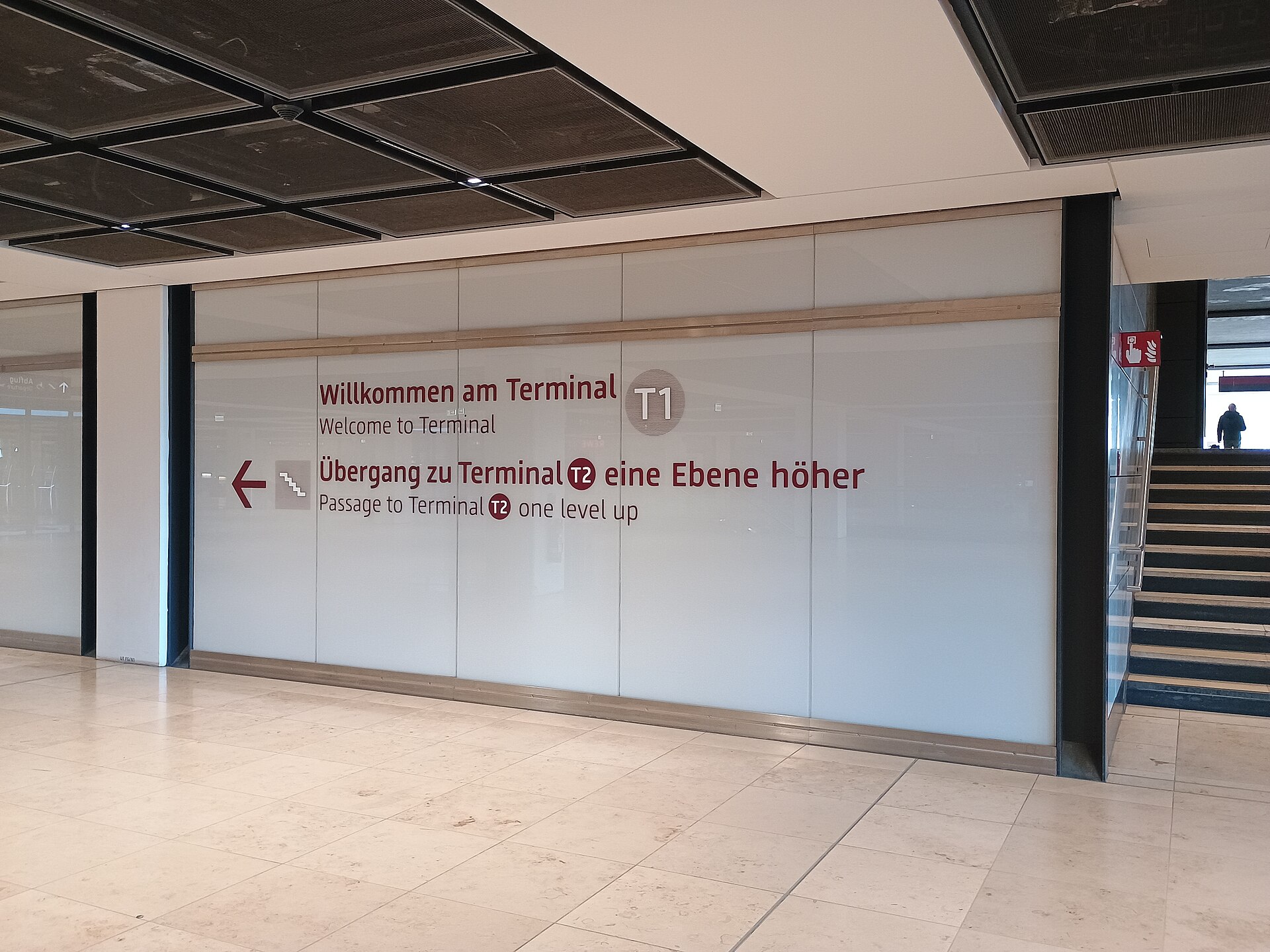
Terminal 2 has its own arrivals area and baggage reclaim, but the trains and the main taxi ranks are at Terminal 1. Once you have your bags, follow the signs for Terminal 1: it is a few minutes’ walk, and the walkway brings you in on its arrivals level, E0. Ryanair closed its Berlin base on 24 October 2026 and halved its Berlin capacity for winter 2026–27, dropping 12 routes, though it still flies to BER. For how the two buildings fit together, see our BER terminals guide.
Meeting someone at BER
Tell whoever is collecting you to wait in the Terminal 1 arrivals hall, even if you are flying into Terminal 2, and agree a specific spot — a named café, or the top of the escalators down to the station. If they are coming by car, the forecourts at both terminals give drivers the first ten minutes free, tracked by number-plate recognition. Ten minutes is not long, so call them from the baggage belt rather than from the kerb. Anything longer means a car park; our BER parking guide has the options.
Step 6: Getting Into the City
This is the part people worry about most, and it is the easiest. There is a station under Terminal 1, the trains are frequent, and one ticket covers the lot. What follows is the arrival-day summary; our BER to city centre guide goes into routes by neighbourhood.
The station under your feet
From the arrivals hall, follow the signs for trains and the S-Bahn down the escalators or lifts to the station, which lies directly beneath Terminal 1. Down there, signs point the way to the S-Bahn, the FEX and the regional trains. The departure boards list the next trains with their destinations, and on the regional lines that destination matters, as you will see below.
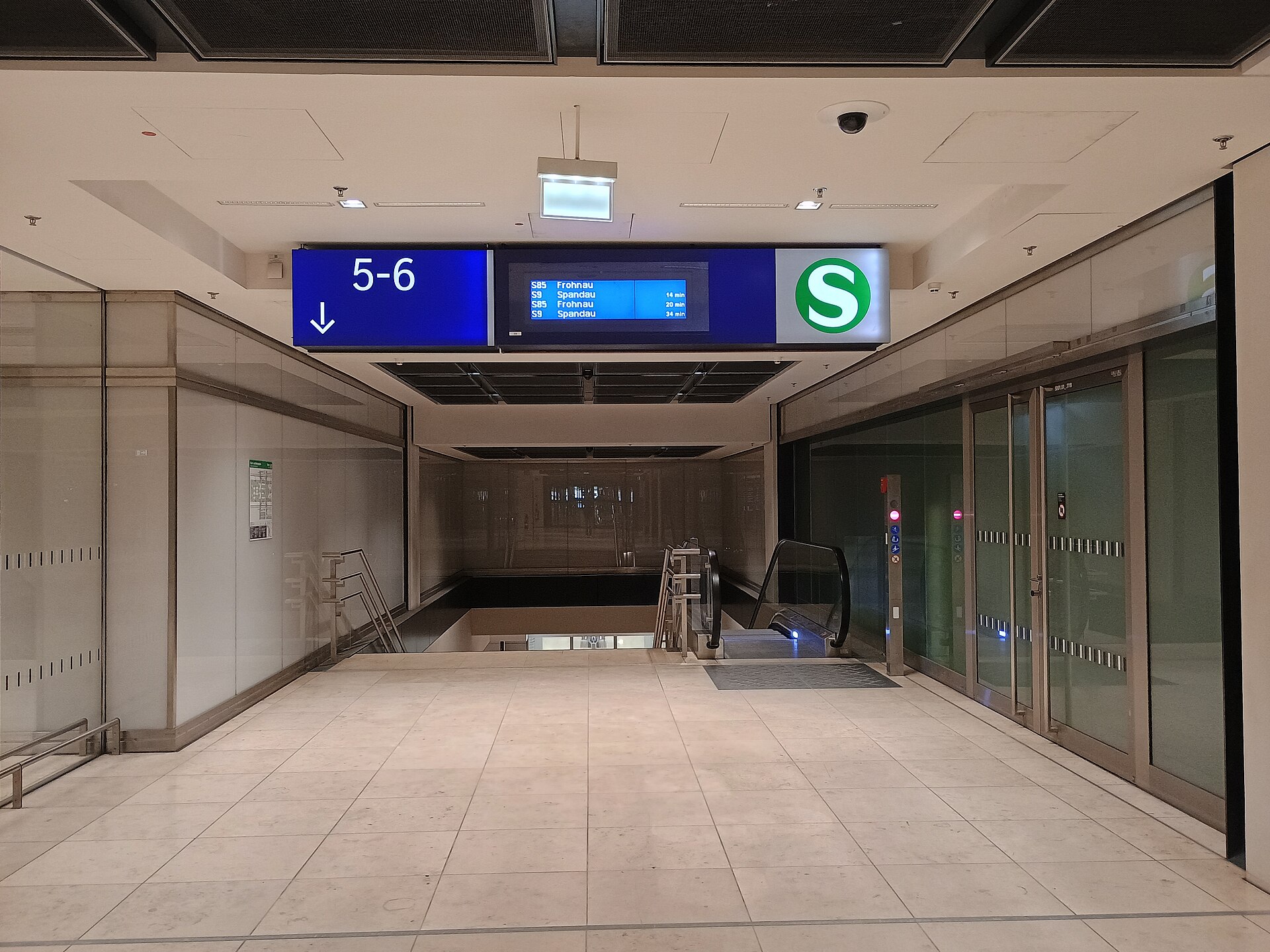
Which train?
Since the rebuilt Dresdner Bahn opened in December 2025, the scheduled run from the airport to Hauptbahnhof has dropped from 39 minutes to about 23. The choice now looks like this:
| Train | Useful stops in Berlin | Time | Frequency |
|---|---|---|---|
| FEX | Südkreuz, Potsdamer Platz, Hauptbahnhof | About 23 min to Hauptbahnhof, 19 to Potsdamer Platz | Four trains an hour with the RE20 until December 2026; reduced service overnight |
| S9 | Schöneweide, Treptower Park, Warschauer Straße, Alexanderplatz, Friedrichstraße, Hauptbahnhof, Zoologischer Garten | Around 50 min to the centre | Every 20 min; every 30 min through weekend nights |
| S85 | Adlershof, Schöneweide, Ostkreuz, then north round the eastern Ring towards Pankow | Much like the S9 as far as Ostkreuz | Every 20 min |
| RB24 and RB32 | Schöneweide, Ostkreuz, Lichtenberg | Fewer stops than the S-Bahn | Hourly each, two an hour together |
| RE20 | Südkreuz, Potsdamer Platz, Hauptbahnhof | Similar to the FEX | Hourly, roughly 04:00–21:00 |
The rule of thumb is simple. Staying near Hauptbahnhof, Potsdamer Platz, Tiergarten, Schöneberg or western Kreuzberg: take the FEX and change if you need to. Staying in Friedrichshain, Prenzlauer Berg or around Alexanderplatz: the S9 or S85 may drop you closer, even though it takes longer. Check your exact address in the app; it will usually give you both options with the change included.
Watch the direction on regional trains. The S9, the S85 and the FEX all start at the airport and can only go one way. The regional lines do not: the RE20 carries on south to Königs Wusterhausen and Lübbenau, and the RB24 and RB32 continue into Brandenburg in the other direction, and trains for Potsdam or Königs Wusterhausen skirt the city without going into the centre at all. Board the wrong one and you will see a lot of pine forest before you see Berlin. The platform screen shows the destination; Berlin Hbf, Ostkreuz or Lichtenberg is what you want. (The RE20 to Lübbenau is, incidentally, the direct train for a Spreewald day trip later in your stay.)
Tickets
BER is in fare zone C, just outside the city’s AB zones, so the ticket you need is an ABC single, which costs €5.00. It is valid on the FEX, the regional trains, the S-Bahn and any onward U-Bahn, tram or bus connection within the time limit. The traps are well known and still catch people every day:
- An AB ticket is not valid from the airport. If you already hold an AB day or weekly ticket, buy an extension ticket for zone C for this one journey.
- Paper tickets from the machines must be stamped in one of the small validators before you board. An unstamped ticket counts as no ticket, and the on-the-spot fine is €60.
- App tickets are valid as soon as you buy them, so buy on the platform, not an hour earlier at the café.
- A Deutschlandticket, at €63 a month in 2026 (€66.80 from January 2027), covers the whole journey, as it covers all local and regional transport in Germany. It is a monthly subscription, so remember to cancel it if you only want one month.
For every ticket type and what each one covers, see our guide to BVG tickets, and for how the network fits together, our U-Bahn and S-Bahn guide.
Taxis and ride-hailing
Licensed taxis wait at the North and South ranks directly outside Terminal 1 on level E0. The ride to the centre takes about 45 minutes and costs roughly €60–70 on the meter, more in heavy traffic or to the far west of the city. Most drivers take cards, but ask before you set off. If anyone approaches you inside the hall offering a ride, they are not the taxi rank.
Uber, Bolt and FREENOW have a pick-up zone on the same level. Whether an app ride is cheaper than a taxi depends on the time and demand, so compare the quote with the meter rather than assuming.
The honest verdict: for one or two people heading anywhere near the centre, a taxi is roughly €60 for a journey the FEX does faster for €5. It makes sense for three or four people with heavy bags going somewhere awkward, for anyone with limited mobility, and late at night when the trains thin out.
Hire cars
The car rental centre sits between the two terminals, with Avis and Budget, Hertz, SIXT, Europcar and Enterprise. Collect a car here if you are heading out into Brandenburg or beyond. Do not collect one for Berlin itself: public transport is better, parking in the central districts is expensive and scarce, and a car will spend most of your stay costing you money in a garage.
Landing Late at Night
BER has a night-flight ban between midnight and 05:00, so scheduled arrivals stop around midnight, although a delayed flight can still land close to it. The trains keep going later than most people expect:
- Until December 2026 the FEX and the RE20 between them run four trains an hour, and the FEX keeps a reduced service going overnight.
- The S9 runs right through Friday and Saturday nights, every 30 minutes.
- On weeknights the trains thin out late in the evening, and a night bus or a taxi may suit you better. Look up your connection before you fly if you are due to land after 23:00, and see our guide to night transport in Berlin.
The REWE in Terminal 1 never closes, so water and food are on hand however late you land. If your flight is very late and you are flying on again early, the hotels on Willy-Brandt-Platz are a few minutes’ walk from the arrivals hall; our BER airport hotels guide compares them. The airport, the station and the trains are busy and generally safe late at night; the usual big-city care applies, and our Berlin safety tips cover the rest.
Arriving With Children, Reduced Mobility or a Lot of Luggage
- Children. Under-sixes travel free on Berlin public transport, and six- to fourteen-year-olds pay a reduced fare. Lifts run from the arrivals hall to the platforms, so there is no need to wrestle a pushchair onto an escalator. Our tips for Berlin with toddlers cover what to pack for the first day.
- Reduced mobility. Request assistance through your airline at least 48 hours before you fly; under EU rules, it is free and covers getting off the plane and through the airport. The station is step-free by lift. See our accessible transport guide for the city beyond the airport.
- Heavy luggage. The FEX and the regional trains generally have more room for bags than the S-Bahn, which fills up near the centre during the morning and evening peaks. Take a trolley down to the platform, and if you have more bags than hands, a taxi stops being an indulgence.
Six Mistakes First-Time Arrivals Make
- Walking outside to find the station. It is underneath Terminal 1. Go down, not out.
- Buying an AB ticket. The airport is in zone C. You need ABC.
- Forgetting to stamp a paper ticket. It is a €60 mistake, and “I didn’t know” does not work with Berlin inspectors.
- Leaving the reclaim hall without reporting a missing bag. Report it before customs, every time.
- Boarding a regional train going the wrong way. Check the destination on the screen; Königs Wusterhausen is not Berlin.
- Arranging to meet in the wrong place. Terminal 1 arrivals hall, a named spot, and a call from the baggage belt.
Frequently Asked Questions
How long does it take to get out of BER after landing?
As a rough guide: fifteen to twenty minutes from a Schengen flight with hand luggage only, thirty to forty-five with checked bags, and longer from outside Schengen, particularly on your first Entry/Exit System registration or when several long-haul flights land together.
What is the fastest way from BER to central Berlin?
The FEX, which reaches Hauptbahnhof in about 23 minutes and Potsdamer Platz in about 19. Until December 2026 it shares the route with the RE20, giving four departures an hour between them, and it runs a reduced service through the night. It costs the same €5.00 ABC single as the S-Bahn.
Where is the train station at BER?
Directly beneath Terminal 1. Take the escalators or lifts down from the arrivals hall: the station, now named Flughafen BER, is on level U2 beneath the terminal.
Do I need ETIAS to enter Germany?
Not yet. ETIAS has no confirmed start date, and the EU says it will announce one months in advance. Non-EU visitors are, however, registered in the Entry/Exit System with fingerprints and a facial image on their first entry.
Can I buy a Berlin WelcomeCard at the airport?
Yes, at the Berlin Brandenburg WelcomeCenter in the Terminal 1 arrivals hall, open daily 08:00–20:00. Work out whether it pays back for your plans before you buy.
I have landed at Terminal 2. How do I get to the train?
Collect your bags in Terminal 2, then follow the signs to Terminal 1, a few minutes on foot along the walkway on arrivals level E0. The station is directly beneath Terminal 1, and the taxi ranks are just outside it.
Can I leave luggage at BER?
Yes. The left-luggage office is in Terminal 1 and charges roughly €7–10 per bag per day. It is useful if you arrive before check-in time and want to go straight into the city unencumbered; our BER layover guide covers the timings.
Related Berlin Guides
- BER Airport: The Complete Guide
- BER Terminals 1 and 2 Explained
- BER Airport to Berlin City Centre
- A Layover at BER
- BER Airport Hotels
- BVG Tickets Explained
- Berlin U-Bahn and S-Bahn Guide
- Berlin Visa and Entry Requirements
- Berlin WelcomeCard Review
- Essential Berlin Apps
- Where to Stay in Berlin
Photo Credits
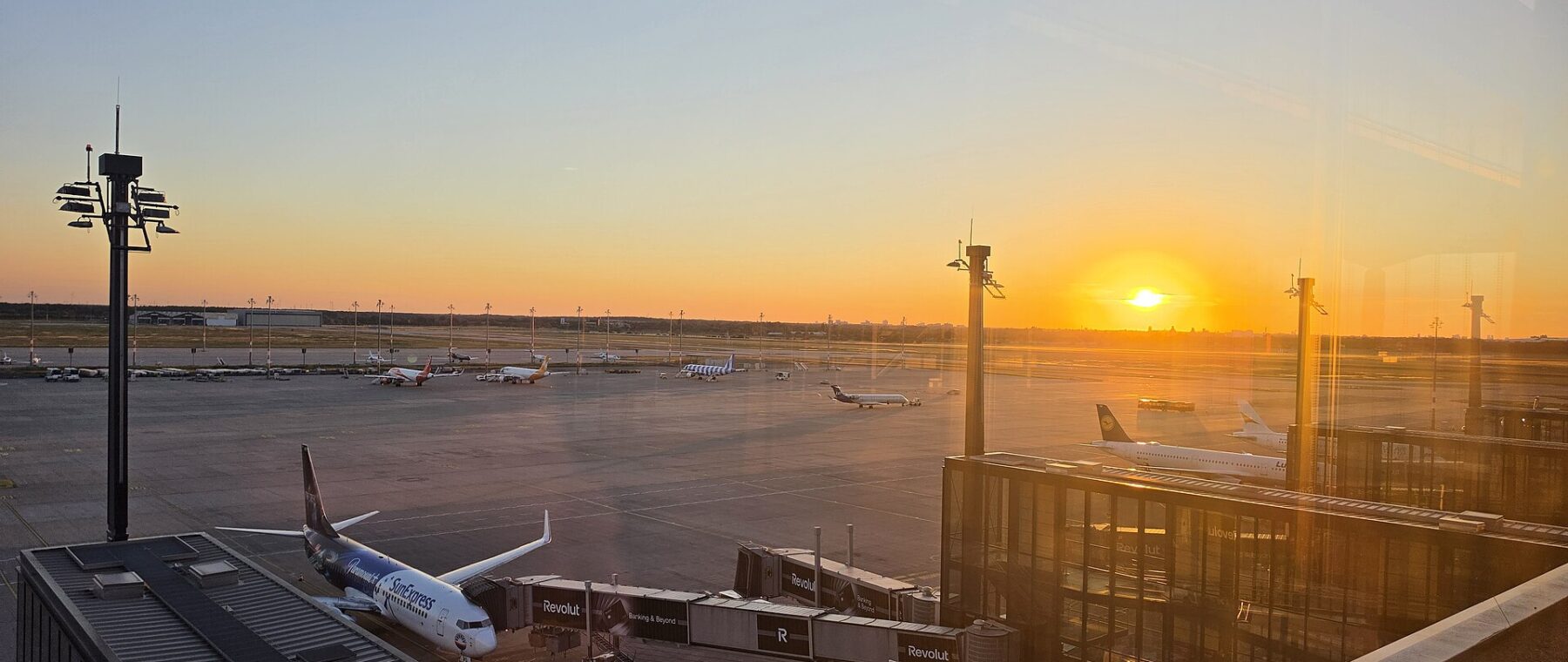
Sunrise over the BER apron and Main Pier jet bridges: 2026 at Berlin Brandenburg Airport 29 by NutzerAusBerlin, CC0, via Wikimedia Commons.
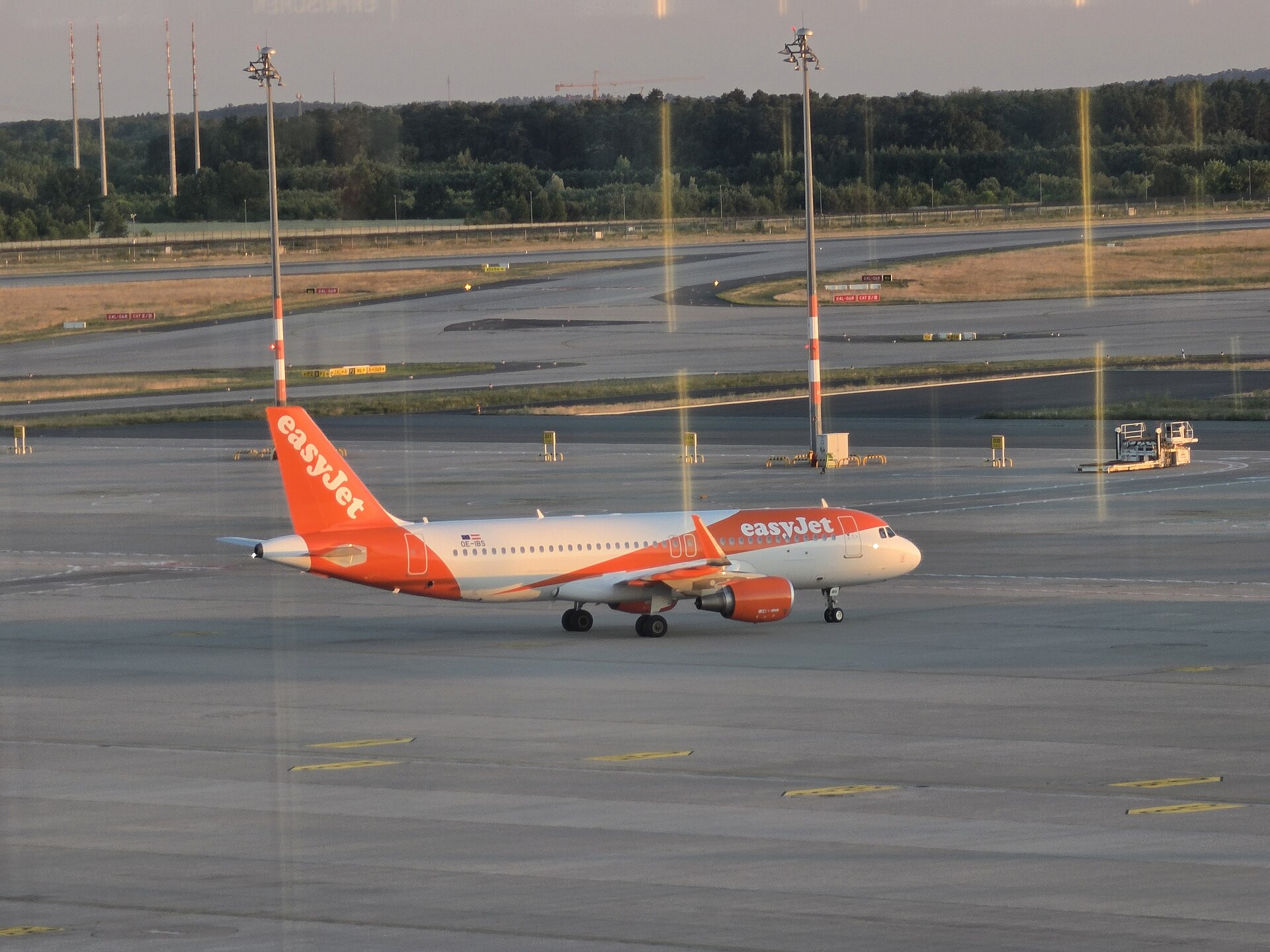
easyJet aircraft taxiing at BER: 2026 at Berlin Brandenburg Airport 25 by NutzerAusBerlin, CC0, via Wikimedia Commons.
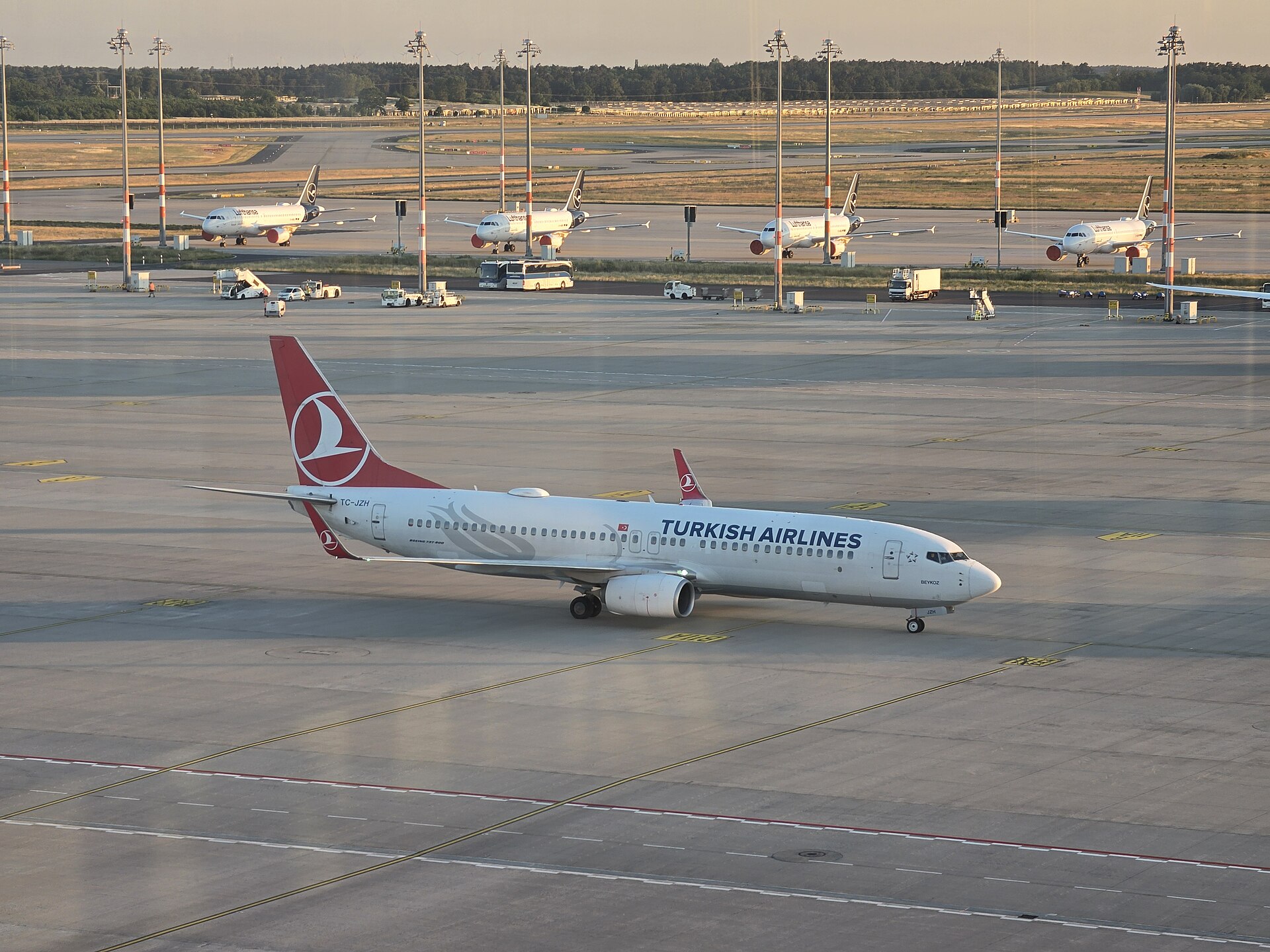
Turkish Airlines aircraft taxiing at BER: 2026 at Berlin Brandenburg Airport 18 by NutzerAusBerlin, CC0, via Wikimedia Commons.
Final Word
BER spent years as a national joke, and its reputation still arrives a few minutes before you do. The reality, for an arriving passenger, is an airport that works: a short walk, a passport check if you need one, a belt, a set of doors, and a station directly below your feet with a train into the centre every few minutes. The only real skill involved is doing things in the right order — report the missing bag before customs, buy the ABC ticket rather than the AB, go down rather than out.
Get those right and you can be standing under the glass roof of Hauptbahnhof within an hour of touching down, which is not something every European capital can promise. Welcome to Berlin.