BER Food & Shopping: What’s Worth Buying Airside
The 24-hour REWE on the station level, the food court, the last currywurst, when duty-free is really cheaper, how to claim your VAT back, and which Berlin souvenirs to buy in town instead.
The best-value meal at Berlin’s airport is not in the food court or the marketplace. It is sold on the station level, a few steps from the ticket machines, by a supermarket that never closes. That is not a joke at the expense of airport catering; it is simply the most useful thing to know before you fly out of BER. Behind security there are around 25 shops, a food court on the gallery and three duty-free stores, and most of what they sell costs noticeably more than it would in the city. So the smartest BER airport food shopping tends to happen before you reach security — and the smartest souvenir shopping happens before you reach the airport at all.
This guide walks through what there is to eat and buy at BER, landside and airside, in Terminal 1 and Terminal 2, and gives an honest verdict on each: the 24-hour supermarket, the food court, the last currywurst, duty-free and when it is actually cheaper, tax-free VAT refunds for non-EU visitors, and which souvenirs to leave for the city. Hours and details were checked in September 2026; outlets change, so treat named shops as a snapshot. For the airport as a whole, start with our complete BER airport guide.
BER Food and Shopping at a Glance
| Where | What is there | Our verdict |
|---|---|---|
| Station level, Terminal 1 (before security) | REWE supermarket and a Kamps bakery, both open 24 hours | The cheapest food at BER, at any hour. Stock up here. |
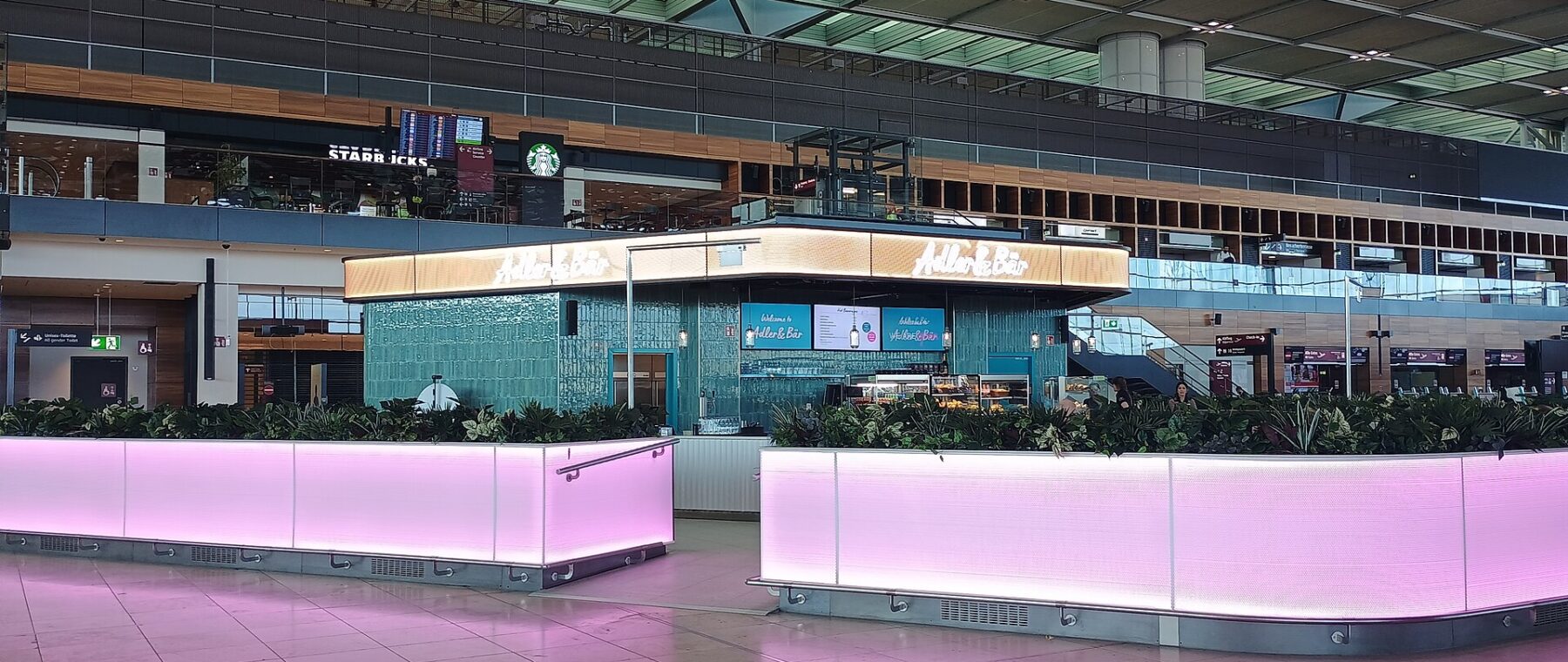
| Check-in hall, Terminal 1 (before security) | Cafés and coffee bars, including a Starbucks on the gallery | Fine for a coffee if you are early; no reason to linger |
| Market Place, Terminal 1 (after security) | Around 25 shops, starting with a large walk-through store | Browse by all means; do not do your souvenir shopping here |
| Food court, Terminal 1 (after security, on the gallery) | Bakeries, coffee, currywurst and German snacks, international fast food, a few sit-down places and bars | The main place to eat airside; airport prices |
| Duty free, Terminal 1 (after security) | Three Heinemann Duty Free & Travel Value shops | Only duty-free if you fly outside the EU; compare with supermarket prices |
| Terminal 2 | A small plaza with a handful of outlets | Eat in Terminal 1 first |
The Golden Rule: Buy Your Food Before Security
Every airport in the world charges more airside than the high street does, and BER is no exception. What BER has that many airports do not is a proper supermarket in the public area, open around the clock at ordinary prices, directly on your route from the train to the check-in hall. If you arrive by rail, you walk right past it.
The REWE on the station level
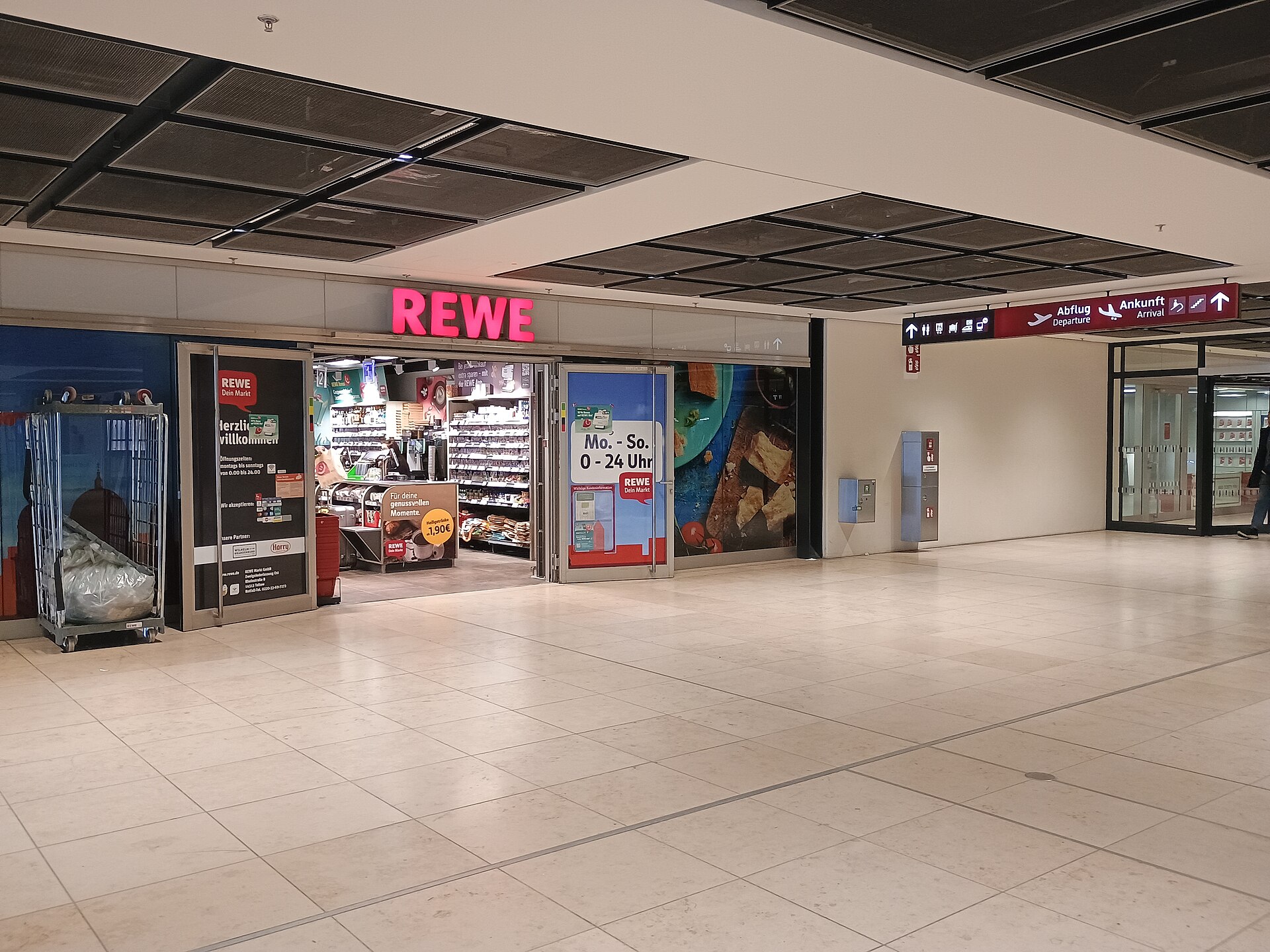
REWE is one of Germany’s big supermarket chains, and the Terminal 1 branch is open 24 hours a day, seven days a week. It sells what any small city supermarket sells: sandwiches and wraps, salads, fruit, yoghurt, crisps, chocolate, cold drinks, beer and wine, and basic toiletries. For a family, a picnic from here instead of a food-court lunch can easily save more than the price of the train ticket to the airport.
Two things to remember. First, food goes through security; drinks do not. Solid food is fine in your hand luggage, but the liquids rules still apply, so a bottle of water bought landside will have to be finished or binned at the checkpoint. Buy the sandwich here, not the drink. Second, soft and spreadable things — yoghurt, hummus, soft cheese, jam — count as liquids at security. Pick firm food.
The Kamps bakery
Next to the station there is also a Kamps bakery, part of a German bakery chain, likewise open around the clock. It is where to find a pretzel, a sweet pastry or a filled roll for the journey, and a coffee to drink before you go upstairs. Nothing here will change your life, but it is quick, it is always open, and at five in the morning it is the most welcome shop in the building.
Water: bring an empty bottle
The simplest saving at BER costs nothing. Pack an empty reusable bottle, carry it through security, and fill it at the free drinking-water dispensers airside, near the washrooms. Bottled water after security is the classic airport mark-up, and there is no need to pay it.
Eating Airside: What to Expect
Once through security in Terminal 1, you arrive in the Market Place, the central shopping area with around 25 shops, and the food court is on the gallery beside it. Between them, they cover the predictable range: bakeries and coffee bars, currywurst and other German snacks, international fast food — Burger King and AsiaGourmet among the familiar names — plus a few sit-down restaurants and bars.
It is all perfectly adequate, and none of it is why anyone visits Berlin. Expect airport prices across the board; a coffee and a pastry airside will cost noticeably more than the same thing in a Kreuzberg café, and a sit-down meal with a beer adds up quickly. The honest verdict: eat your last proper meal in the city, bring a REWE picnic for the wait, and use the food court for a coffee or a hot snack rather than a planned dinner.
The last currywurst
You will find currywurst airside, and if you have somehow reached departure day without eating one, it will do. It will not, however, be the Berlin currywurst experience: that is a paper tray at a stand under the U-Bahn tracks, and the airport version is a pleasant approximation at a higher price. Our guide to the best currywurst in Berlin has the stands worth crossing town for; plan one for your last evening instead.
Vegetarian and vegan
Berlin is one of the easiest cities in Europe to eat meat-free, and its airport is noticeably less so. Choice airside is thinner than in the city, and it helps to be flexible. The REWE is the easy answer, with plenty of plant-based sandwiches, salads and snacks at normal prices. For the real thing, eat before you leave; our vegan restaurants in Berlin guide covers the best of the city.
Flying outside Schengen
If your flight leaves from the non-Schengen area, you will pass through exit passport control after security, which is also where non-EU travellers’ Entry/Exit System records are updated. Queues there vary, so check how long it is before you settle down to eat. Terminal 1’s smokers’ lounge is on level E2, and our BER lounges guide covers when a lounge pass is worth paying for, and when the food court is better value.
Shopping at BER: What Is Worth Buying, and What Is Not
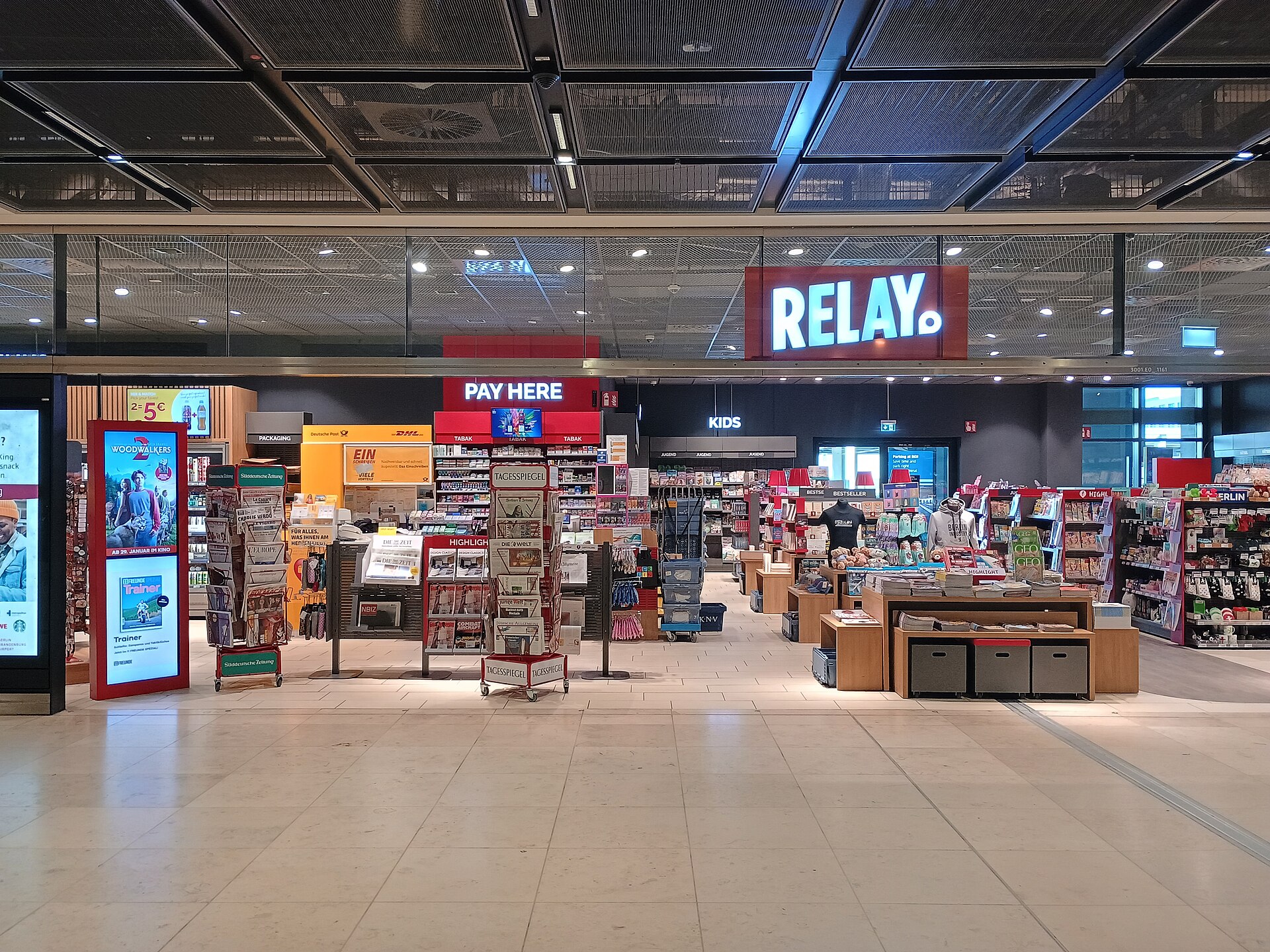
The shopping at BER is the standard international airport mix: newsagents and bookshops, travel goods and electronics, fashion and accessories, sweets, souvenirs, and the duty-free stores. The walk-through shop you enter straight after security is designed so that you cannot avoid it; that is the point of it, and you are under no obligation to slow down.
Some things are genuinely worth buying at the airport, and others are much better bought in town:
| Item | Buy at BER? | Better idea |
|---|---|---|
| Phone charger, adapter, headphones | Yes, if you forgot them | — |
| Books, magazines, a neck pillow | Yes | — |
| Snacks and a sandwich | Yes, from the REWE before security | Not from the food court |
| Bottled water | No | Empty bottle, free dispensers airside |
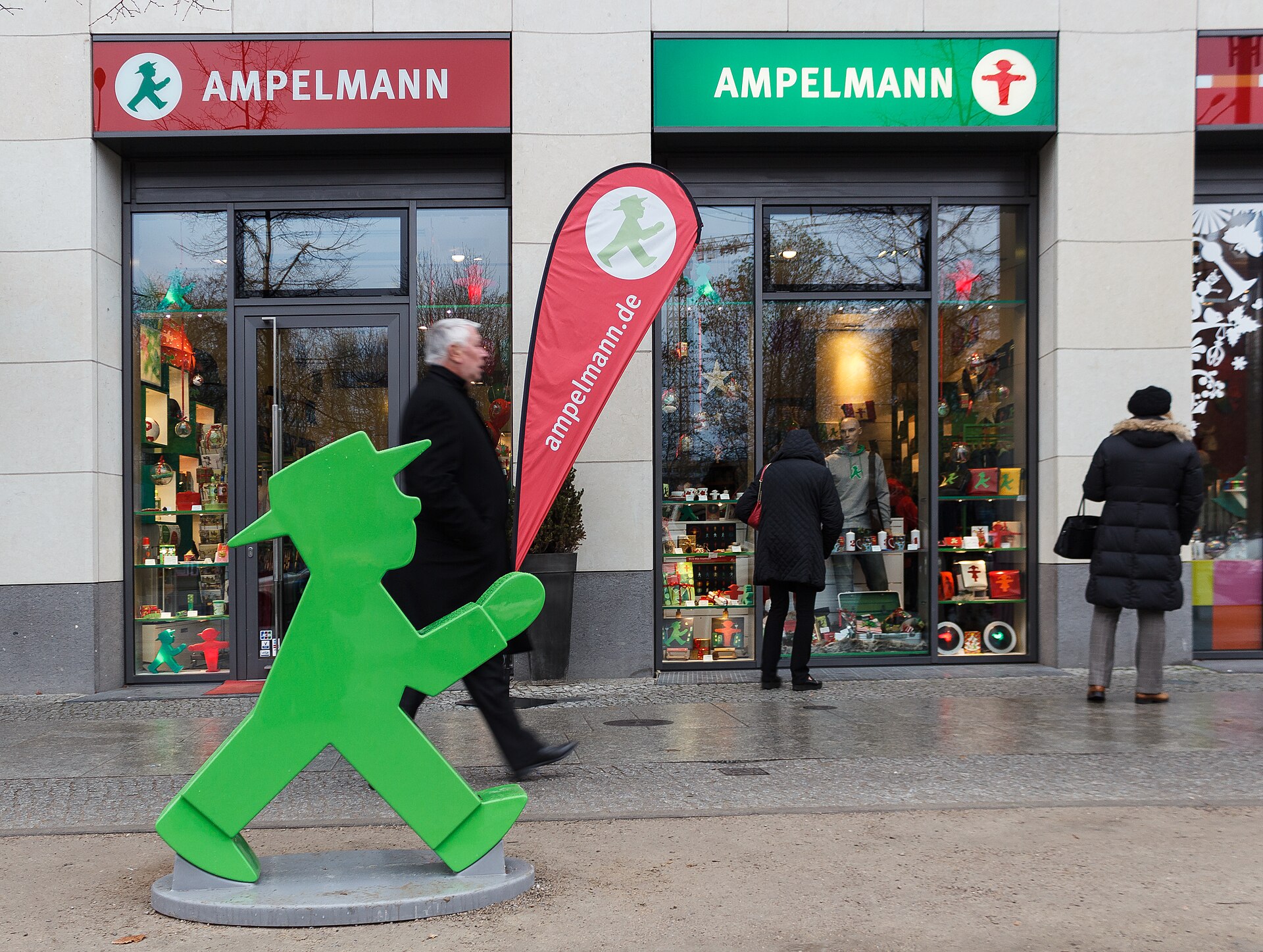
| Ampelmann souvenirs | Only as a last resort | Ampelmann’s own shops in the city have the full range |
| Chocolate gifts | Only if you forgot | Rausch Schokoladenhaus near Gendarmenmarkt |
| Curry powder for currywurst | No | From the currywurst stands themselves |
| Wine, beer, spirits | Only duty-free outside the EU, and compare | A German supermarket, often cheaper |
| “Berlin Wall” fragments | No | Think hard about authenticity wherever you buy one |
Our guide to the best souvenirs from Berlin goes through what is worth taking home and where to find the real thing, and our Berlin shopping guide covers the city’s streets, department stores and markets.
The Supermarket Souvenir
Here is a small secret that Berliners returning from abroad know well: some of the best edible souvenirs cost a couple of euros in any German supermarket, the one at the airport included. They are not glamorous, but they are the things people genuinely miss, and they travel well.
- Chocolate and biscuits. Ritter Sport in flavours you never see abroad, Leibniz butter biscuits, and Sarotti, a chocolate brand with Berlin roots. All solid, all fine in hand luggage.
- Haribo and friends. The German sweet aisle is a revelation to anyone who has only seen the export range.
- Lebkuchen and Christmas biscuits, from autumn onwards, in tins that survive a suitcase.
- Spreewald gherkins, the pickled cucumbers from the wetlands south-east of Berlin, in jars — which count as liquids, so pack them in your checked bag.
- Berliner Luft, the peppermint liqueur that turns up at every Berlin party, and Club-Mate, the caffeinated drink the city’s clubs and coders run on. Both are liquids too: buy them in town and pack them in the hold.
The trick is to do the liquid part of this shopping in the city, where you can pack the jars and bottles into your checked luggage wrapped in a jumper, and to leave only the solid treats for the REWE on your way to check-in. If the Spreewald gherkins appeal, the Spreewald day trip lets you eat them where they are made.
Duty Free, Explained Honestly
Heinemann runs the duty-free business at BER, with three Duty Free & Travel Value shops airside in Terminal 1. The first thing to understand is that duty-free is only duty-free if you are flying out of the EU. Intra-EU duty-free shopping was abolished in 1999, so if you are flying from Berlin to Paris, Madrid or Vienna, the same shelves are sold to you at normal German prices, tax included. The boarding pass you show at the till decides which price you pay.
If you are flying to the United Kingdom, the United States, Turkey, Switzerland or anywhere else outside the EU, duty-free prices apply. Even then, check before you assume you are getting a bargain. Germany’s supermarkets are cheap for wine, beer and spirits by European standards, and a bottle from the REWE downstairs can cost the same as, or less than, its duty-free equivalent. Duty-free tends to be better value on tobacco, on large-format spirits and on premium brands, and it is the only way to carry a full-size bottle of spirits or perfume on board in your hand luggage.
- Liquids bought airside are sealed in a tamper-evident bag with the receipt. Do not open it before you reach your final destination, particularly if you have a connection, and check the rules at the connecting airport before you buy.
- Your home country’s allowances still apply when you land. Duty-free at BER only means you have not paid German tax; it does not mean your own customs will wave through six bottles of gin.
BER and Heinemann have announced plans to redesign the heart of Terminal 1, expanding the airside marketplace to around 3,800 square metres with duty-free shopping, restaurants and new passenger areas overlooking the apron. Expect changes, and possibly some building work, over the coming years.
Tax-Free Shopping: Getting Your VAT Back at BER
Visitors who live outside the EU can reclaim German VAT on goods they take home in their luggage. The standard rate is 19%, with 7% on some goods such as food and books, and it adds up quickly on a camera, a coat or a piece of KPM porcelain. The process is straightforward, but it has to be done in the right order:
- In the shop, ask for a tax-free form at the till and show your passport. The purchase must be over €50 on a single receipt, and the shop must take part in a refund scheme; most larger shops and department stores do.
- At the airport, before you check your bag in, take the goods, the receipts, the form, your passport and your boarding pass to customs (Zoll) for the export stamp. The goods must be with you, ready to show, and must leave the EU within three months of the end of the month you bought them.
- If the goods are in your hand luggage and you connect through another EU airport, the stamp is done at the last EU airport you leave from, not at BER.
- Claim the refund from the refund company, at its desk or by post or online, as the form explains.
Two honest notes. The refund company takes a fee, so what you get back is a good deal less than the full 19%, and on a modest purchase the effort may not be worth it. And the customs check needs time: arrive earlier than usual if you have goods to present, and ask at an information desk if you cannot find the customs office in Terminal 1.
Terminal 2: Eat in Terminal 1 First
Terminal 2 is essentially a check-in and security building for low-cost airlines, and its shops and cafés reflect that: a small plaza after security and a handful of outlets. If your flight leaves from Terminal 2, arrive by train at Terminal 1 as everyone does, do your food shopping at the REWE or the bakery on the station level, and then walk the five minutes across. Our BER terminals guide explains how the two buildings connect.
A Last Hour at BER That Works
Here is the routine we would suggest for a relaxed departure from Terminal 1, on a budget and without missing anything worthwhile:
- Arrive by train and come up from the platform to the station level.
- Stop at the REWE or the Kamps bakery for firm food for the journey. Skip the bottled drinks.
- Check in, and if you are claiming a VAT refund on goods in your checked bag, get the customs stamp before you drop it.
- Clear security, fill your empty bottle at a water dispenser, and walk through the Market Place at your own pace.
- Find your gate first, then come back for a coffee in the food court if there is time. Some gates are a proper walk from the centre.
- Buy duty-free only if you are leaving the EU, and only after comparing the price with what you remember from the supermarket.
Frequently Asked Questions
Is there a supermarket at BER?
Yes. A REWE supermarket in the public area of Terminal 1, on the station level, is open 24 hours a day, seven days a week, at normal supermarket prices. There is also a Kamps bakery nearby, likewise open around the clock.
Can I take food through security at BER?
Yes, solid food is fine in hand luggage. Drinks and anything spreadable or runny count as liquids and are subject to the usual limits, so buy firm food before security and drinks after it, or bring an empty bottle to fill airside.
Is duty-free cheaper at BER?
Only if you are flying outside the EU, and not always even then. On flights within the EU you pay normal German prices. German supermarkets are cheap for alcohol, so compare before you buy; duty-free is better value on tobacco and some premium spirits.
Where do I get my tax-free form stamped at BER?
At customs (Zoll) in Terminal 1, before you check in the bag containing the goods. Bring the unused goods, receipts, the tax-free form, your passport and your boarding pass, and allow extra time. If the goods are in your hand luggage and you connect through another EU airport, get the stamp there instead.
Can I buy Berlin souvenirs at the airport?
Yes, but the range is small and the prices are no better. Ampelmann’s own shops, the Rausch chocolate house near Gendarmenmarkt and the city’s markets are much better places to buy.
What is there to eat in Terminal 2?
Not much: a few outlets around a small plaza. Eat or buy food in Terminal 1, at the REWE or the bakery on the station level, before walking across.
Related Berlin Guides
- BER Airport: The Complete Guide
- BER Terminals 1 and 2 Explained
- BER Airport Lounges
- Sleeping Overnight at BER
- A Layover at BER
- The Best Souvenirs From Berlin
- Shopping in Berlin
- The Best Currywurst in Berlin
- Cheap Food in Berlin
- Berlin Budget Tips
Photo Credits
Check-in hall of Terminal 1 with cafés on the gallery: (20260318) BER Airport Terminal 1, empty due to strike 21 by Roy Zuo, CC BY-SA 4.0, via Wikimedia Commons.
Relay shop in Terminal 1: (20260318) BER Airport Terminal 1, empty due to strike 27 by Roy Zuo, CC BY-SA 4.0, via Wikimedia Commons.
Ampelmann shop in Berlin: Ampelmann Shop Karl-Liebknecht Strasse 2013-11-24 by Slaunger, CC BY-SA 3.0, via Wikimedia Commons.
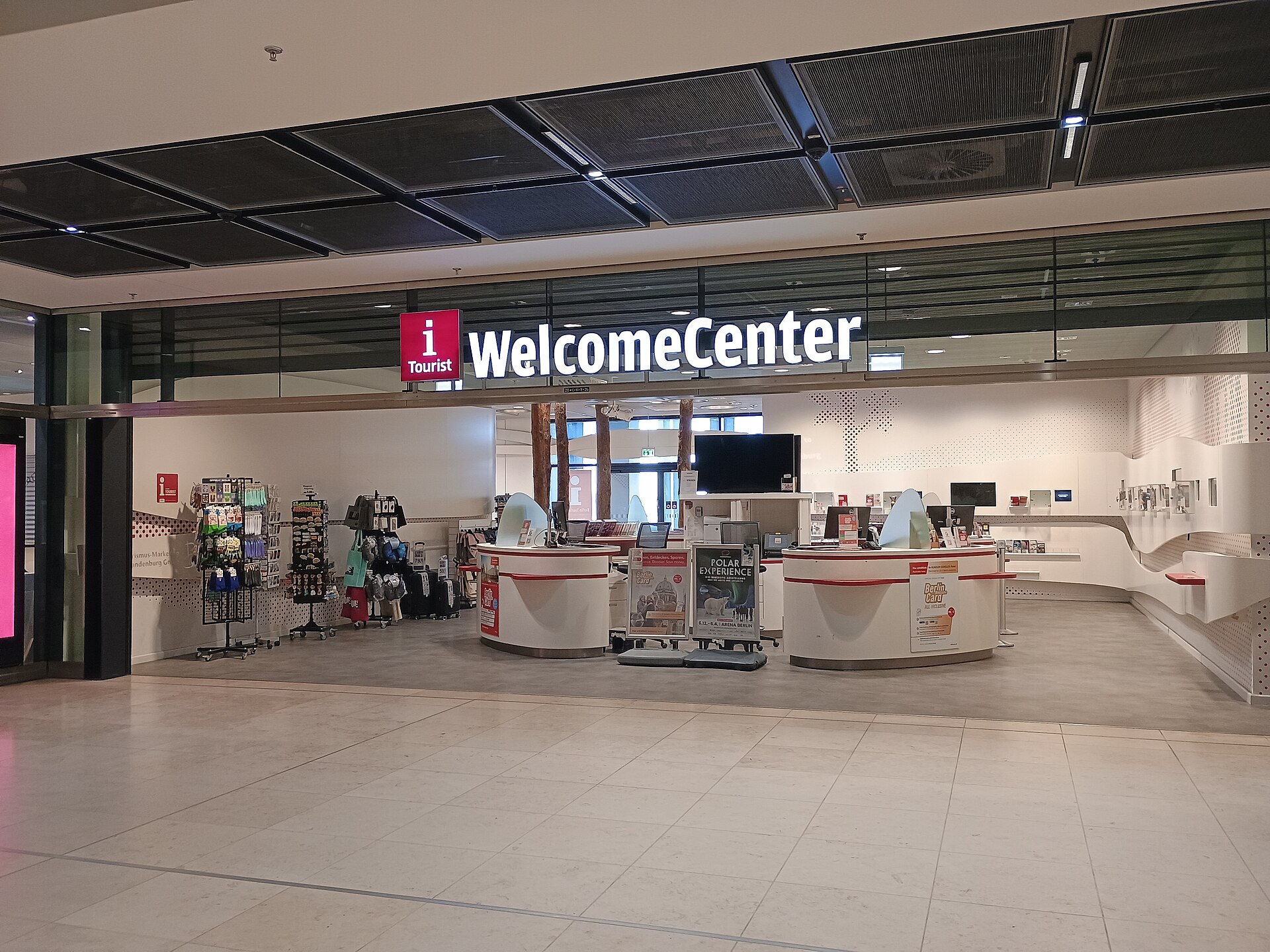
WelcomeCenter in Terminal 1: (20260318) BER Airport Terminal 1, empty due to strike 24 by Roy Zuo, CC BY-SA 4.0, via Wikimedia Commons.
Final Word
Nobody should plan to spend money at BER, and happily nobody has to. The airport’s most valuable shop is a supermarket on the station level that sells sandwiches at city prices at three in the morning; its most useful habit is an empty water bottle; and its duty-free only earns the name if your boarding pass says you are leaving the EU.
Do your real shopping in Berlin — the Ampelmann shops, the chocolate, the markets, the last currywurst at a proper stand — and treat the airport as what it is: a place to pick up the charger you forgot, a paperback for the flight and a coffee at the gate. That is not a criticism of BER. It is just the best way to leave Berlin with more money and better souvenirs.