Charlottenburg Guide: Old West Berlin, Still Elegant
The bombed church and its blue-glass twin, the Ku'damm, the palace and its free gardens, Kantstraße's noodle bars and the Funkturm at 100 — what old West Berlin is like today.
Charlottenburg has a way of making first-time visitors to Berlin a little suspicious. The pavements are wide and swept. Women of a certain age walk small dogs past jewellers. The apartment buildings have doormen’s lodges and marble stairwells, the cafés have tablecloths, and nobody on Savignyplatz appears to have been up all night. After a few days in Kreuzberg or Friedrichshain, it can feel like a different city — which, until 1920, it literally was. A good Charlottenburg Berlin guide has to explain why the old West still looks like this, and why it is worth a day of anybody’s trip rather than being written off as the place where the tour buses start.
This page covers what Charlottenburg is actually like: the Kurfürstendamm and the bombed church at its head, the palace and the museums across the road from it, the streets around Savignyplatz, Kantstraße’s long run of Asian restaurants, the Funkturm in its centenary year, and the quieter corners behind them. Prices and opening hours were checked in September 2026; treat them as the right order of magnitude. For how Charlottenburg compares with the other districts, see our Berlin neighbourhoods guide.
Charlottenburg at a Glance
| Place | What it is | Cost (Sept 2026) | Time needed |
|---|---|---|---|
| Kaiser Wilhelm Memorial Church | Bombed tower plus 1960s blue-glass church | Free (€5 donation suggested) | 30–45 min |
| Kurfürstendamm | West Berlin’s great shopping boulevard | Free to walk | 1–2 hours |
| Charlottenburg Palace | Largest Hohenzollern palace in Berlin | €12 single; gardens free | 2–3 hours |
| Bröhan-Museum, Scharf-Gerstenberg | Art Nouveau and Surrealism opposite the palace | Check current prices | 1 hour each |
| Savignyplatz and Kantstraße | Bookish square, restaurants, Berlin’s Asian food street | Dinner €15–35 | An evening |
| Funkturm | 1926 radio mast with an observation deck | Check current price | 45 min |
| Olympiastadion | 1936 stadium, still in use | €11 self-guided; guided price on the stadium’s site | 1–1.5 hours |
| Lietzensee | Small lake park between the palace and the Messe | Free | 30 min stroll |
What Kind of Place Charlottenburg Is
For two centuries Charlottenburg was a town of its own west of Berlin, growing up around the summer palace that Elector Frederick III built for his wife, Sophie Charlotte, at the end of the seventeenth century. When she died in 1705 the palace and the settlement took her name. By the time Greater Berlin swallowed it in 1920, Charlottenburg was reputedly the richest town in Prussia: the home of bankers, industrialists, professors and the successful end of the arts, living in grand apartment buildings along boulevards laid out to rival Paris.
Then came the division of the city. With the historic centre in Mitte on the Soviet side, West Berlin needed a downtown, and Charlottenburg became it. For forty years the area around Bahnhof Zoo, the Kurfürstendamm and Breitscheidplatz was the shop window of the West — neon, department stores, cinemas, cabaret, the Europa-Center with a revolving Mercedes star on its roof, all of it a deliberate advertisement to the East. It was also, as anybody who has read or watched Christiane F. knows, the station where West Berlin’s runaways and addicts gathered.
After 1990 the energy moved east almost overnight, and for twenty years the “City West” had the faintly abandoned air of a place that used to be important. Since the 2010s it has pulled itself back up: the Zoofenster and Upper West towers went up by Breitscheidplatz, the Bikini-Haus reopened as a concept mall, and the Kurfürstendamm regained its luxury tenants. Today Charlottenburg is the settled, prosperous, older, and — it has to be said — somewhat less surprising half of central Berlin. It is also where a great many Berliners would quietly choose to live if they could afford it.
A note on names: the borough is officially Charlottenburg-Wilmersdorf, merged in 2001. When people say “Charlottenburg” they generally mean the old town from the Tiergarten edge to the palace, plus Westend beyond it. That is the area this guide covers.
Breitscheidplatz and the Kaiser Wilhelm Memorial Church
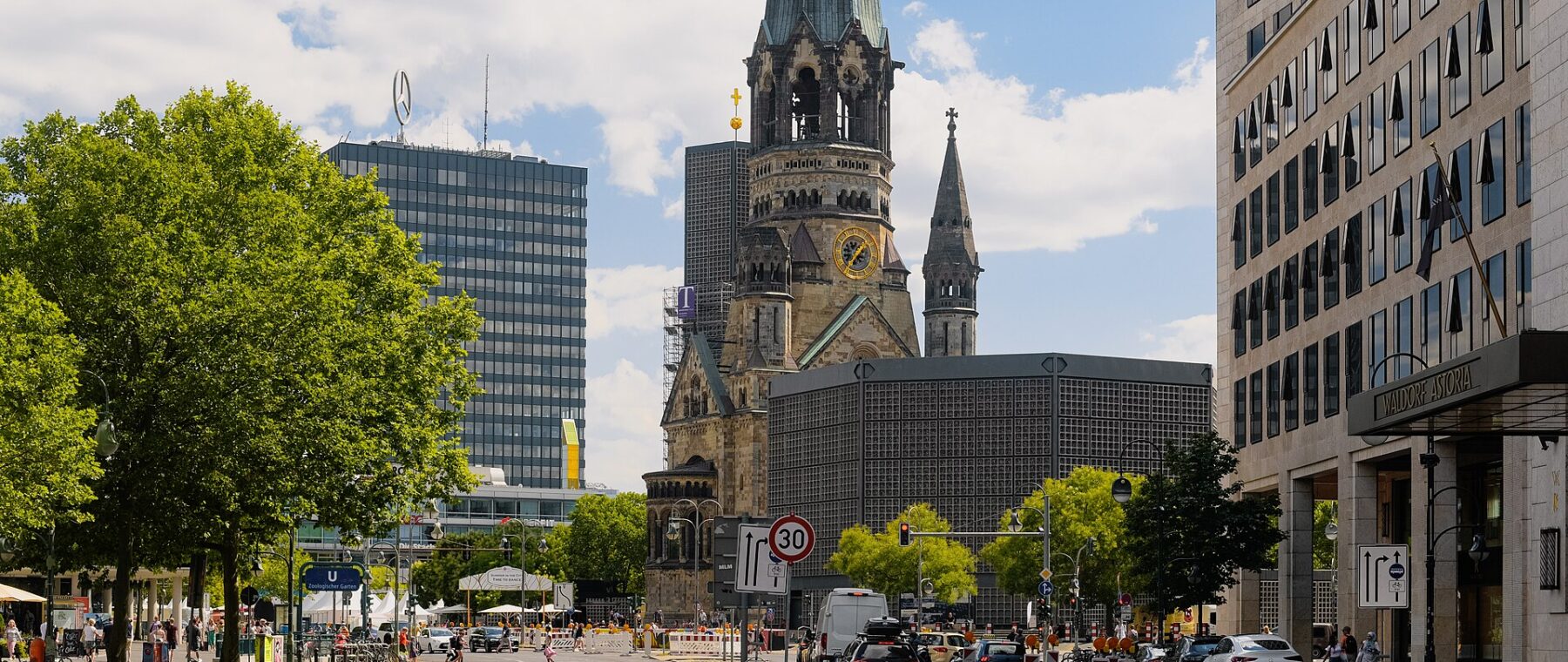
Get off at Zoologischer Garten, walk three minutes south, and you meet the single most famous image of West Berlin: the broken tower of the Kaiser-Wilhelm-Gedächtniskirche, jagged at the top like a snapped tooth, flanked by two uncompromising modernist blocks of blue glass.
The original church went up between 1891 and 1895, a neo-Romanesque memorial to Emperor Wilhelm I commissioned by his grandson Wilhelm II. RAF bombs wrecked it on the night of 23 November 1943. In the 1950s the city planned to clear the ruin completely, and Berliners protested so hard that the architect Egon Eiermann was made to keep the tower. Between 1959 and 1963 he built a new octagonal church and a hexagonal bell tower beside it, their walls made of more than 20,000 small panes of deep blue glass set in concrete. Berliners, never ones to pass up a nickname, call the ensemble the hollow tooth, the lipstick and the powder compact.
What to see inside
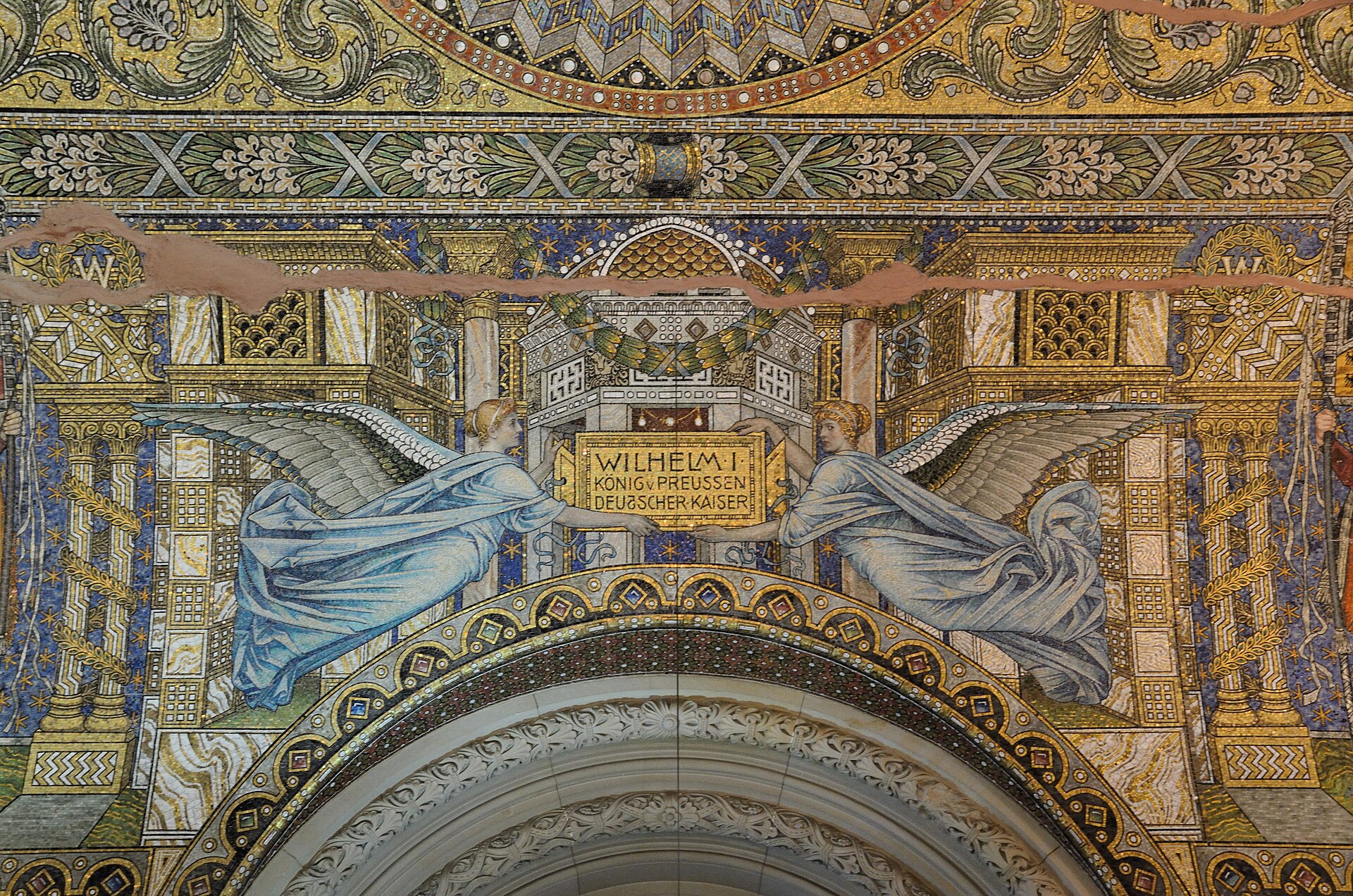
- The Memorial Hall in the base of the old tower is the reason to go. The surviving ceiling mosaics — Hohenzollern emperors in procession, angels and gold ground — are still split by cracks from the bombing, and there is a small exhibition on the church’s history and destruction. Note that from 11 May 2026 the hall is closed on Mondays.
- The new church is the surprise. From outside it looks like a grey grid; inside, on a sunny day, it is a room of deep, glowing blue light, with a huge golden figure of Christ hovering over the altar. Sit for five minutes and the traffic outside disappears.
- The Stalingrad Madonna, a charcoal drawing made by a German army doctor and pastor, Kurt Reuber, in the encircled city at Christmas 1942, hangs in the new church. It is small, moving and easy to miss.
The church is open Monday to Saturday 10:00–18:00 and Sunday 11:00–18:00, with last entry at 17:45; it closes on Good Friday. Entry and public tours are free, with a suggested donation of around €5. It is a working church, so services take precedence.
The golden crack on the steps
On 19 December 2016 a terrorist drove a stolen lorry into the Christmas market on Breitscheidplatz, killing twelve people on the night; a thirteenth victim died later of his injuries. The memorial is a crack in the ground, filled with gold-coloured metal, running down the church steps and across the square, with the victims’ names cut into the step edges. It is easy to walk over without noticing, which is part of its design. The Christmas market still takes place here each Advent, now behind permanent barriers.
The Kurfürstendamm
The Kurfürstendamm — the Ku’damm to everyone — runs about three and a half kilometres south-west from Breitscheidplatz. Bismarck had it laid out as a grand boulevard in the 1880s with the Champs-Élysées explicitly in mind, and it is still lined with the plane trees, wide pavements and big turn-of-the-century buildings of that ambition.
Its eastern kilometre, from the church to around Uhlandstraße, is the commercial core: international chains, flagship stores, and on the corner of Joachimsthaler Straße the red-and-white striped awning of the old Café Kranzler, a rotunda from the 1950s that was once the most famous café in West Berlin. Further west, between Fasanenstraße and Olivaer Platz, the Ku’damm moves upmarket, with the luxury fashion houses in the grand old buildings on either side. Past Adenauerplatz it quietens into an elegant residential avenue.
Is it worth walking? For an hour, yes — it gives you a physical sense of how different the old West Berlin was from the East, and the side streets are lovely. As a shopping destination it is essentially a very good high street plus a luxury strip, and if that is what you are after our Kurfürstendamm and KaDeWe shopping guide covers it properly. KaDeWe itself, strictly speaking, stands just over the border in Schöneberg, at the eastern end of Tauentzienstraße, a ten-minute walk from the church.
Bikini Berlin and the zoo
Across Budapester Straße from the church, the 1950s Bikini-Haus — named for the open-air gap that once separated its upper and lower floors — reopened in 2014 as a mall of smaller design-led shops. The reason to go in is the big window at the back, which looks straight down into the monkey enclosure of the Berlin Zoo next door. The zoo and its aquarium, the oldest in Germany and the most species-rich in the world by some counts, are covered in our Berlin Zoo and Aquarium guide.
Fasanenstraße and the Side Streets
The best thing on the Ku’damm is the streets that cross it. Fasanenstraße, running south from the boulevard, is the handsomest, with a row of nineteenth-century villas set back behind front gardens. The Literaturhaus Berlin occupies one of them, with a café in its conservatory and garden that is one of the most civilised places in the city to eat a slice of cake. The old Käthe Kollwitz Museum used to be next door; in 2022 it moved to the Theaterbau beside Charlottenburg Palace, so do not be misled by older guides.
North of the Ku’damm on the same street stands the Jewish Community Centre, built in 1959 on the site of the great Fasanenstraße synagogue, which was burned on the night of 9 November 1938. Fragments of the synagogue’s portal were set into the new building’s façade. Our Jewish history in Berlin guide places it in the wider story.
Photography: C/O Berlin and the Helmut Newton Foundation
Charlottenburg is Berlin’s photography district. C/O Berlin fills the 1950s Amerika Haus on Hardenbergstraße with big international photography exhibitions and is consistently one of the best-curated exhibition spaces in the city. Directly behind Zoo station, the Museum für Fotografie houses the Helmut Newton Foundation, with a permanent display on Newton — who was born in Berlin and left as a Jewish teenager in 1938 — and rotating shows. Check both websites for current exhibitions and prices; for more galleries see our contemporary art galleries guide.
Savignyplatz and Kantstraße
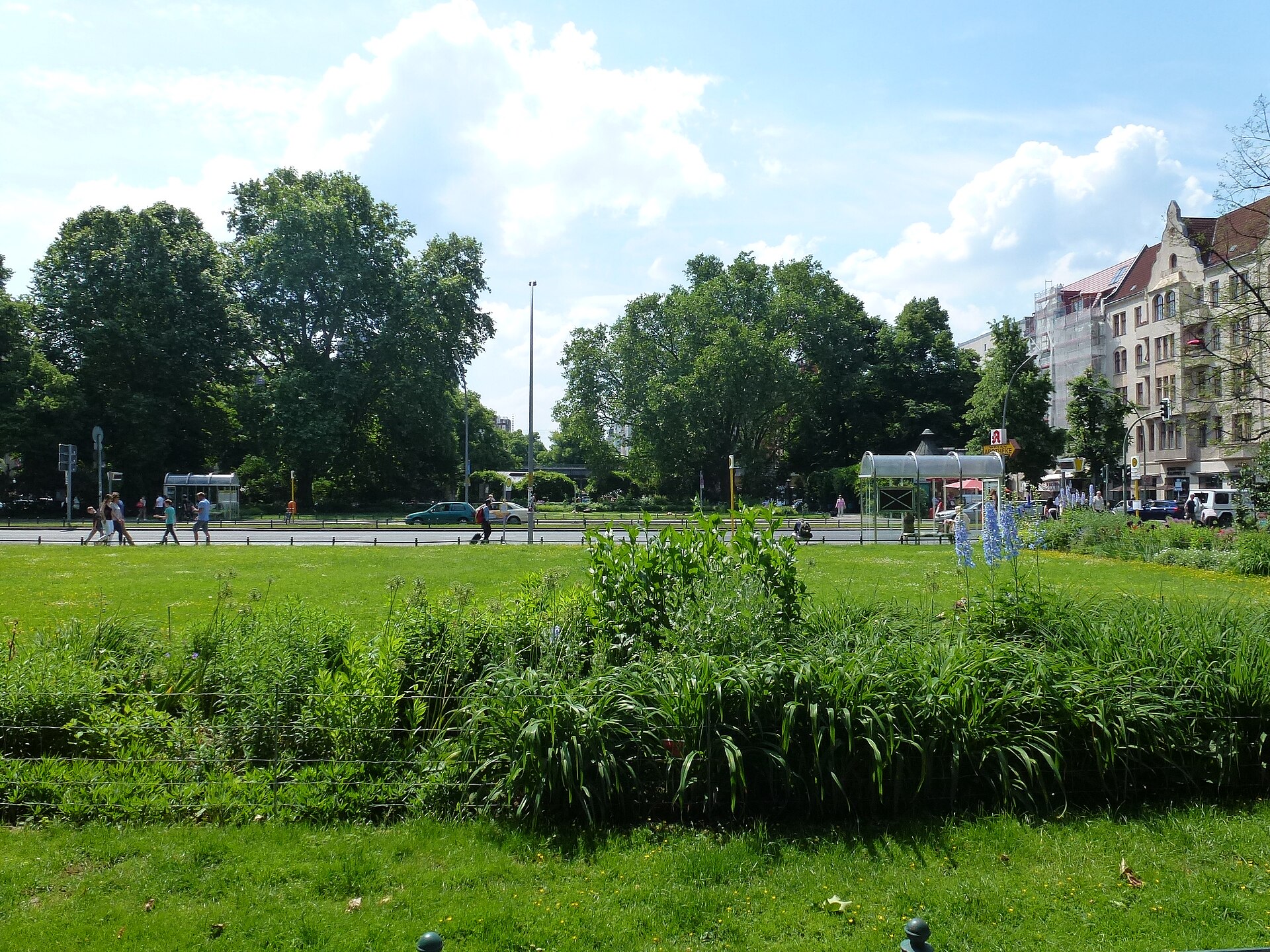
If Charlottenburg has a heart that is not a monument, it is Savignyplatz. The square itself is a modest pair of lawns, but the streets around it — Grolmanstraße, Knesebeckstraße, Carmerstraße — and the brick arches of the S-Bahn viaduct just to the north hold the district’s best concentration of bookshops, wine bars, Italian restaurants and old-fashioned Berlin pubs. For decades this was where West Berlin’s writers, film people and journalists ate and argued, and some of that intelligentsia atmosphere survives, particularly late in the evening. The legendary Paris Bar on Kantstraße, with its walls of art, is still going, though its prices assume you have sold a painting recently.
It is the part of Charlottenburg where the district feels most like a neighbourhood rather than a showroom, and it is a lovely place to spend a long evening. Nothing about it is cheap, but nothing about it is a trap either.
Kantstraße: Berlin’s Asian food street
West of Savignyplatz, Kantstraße becomes something Berliners half-jokingly call Chinatown. For several blocks towards Wilmersdorfer Straße it is lined with Chinese, Vietnamese, Taiwanese, Thai and Korean restaurants, supermarkets and bubble-tea shops, with a quality and range — hand-pulled noodles, Sichuan hotpot, Cantonese roast meats, dim sum — that the rest of the city struggles to match. Main dishes mostly run €10–18. It is one of the best reasons to be in West Berlin in the evening, and very few visitors know about it.
Along the same street, the Theater des Westens — a gloriously overwrought 1896 theatre building — stages the big touring musicals, and further west on Bismarckstraße the Deutsche Oper Berlin is the city’s largest opera house, a blunt 1961 building with an excellent company. For both, see our art and culture itinerary.
Charlottenburg Palace and Its Neighbours

Two kilometres north-west, Schloss Charlottenburg is the largest surviving Hohenzollern palace in Berlin and the district’s great set piece. We cover it room by room in our Charlottenburg Palace guide, so here are only the essentials:
- A single ticket, €12, gets you into either the Old Palace or the New Wing, not both. The Charlottenburg+ ticket covers the whole palace plus the smaller buildings in the grounds.
- The audio guide is included. Highlights are the Porcelain Cabinet, the Golden Gallery and the White Hall.
- Opening hours are 10:00–17:30 from April to October and 10:00–16:30 from November to March. Allow about two hours.
- The palace gardens are free, and on a fine day they are one of the best free things in western Berlin: a formal baroque parterre, then an English landscape park running down to the Spree, with the Mausoleum of Queen Luise and the Belvedere tea house among the trees.
The honest verdict: if you only have time for one palace in the Berlin area, most people should make it Sanssouci in Potsdam instead — see our Potsdam day trip guide. If you are staying in the city, Charlottenburg is a very good second best and an easier half-day.
The museums across Schloßstraße
Opposite the palace, two identical domed officers’ barracks by Friedrich August Stüler face each other across Schloßstraße. The eastern one holds the Museum Berggruen — Picasso, Klee, Matisse and Giacometti — which is closed for a full renovation, so check the museum’s own site for the reopening date before you plan around it. The western barracks and its annex house the Sammlung Scharf-Gerstenberg, a collection of Surrealist and fantastic art from Piranesi to Magritte and Dalí that deserves more visitors than it gets.
A few doors south, the Bröhan-Museum is a gem for anyone who likes Art Nouveau and Art Deco furniture, glass and design, displayed in period room sets. And beside the palace, in the former palace theatre, the Käthe Kollwitz Museum now shows a major collection of the artist’s prints, drawings and sculptures. Check each museum’s own site for current prices before you go.
Klausenerplatz and Lietzensee
Behind the museums, the streets around Klausenerplatz form a small, quiet, tree-lined neighbourhood of restored tenements that most visitors walk straight past on the way to the palace. Further south, Lietzensee is a narrow lake in a steep-sided park framed by apartment blocks. It is the kind of place Berliners walk the dog rather than a sight in its own right, and it is a pleasant way to walk between the palace and the Funkturm.
Westend: The Funkturm, the Olympiastadion and Le Corbusier
The Funkturm
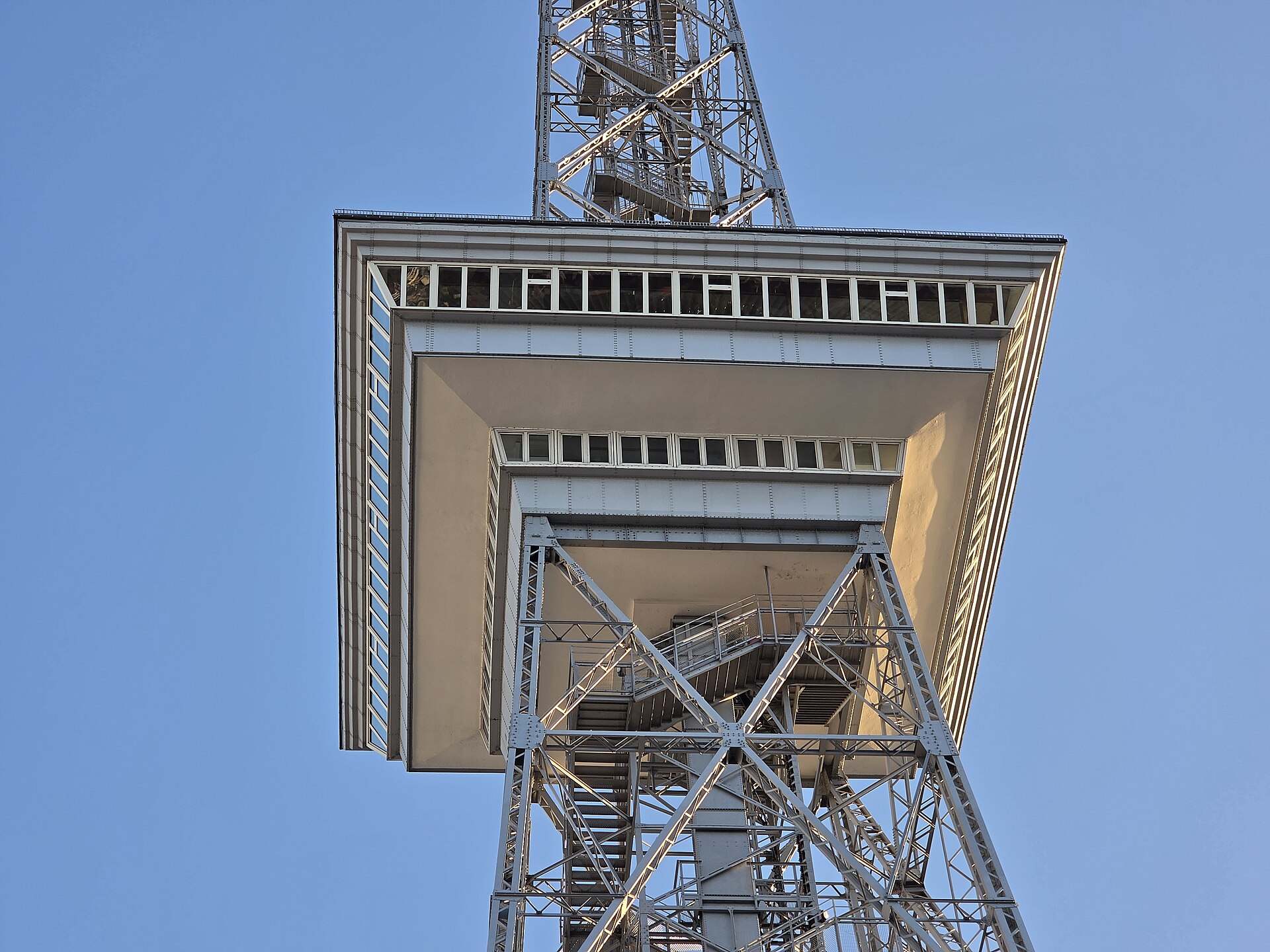
The Funkturm, the steel radio mast beside the trade-fair grounds, was inaugurated on 3 September 1926 and celebrated its centenary this year. Berliners call it the Langer Lulatsch, roughly “the lanky beanpole”. It was West Berlin’s answer to the TV Tower before the TV Tower existed, and it is a very different kind of viewpoint: open, windy, low enough to see detail, and pointed at the western half of the city rather than the eastern.
After a ten-month renovation, the tower reopened in March 2026. The observation platform is open Tuesday to Sunday, 11:00–21:00, and the restaurant partway up opens on Friday and Saturday evenings, 18:00–22:00. Check the current admission price with Messe Berlin before you go. Our best views in Berlin guide compares it with the city’s other viewpoints; the short version is that it is cheaper-feeling, less crowded and more characterful than the TV Tower, with a less famous skyline.
Directly beneath it sits the ICC Berlin, a vast silver 1970s congress centre that looks like a docked spaceship and has been closed for regular use since 2014 while the city argues about what to do with it. It opens occasionally for events and is worth a look from the outside if you like your architecture extreme.
Olympiastadion
Built for the 1936 Olympics and still very much in use — it is Hertha BSC’s home and hosted the 2024 European Championship final — the Olympiastadion is at once a working stadium and one of the most important surviving pieces of Nazi architecture in Germany. A self-guided visit costs €11, covering the bowl and main entrance; the English guided tour, priced on the stadium’s own site, goes into the VIP areas, the changing rooms and the underground warm-up hall. The guided tour is the better buy, because the context is what makes the place. Take the U2 to Olympia-Stadion or the S3/S9 to Olympiastadion.
Le Corbusier’s Unité d’Habitation
A ten-minute walk south of the stadium, the Corbusierhaus is Le Corbusier’s 1950s Berlin version of his Marseille Unité d’Habitation, a vast slab of more than 500 flats built for the 1957 Interbau exhibition. It is a private residential building, so you are looking from outside. Worth the detour for architecture lovers only.
A Day in Charlottenburg
- 09:45 — Breitscheidplatz. Memorial Hall and the blue church before the crowds (not Monday, when the hall is shut).
- 11:00 — Walk the Ku’damm west to Fasanenstraße; coffee in the Literaturhaus garden.
- 12:30 — Bus M45 or 109 from the Zoo area to the palace (or U7 to Richard-Wagner-Platz and walk ten minutes).
- 13:00 — Lunch near Klausenerplatz, then Charlottenburg Palace, one wing.
- 15:30 — Free palace gardens down to the Spree, or the Scharf-Gerstenberg collection across the road.
- 17:00 — Funkturm platform for the late-afternoon light (not Monday).
- 19:30 — Dinner on Kantstraße, then a drink around Savignyplatz.
One excellent budget trick: the 100 and 200 buses both start near Zoologischer Garten and run east through the Tiergarten past many of Berlin’s major sights to Alexanderplatz, on an ordinary AB ticket. Sit upstairs at the front of the double-decker for the cheapest sightseeing tour in the city. Our Berlin transportation guide covers the routes.
Getting Around Charlottenburg
- Zoologischer Garten is the main hub: S-Bahn S3, S5, S7 and S9 on the east–west Stadtbahn, and the U2 and U9.
- U1 and U9 stop at Kurfürstendamm; the U1 also at Uhlandstraße, at the upmarket end of the boulevard.
- S-Bahn Savignyplatz is one stop west of Zoo, and S-Bahn Charlottenburg one more, by Stuttgarter Platz.
- U2 runs west along Bismarckstraße and Kaiserdamm: Deutsche Oper, Sophie-Charlotte-Platz (15 minutes’ walk to the palace), Kaiserdamm (for the Funkturm and Lietzensee) and on to Olympia-Stadion.
- U7 crosses the district north–south: Richard-Wagner-Platz (closest U-Bahn to the palace), Bismarckstraße, Wilmersdorfer Straße and Adenauerplatz.
- Ring S-Bahn S41/S42 stops at Messe Nord/ICC and Westend.
Everything here is in zone A or B. For tickets see our BVG tickets guide.
What It Costs
| Item | Typical price (September 2026) |
|---|---|
| Kaiser Wilhelm Memorial Church | Free; ~€5 donation suggested |
| Charlottenburg Palace, single ticket | €12 (one wing) |
| Palace gardens | Free |
| Olympiastadion | €11 self-guided; guided tour price on the stadium’s site |
| Coffee and cake in a Ku’damm-area café | €8–12 |
| Noodle dinner on Kantstraße | €12–20 |
| Dinner for two with wine around Savignyplatz | €80–120 |
Charlottenburg is noticeably more expensive to eat and drink in than the eastern districts, though not by as much as its reputation suggests — Kantstraße and Wilmersdorfer Straße both have plenty of good, cheap food. For more ways to keep costs down, see Berlin on a budget.
Frequently Asked Questions
Is Charlottenburg worth visiting?
Yes, for at least a day. It has the Kaiser Wilhelm Memorial Church, Charlottenburg Palace, the Kurfürstendamm, some of the best food in West Berlin on Kantstraße, and a very different atmosphere from the eastern districts. If you only want nightlife and street art, it will not be your part of town.
What is the difference between Charlottenburg and Mitte?
Mitte was the historic centre and became East Berlin’s core; Charlottenburg was a separate wealthy town that became West Berlin’s downtown during the division. Mitte has more of the headline historic sights. Charlottenburg is calmer, more residential, more old-fashioned and more polished. See our Mitte guide for comparison.
Is Charlottenburg Palace in Charlottenburg?
Yes, about two kilometres north-west of the Kurfürstendamm. The nearest U-Bahn stations are Richard-Wagner-Platz on the U7 and Sophie-Charlotte-Platz on the U2, each 10–15 minutes’ walk; buses M45 and 109 stop outside.
Is the Kaiser Wilhelm Memorial Church free?
Yes. Entry and the public tours are free, with a suggested donation of around €5. It is open Monday to Saturday 10:00–18:00 and Sunday 11:00–18:00, and the Memorial Hall in the old tower has been closed on Mondays since May 2026.
Is Museum Berggruen open?
Not at the time of writing. It closed for a complete renovation and had not announced a firm reopening date in September 2026; late 2026 or 2027 is likely. The Sammlung Scharf-Gerstenberg across the road is open.
Can you go up the Funkturm?
Yes. After renovation it reopened in March 2026, with the observation platform open Tuesday to Sunday, 11:00–21:00. Take the U2 to Kaiserdamm or the Ring S-Bahn to Messe Nord/ICC.
Is Charlottenburg safe?
It is one of the safest parts of central Berlin. The one area to keep an eye on your belongings is around Bahnhof Zoo and Breitscheidplatz, which is busy and attracts pickpockets. See our Berlin safety tips.
Related Berlin Guides
- Berlin Neighbourhoods: What Each District Is Actually Like
- Charlottenburg Palace Guide
- Kurfürstendamm and KaDeWe Shopping
- Berlin Zoo and Aquarium
- Mitte Guide
- Neukölln Guide
- Best Views in Berlin
- Hotels in Charlottenburg
Photo Credits
Kaiser Wilhelm Memorial Church from Hardenbergstraße: 20220812 Kaiser-Wilhelm-Gedächtniskirche by Flocci Nivis, CC BY 4.0, via Wikimedia Commons.
Memorial Hall mosaic: Berlin – Kaiser-Wilhelm-Gedächtniskirche – Innenraum1 by Taxiarchos228, FAL, via Wikimedia Commons.
Savignyplatz: Charlottenburg Savignyplatz 01 by Fridolin freudenfett, CC BY-SA 4.0, via Wikimedia Commons.
Funkturm: Berlin Funkturm 2026-04-01 img02 by LarsMueller, CC0, via Wikimedia Commons.
Final Word
It is fashionable to be a little dismissive of Charlottenburg — too tidy, too old, too West. Spend a day there and that verdict starts to look lazy. This is where you understand what West Berlin was for: a showcase city, lit up at the end of a corridor through a hostile state, keeping its bombed church as a wound and building a glowing blue box beside it. It is also where you get the best noodles in town, a baroque palace garden for nothing, and a radio mast from 1926 with a view of the half of the skyline nobody photographs.
Go on a weekday, not a Monday. Start with the blue light in the new church, end with dinner on Kantstraße, and let the rest of the day wander. It is the gentlest district in central Berlin, and after a few nights in the east, that turns out to be a pleasure.