Berlin Brandenburg Airport (BER): The Complete Guide
Which terminal you need, why your AB ticket will not do, the night-flight ban, sleeping cabins, luggage storage, the visitor terrace and how early to arrive — BER, explained properly.
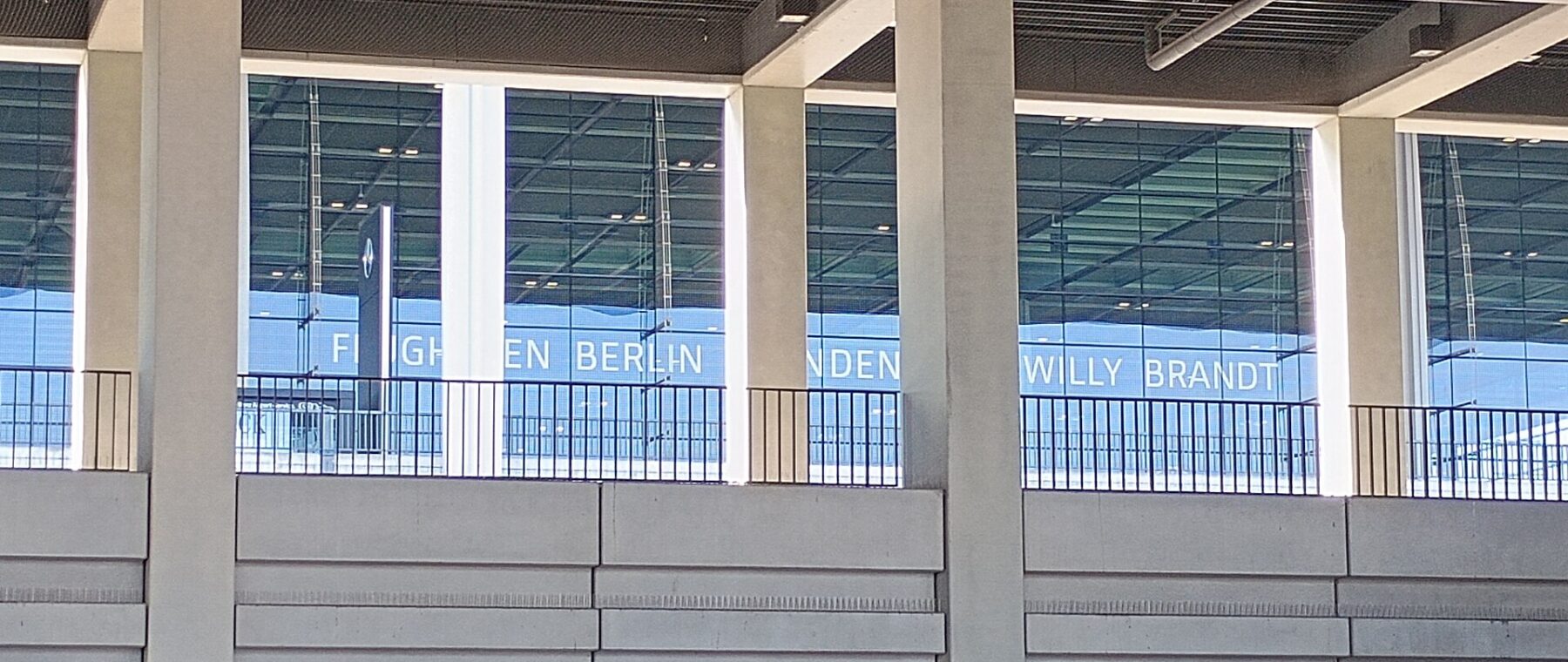
For most of the 2010s, Berlin Brandenburg Airport was a national punchline — a finished-looking terminal standing empty in a field in Brandenburg while its opening date slid back year after year, and Berliners sold T-shirts about it. It finally opened on 31 October 2020, nine years late and billions over budget, in the middle of a pandemic. Six years on, it is simply the airport: large, calm, efficiently linked by rail, a little short on charm, and more straightforward than its reputation. This BER airport guide covers everything you need to use it well, whether you are landing for your first trip to Berlin, catching a 6am flight home or killing seven hours between connections.
It covers where the airport is and how it is laid out, which terminal you need, what happens when you land and what to allow when you leave, security and the night-flight rules, food, shops, luggage storage, sleeping cabins, the visitor terrace, the art most people walk straight past, accessibility, and the questions people most often get wrong. Details were checked in October 2026 — prices in particular should be treated as the right order of magnitude rather than a guarantee.
BER at a Glance
| Question | Short answer (September 2026) |
|---|---|
| Official name | Berlin Brandenburg Airport “Willy Brandt” — code BER |
| Where | Schönefeld, Brandenburg, just outside Berlin to the south-east |
| Terminals in use | Terminal 1 (main) and Terminal 2 (next door, mainly low-cost). Terminal 5 is permanently closed. |
| Other Berlin airports | None. Tegel closed in November 2020; Tempelhof in 2008. |
| Rail station | Directly beneath Terminal 1, serving S-Bahn and regional trains |
| Time to the centre | About 23 minutes to Hauptbahnhof by FEX or RE20; 30–45 minutes by taxi, depending on traffic and where you are going |
| Ticket zone | The airport is in fare zone C — an AB ticket is not enough |
| Night flights | Banned 00:00–05:00, with restrictions 23:00–00:00 and 05:00–06:00 |
| Sleeping cabins | NapCabs in Terminal 1, roughly €17/hour by day and €12/hour at night |
| Luggage storage | Terminal 1/2, level U1, staffed |
| Visitor terrace | Terminal 1, ticketed 90-minute time slots |
| Supermarket | REWE on the public side, open daily around the clock |
A Short, Painful History
You do not need the history to catch a flight, but it explains a lot about the building you are standing in, and it is one of the great modern German stories.
Divided Berlin had three airports: Tegel and Tempelhof in the West, Schönefeld in the East. After reunification the obvious plan was to replace all three with a single large airport. The site chosen was at Schönefeld, construction began in 2006, and opening was set for October 2011, then put back. Weeks before the new date, with invitations sent and airlines’ timetables printed, the opening was cancelled. The fire-protection and smoke-extraction systems did not work, and the more the inspectors looked, the more they found: tens of thousands of faults, wiring that did not match its plans, a planning and management process that had lost control of the project.
What followed was eight years of rebuilding, lawsuits, sackings and mockery. The terminal’s systems were maintained and its escalators run at intervals so they would not seize up; trains ran through the empty station to keep the air moving. When BER finally opened on 31 October 2020, years late and far over budget, it arrived in the middle of the COVID-19 pandemic, at the very moment air travel had collapsed. Tegel, the much-loved hexagonal West Berlin airport where you could walk from taxi to gate in a few minutes, closed a week later. The old Schönefeld terminal was folded in as “Terminal 5” and then closed for good.
The result is an airport that works rather better than its reputation suggests, even if it can feel oddly spacious in some places and stretched in others.
Where BER Is, and How It Is Laid Out
BER sits just outside the Berlin city boundary, south-east of the centre, in the Brandenburg municipality of Schönefeld. From the air on approach you will see the pine forests and lakes of Brandenburg to the south and the edge of the city to the north.
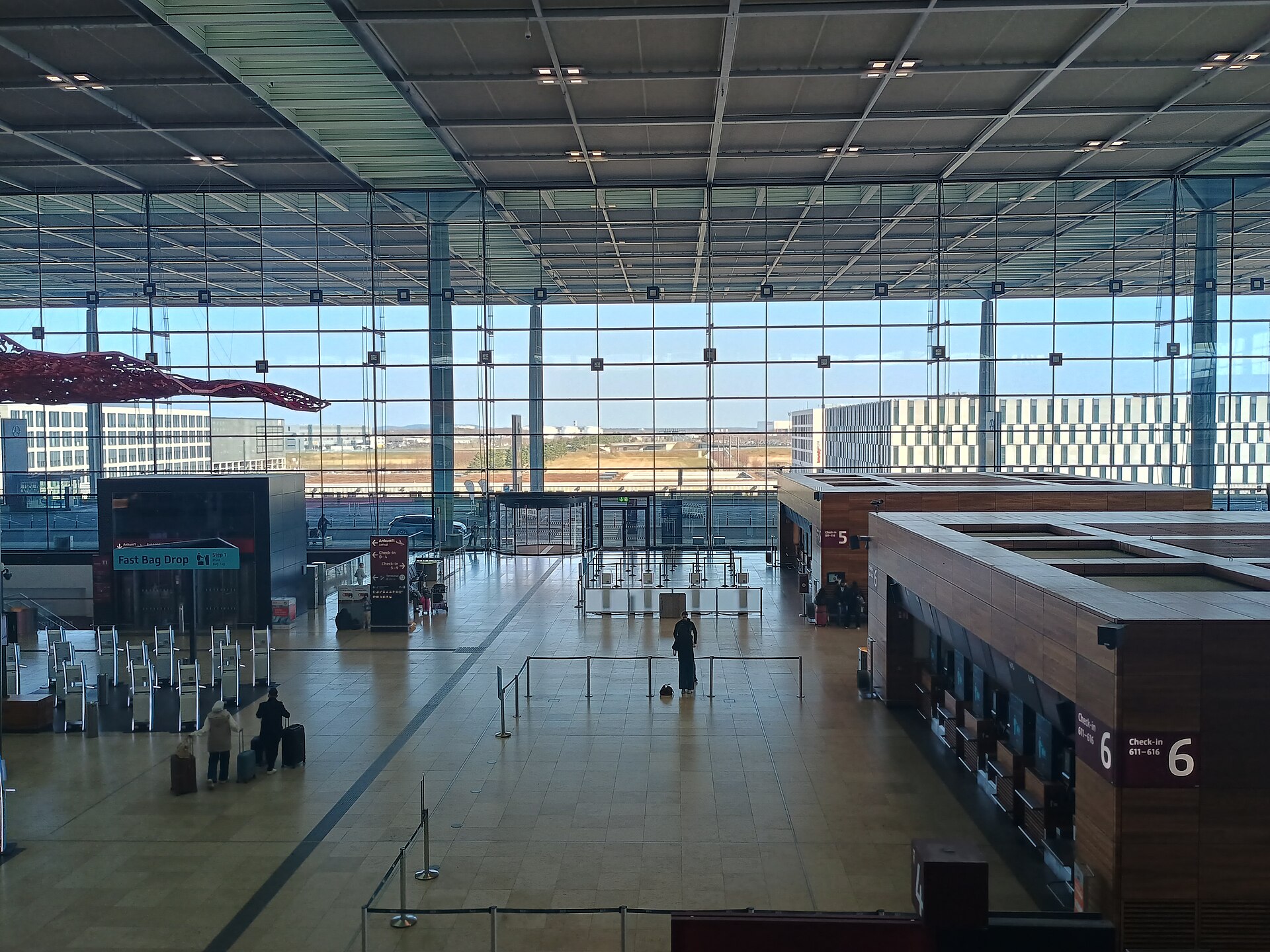
The airport is built around a single central complex. Terminal 1 is the main building: a big, calm, glass-fronted hall with check-in on the upper level, arrivals on the level below, and the rail station directly underneath, so you can go from train platform to check-in desk by lift or escalator without going outside. The piers with the gates stretch out from the main building. Terminal 2 is a separate, simpler building immediately to the north, connected to Terminal 1 by a walkway. The taxi ranks are outside Terminal 1 on arrivals level E0, and Terminal 2 has its own selection of shops, restaurants and service facilities.
The architecture was deliberately restrained — lots of walnut, pale stone, dark steel and daylight — and it wears well. Signage is in German and English throughout and generally clear. The main thing first-time visitors notice is the scale: walking distances airside can be long, especially to the far gates of the piers, so do not assume that being through security means being at your gate.
Which Terminal Do You Need?
This is the question that trips people up most, not least because older booking confirmations, travel articles and even some airline emails still mention terminals that no longer exist.
- Terminal 1 handles most airlines, including the full-service European carriers and the long-haul flights. If in doubt, it is probably Terminal 1.
- Terminal 2 is used mainly by low-cost carriers, most notably Ryanair. It has its own check-in area and security, but no station and fewer facilities.
- Terminal 5 — the old Schönefeld airport terminal — closed in February 2021, and the airport has since ruled out reopening it. If anything tells you to go to “Terminal 5” or “Schönefeld Airport”, it is out of date. Do not get off the train at the old Schönefeld station expecting to find it open.
- Tegel (TXL) closed in 2020. Its buildings are being turned into a technology and research campus. No flights use it.
Your airline’s app or booking confirmation will show the terminal a day or two before departure, and the departure boards at BER do the rest. Terminal assignments can change with the season, so check rather than relying on what you flew from last time.
Walking between Terminals 1 and 2
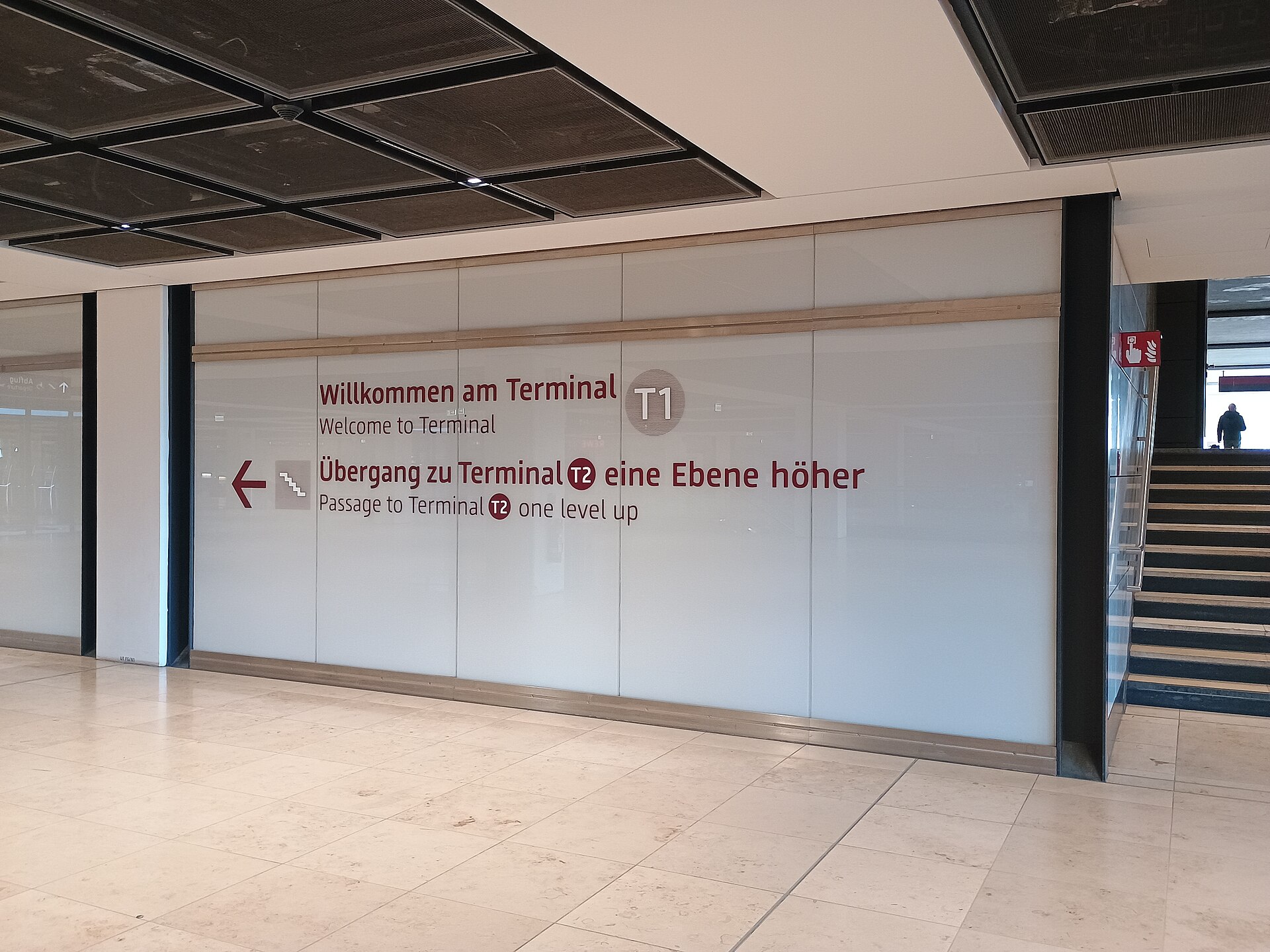
If you arrive by train and fly from Terminal 2, you get off at the Terminal 1 station and walk. Follow the signs for T2 along the walkway on arrivals level E0; it is a few minutes on foot. Passengers connecting between flights can reach every gate from every security control. Allow for the walk when you plan your arrival time, especially with heavy bags or small children.
Getting Between BER and Central Berlin
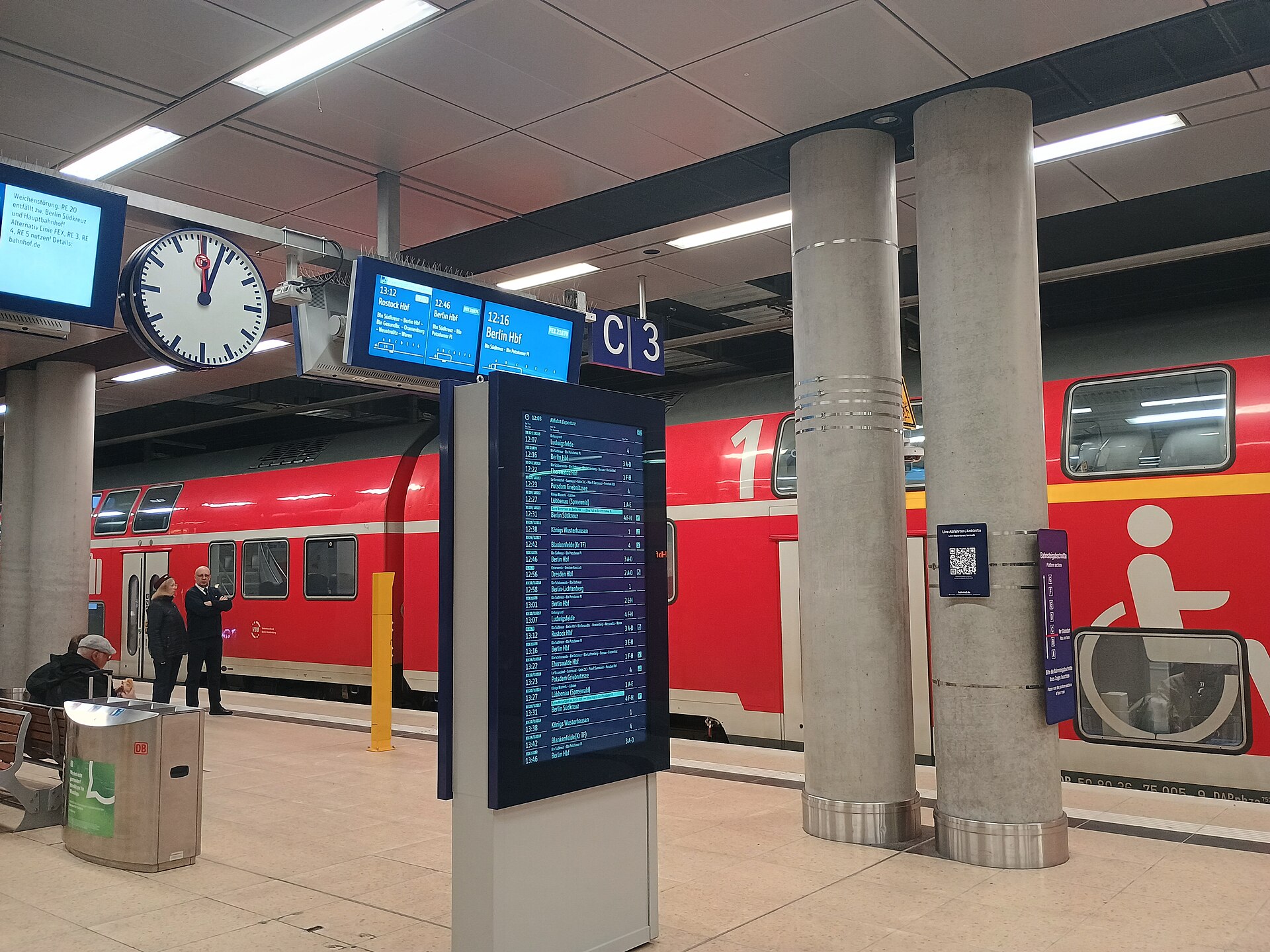
BER is well connected, and the rail station under Terminal 1 means you can be on a train within minutes of collecting your bags. There are three sensible options: regional express trains, which are the fastest way to the main city-centre stations; the S-Bahn, which is slower but stops at many more places and may leave you closer to your hotel; and a taxi, which is the easiest door-to-door option with luggage and by far the most expensive.
The single most important thing to know is that the airport is in fare zone C. A standard AB ticket, which covers the whole of the city itself, will not do. You need an ABC ticket, or an AB ticket plus a zone C extension, and ticket inspectors on airport trains are used to fining visitors who did not know. If you are buying a multi-day ticket or a Berlin WelcomeCard, choose the ABC version so your airport journeys are covered — our Berlin WelcomeCard review looks at whether that is worth it.
Which option is right depends on where you are staying, when you land and how much luggage you have. Our BER airport to city centre guide compares every route, the journey times, the current fares, the late-night options and exactly where to find each one in the terminal. If you arrive late at night, also see our guide to Berlin night transport.
Arriving at BER
Passport control and the new EU entry system
If you are arriving from another Schengen country, there is usually no passport control at all — you walk off the plane to baggage reclaim, although you should still carry your ID, because spot checks do happen. If you are arriving from outside the Schengen area, including the UK, the US, Canada and Australia, you will go through border control.
The EU’s Entry/Exit System (EES) started in stages on 12 October 2025 and has been fully operational since 10 April 2026. It registers non-EU short-stay travellers at the external border the first time they enter, taking a facial image and, from age 12, fingerprints, and it replaces passport stamps. The first registration can take a few minutes longer than the old stamp. Queues at BER’s non-Schengen arrivals are usually manageable, but they can build when several long-haul or UK flights land at once. For the full picture on passports, visas and the planned ETIAS travel authorisation, see our Berlin visa and entry requirements guide.
Baggage reclaim and customs
Baggage reclaim is straightforward and well signed. Bags on a typical European flight tend to arrive within twenty to forty minutes of landing. Customs works on the usual green and red channel system; if you are arriving from outside the EU with more than the duty-free allowances, go through the red channel. If your bag does not appear, report it at the baggage services desk in the reclaim hall before you leave — it is much harder to sort out once you have passed through the exit.
In the arrivals hall
- Cash machines are in the arrivals area. Use them rather than the currency exchange desks, which give poor rates. If a machine asks whether to charge you in your home currency or in euros, choose euros.
- Tickets for trains can be bought from the machines in the terminal and in the station below, and on the BVG and DB apps. Buy before you board; see our BVG tickets guide.
- Taxis leave from the official rank outside Terminal 1. Use it rather than accepting offers from people in the hall. Ride-hailing pick-ups use designated areas that the apps will direct you to.
- Mobile data: free Wi-Fi is available in the terminals. SIM cards and eSIMs are available, but most EU visitors roam free, and many other visitors now arrive with an eSIM already installed. See our essential Berlin apps guide for what to download before you land.
Departing from BER
How early to arrive
BER’s early years were marked by long security queues, and while things are generally much smoother now, peaks still happen — particularly on early morning departure waves, Friday and Sunday afternoons, and at the start of the Berlin and Brandenburg school holidays. As a rule of thumb:
| Flight type | Arrive at the terminal |
|---|---|
| Schengen, hand luggage only, checked in online | The shortest margin: work back from your airline’s boarding time |
| Schengen, with checked bags | Longer, to allow for bag drop before it closes |
| Non-Schengen (UK, US, etc.), including exit passport control | Longer still: extra time for the passport check |
| School-holiday start or major trade-fair weekend | Add a buffer to any of the above |
Your airline’s own recommendation takes priority, especially for low-cost carriers that close bag drop strictly. Remember to add the train journey and, if you are flying from Terminal 2, the walk from the station.
Check-in and bag drop
BER recommends checking in online where you can. Many airlines offer self-service bag drop, and you can also check in at a staffed counter. Check-in counters open well before departure for long-haul and full-service flights, and the departure boards and airline apps show which counters to use. If you have outsized luggage — bikes, skis, instruments, prams — find out beforehand where to drop it; there is a separate oversized-baggage point.
Security
Security at BER is run under German federal rules, and it is thorough. Liquid rules depend on the checkpoint. The CT scanner lanes in Terminal 1 security areas 1 and 5, and those in Terminal 2, accept liquids in containers of up to two litres; the conventional lanes in central Terminal 1 keep the familiar 100 ml limit, with liquids in a single clear, resealable one-litre bag. Laptops and large electronics may need to come out of your bag depending on which scanner lane you are sent to; follow the staff instructions. Arrive with power banks in your hand luggage, never your checked bag.
If you are leaving the Schengen area, you will also pass through exit passport control, where EES records the departure of non-EU short-stay visitors. Holders of a residence permit or a long-stay visa are not covered.
Tax-free shopping refunds
Visitors from outside the EU can reclaim VAT on eligible purchases made in Germany. The paperwork has to be stamped by customs before you leave the EU, and if the goods are in your checked luggage you must show them to customs before you check that bag in. Leave extra time for this, and check the refund company’s instructions on your form.
The Night-Flight Rules, and What They Mean for You
BER has a strict night-flight ban from midnight to 05:00, with only emergency, government, postal and similar flights allowed. Between 23:00 and midnight, and between 05:00 and 06:00, air traffic is restricted too. There is regular political pressure to relax these rules, and airlines — Ryanair in particular — complain when delayed evening flights miss the midnight cut-off, but in 2026 the ban was still in force.
In practice this has three consequences for travellers:
- A badly delayed late-evening flight to or from BER can be diverted or cancelled rather than simply landing late. If you are on the last flight of the day and it is running very late, check your airline’s app for what it plans to do.
- Early-morning departures mean a very early start. If you are on one of these, check the time of the first train carefully, or consider sleeping at or near the airport.
- The terminal at night is quiet but not deserted. The REWE supermarket and the Kamps bakery stay open around the clock, though most cafés and shops close.
Sleeping at the Airport
If you have a first-wave morning departure, a late arrival with nowhere to go, or a long overnight connection, there are three realistic options.
- NapCabs — small sleeping cabins on level U1 of Terminal 1, opened with an access code, with a bed, a desk and adjustable ventilation. They cost roughly €17 an hour between 06:00 and 22:00 and roughly €12 an hour between 22:00 and 06:00, and they are genuinely useful for a few hours of proper sleep. For a full night, a hotel room will often be better value.
- Airport hotels — the Steigenberger Airport Hotel and the IntercityHotel stand by Terminal 1, on the public side, and there is more accommodation in the town of Schönefeld. For a 06:00 departure, being able to walk to check-in is worth a great deal.
- Sleeping in the terminal — people do it, and the public areas of Terminal 1 are open 24 hours, but airport seating makes a poor bed. If money is tight, it is better than a taxi at 03:30; otherwise, pay for a cabin or a room.
Food, Drink and Shops
BER’s food offer is adequate rather than exciting. Landside, before security, there are cafés and bakeries, and two places that never close: a Kamps bakery and, usefully, a REWE supermarket, where you can stock up on drinks and snacks for the flight. Knowing about the REWE is one of the most useful things to take to BER.
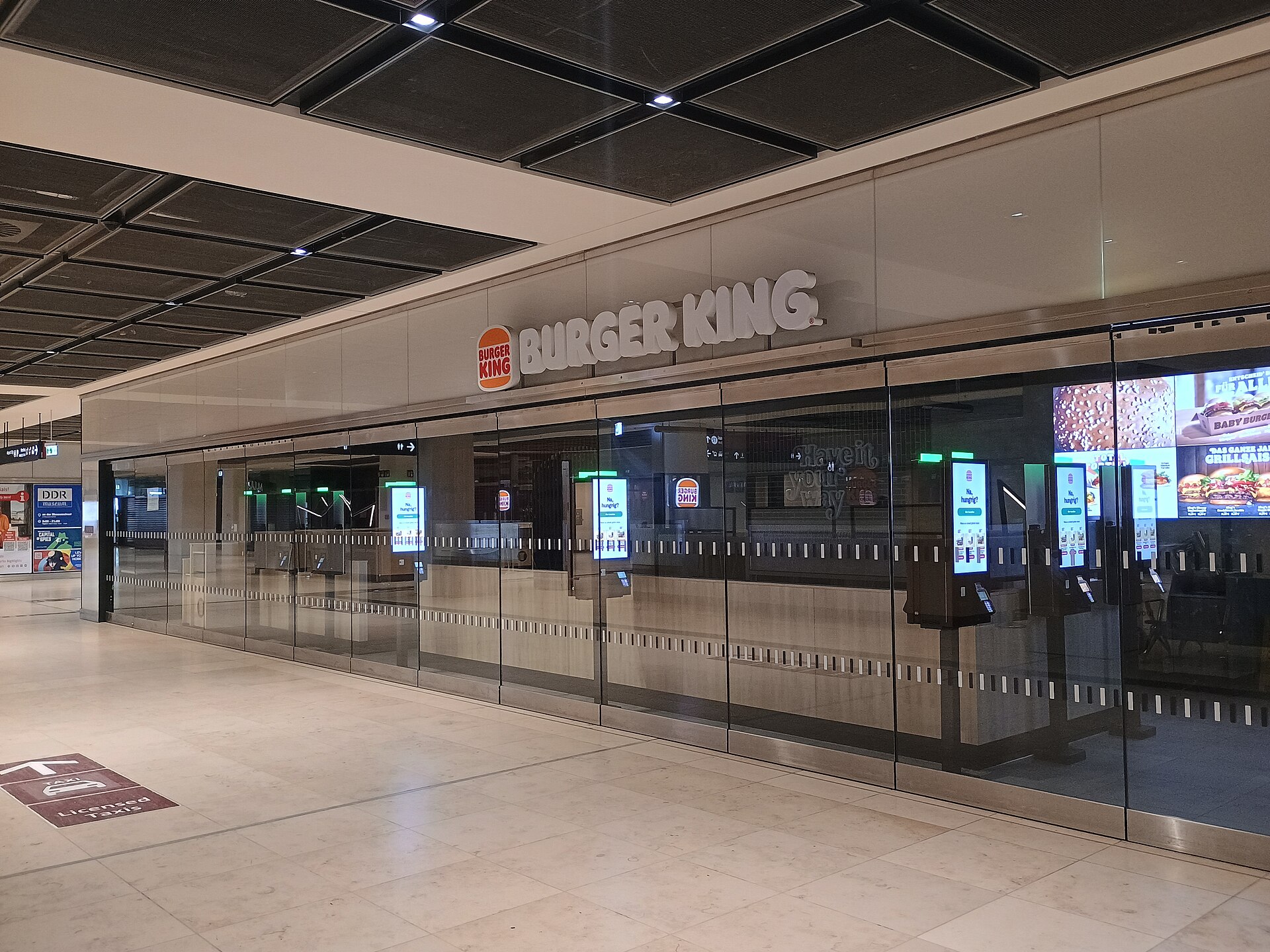
Airside, after security, there is a wider choice of cafés, bars and restaurants, with a strong showing of Berlin and German favourites — currywurst, pretzels, beer — alongside the usual international chains, plus duty-free and a modest range of fashion, electronics, books and souvenirs. Expect airport prices: a coffee and a pastry airside can easily cost twice what they would in the city. Our best souvenirs from Berlin guide suggests better things to buy before you get here.
The honest verdict: eat properly in Berlin before you leave, pick up snacks at the REWE, and do not plan on a memorable last meal at the airport.
Services Worth Knowing About
Luggage storage
BER has a staffed left-luggage office in Terminal 1/2 at level U1, the level between the terminal and the station, where you can leave bags. This is very useful if you have a late flight after checking out of your hotel and want to head back into the city, or if you arrive early and want to explore before check-in. Check current prices at the counter or on the airport website.
The visitor terrace
Terminal 1 has a visitor terrace with views over the aprons and runways, and it is a good way to fill an hour before a flight or to entertain children who like planes. Entry is by ticket for a fixed 90-minute time slot, bought online or at the ticket kiosks on site. Only small bags and backpacks are allowed, so it is not something to do with a full suitcase unless you use the left-luggage office first. To reach it, take the lifts to level 2, the gallery above the check-in hall, and follow the signs to the southern access area. Check the airport website for current prices and opening times, which vary with the season and the weather.
Wi-Fi, charging and working
Free Wi-Fi is available throughout the terminals, and charging points are scattered through the gate areas, though they are more plentiful in some piers than others. If you have serious work to do on a long wait, a lounge day pass or a NapCab with a desk will be more comfortable than the gate seating.
Lounges
BER has a small number of airline and independent lounges, some of which sell day passes or accept lounge-membership schemes. Whether a pass is worth it depends on how long you are waiting and whether the lounge serves your terminal and your part of the airport; for a two-hour wait it usually is not, and for a five-hour delay it often is.
Parking
If you are driving, BER has multi-storey car parks right next to Terminal 1 and cheaper long-stay car parks further out, linked by shuttle. As at most airports, booking online in advance is usually markedly cheaper than paying at the barrier, and the difference over a week can be large. Drop-off and pick-up at the terminal forecourt is time-limited and waiting there can be charged, so check the current rules before a relative offers to wait for you.
Accessibility and Travelling With Children
BER was built recently enough to be designed for barrier-free access, with lifts from the station platforms up to the arrivals and departures levels. Travellers with reduced mobility can request free assistance from arrival at the airport to the aircraft seat; book it through your airline at least 48 hours before you fly, and tell the airline exactly what you need. The service is run by the airport and is generally well regarded. For the rest of your trip, see our accessible transport in Berlin guide.
For families, the terminal has baby-changing rooms and family toilets, and prams and pushchairs can usually be taken to the aircraft door. If you are carrying baby milk or food, check the airport’s travel notes for the rules at your checkpoint, and keep it easily reachable. The visitor terrace is the best way to fill a long wait with children. See Berlin with toddlers for travelling with very young children.
Art at BER: What Most People Walk Past
BER has a surprisingly serious art programme, and a few pieces are worth stopping for rather than walking under.
- The red “magic carpet” hanging above the Terminal 1 check-in hall is by the American artist Pae White — a huge, rippling form that looks like a piece of red cloth caught in the wind. You can see it in the photograph above.
- The Sternentalerhimmel piece in Terminal 1 sets coins into the floor and evokes the Sterntaler fairy tale, in which stars fall from the sky as coins.
- The Open Sky Box is another of the site-specific works commissioned for the terminal; look for it on the way through.
Look out too for the quotations from writers set into the terminal’s walls and glass — lines from Baudelaire, among others, are printed on glass on the way through the building.
Is It Worth Leaving the Airport on a Layover?
The FEX and RE20 take about 23 minutes between BER and Hauptbahnhof, so add the rest of your journey across the city in each direction, and you need to be back through security, and possibly passport control, well before your onward flight. That means leaving the airport is only really worth it on a layover of six to eight hours or more. With less time, stay put: use a lounge, rent a NapCab, go up to the visitor terrace, or take a walk around the terminal.
If you do have the time, store your bags at the left-luggage office, buy an ABC day ticket, and keep your plans simple and close to the rail line — a walk from Hauptbahnhof past the Reichstag to the Brandenburg Gate is achievable and unforgettable. Our one day in Berlin guide will help you choose the highlights, and Berlin travel insurance is worth reading if a tight connection or cancellation would cost you money.
Three BER Scenarios, Planned Properly
Most problems at BER come from the same few situations. Here is how to handle each of them.
The 06:15 departure
You are staying in Mitte and your flight leaves just after six. Working backwards: you want to be at bag drop by around 04:45 for a Schengen flight with a checked bag, which means leaving central Berlin at about 04:00. Rail services do run in the early hours, but not every line and not at daytime frequency, so look up the exact connection the night before in the BVG or DB app rather than assuming. If the first practical train gets you to the terminal with less than an hour and a half to spare, you have three choices: a pre-booked taxi, which is reliable but expensive; a night in one of the hotels beside Terminal 1; or a few hours in a NapCab. For a couple or a family, the hotel often works out cheaper than it first looks once you add up the taxi fare and the lost sleep.
Landing at 23:30
Your flight is late, you land close to midnight, and you still need to get into the city. Do not panic: trains continue to serve the airport late into the evening, and the night network takes over after that, though journeys take longer and may involve a change. Buy an ABC ticket before you board, keep your phone charged for the journey planner, and if you are arriving with small children or a lot of luggage after about 00:30, the taxi rank outside Terminal 1 is the simplest answer. Our airport transfer guide covers the late-night options in detail.
A family with three suitcases and a pushchair
Trolleys are available in the station and the terminal, lifts connect every level, and the rail platforms are step-free. The problem is not the airport, it is the other end: many Berlin U-Bahn stations still lack a lift, and hauling bags up stairs in a busy station is miserable. Check step-free access at your destination station before you choose a train, or pay for a taxi or a large-car transfer for this one journey and use public transport for the rest of the trip.
Strikes, Snow and Other Disruption
BER is well run on an ordinary day, but like every German airport it is exposed to two recurring kinds of disruption. The first is strikes. Security staff, ground handlers and airline crews in Germany strike periodically during pay negotiations, usually with a few days’ notice, and on a strike day a whole airport can grind almost to a halt — the near-empty Terminal 1 in the photograph above was taken on one. If a strike is announced for your travel day, follow your airline’s instructions rather than turning up anyway, and know your rights to rebooking or refunds under EU passenger rules.
The second is winter weather. Snow and freezing fog are not unusual between December and February, and de-icing aircraft adds delays to the first departures of the day. Allow extra time for the journey to the airport too, since rail services are affected as well. The combination of a winter delay and the midnight night-flight ban is what most often turns a late evening flight into a cancellation, so on a snowy day it pays to book an earlier flight if you can.
When a Different Airport Makes More Sense
BER has a limited number of long-haul routes. Many intercontinental journeys to and from Berlin connect through a hub such as Frankfurt, Munich, Amsterdam, London, Paris, Istanbul or Doha, and for some trips it is worth comparing a flight into another German city followed by the train. Hamburg is roughly two hours from Berlin by rail and Munich roughly four, and a direct long-haul flight into one of those airports plus a train can sometimes beat a one-stop connection into BER on total journey time, comfort or price. The same logic occasionally works the other way for short-haul trips: for Hamburg, Leipzig or Dresden, the train from central Berlin is almost always better than flying at all.
Common Mistakes at BER
- Buying an AB ticket for the airport train. The airport is in zone C. You need ABC.
- Going to the wrong airport. Tegel and Schönefeld are closed. All flights use BER Terminal 1 or 2.
- Underestimating the walk to Terminal 2. It is five minutes from the station at a brisk walk, more with bags.
- Cutting it fine for the first flight of the morning. Check the first train, or sleep near the airport.
- Changing money at the exchange desk. Use a cash machine or pay by card.
- Leaving the airport on a four-hour layover. The round trip and security will eat most of it.
- Not reporting a missing bag before leaving the reclaim hall. Do it on the spot.
Frequently Asked Questions
How many airports does Berlin have?
One. Berlin Brandenburg Airport (BER) replaced both Tegel and Schönefeld in 2020. Tempelhof closed in 2008 and is now a park. If a booking, website or guide mentions any other Berlin airport, it is out of date.
How far is BER from the city centre?
BER is in Schönefeld, just over the city boundary to the south-east. The airport trains, FEX and RE20, reach Hauptbahnhof in about 23 minutes; by taxi, allow 30 to 45 minutes, depending on traffic and where in the city you are heading. See our airport to city centre guide for every option.
Is Terminal 5 at BER still open?
No. Terminal 5, the former Schönefeld Airport terminal, closed in February 2021 and will not reopen. All flights now use Terminal 1 or Terminal 2.
Which airlines use Terminal 2 at BER?
Mainly low-cost carriers, most notably Ryanair. Assignments can change, so check your airline’s app or booking confirmation shortly before you fly.
Can you sleep at BER airport?
Yes. Terminal 1 has NapCab sleeping cabins, at roughly €17 an hour by day and €12 an hour at night, and several hotels are within walking distance. The public areas stay open overnight, but they are not comfortable for sleeping.
Does BER have a night-flight ban?
Yes. There are no scheduled flights between midnight and 05:00, with further restrictions from 23:00 to midnight and from 05:00 to 06:00. Late-running evening flights can be diverted or cancelled as a result.
Is there luggage storage at BER?
Yes, a staffed left-luggage office in Terminal 1/2 at level U1; prices are at the counter and on the airport website.
What ticket do I need for the train from BER?
An ABC ticket, because the airport is in fare zone C. An AB ticket on its own is not valid for the airport and can lead to a fine.
How early should I get to BER?
Go by your airline’s check-in and boarding times, leave more room if you have bags to drop, and allow extra time on flights outside Schengen for passport control. Add time at the start of school holidays.
If you need the detail — what is on each of Terminal 1’s levels, where gate areas A, B, C and D are, how Terminal 2 connects to the North Pier, and exactly how long the walk between the two terminals takes — our BER terminals guide sets it all out.
If you are weighing up where to sleep before an early flight, our BER airport hotels guide compares the two hotels you can walk to Terminal 1 from, the shuttle hotels in Schönefeld and the NapCabs, and explains when a city hotel near the airport rail line is the better choice.
For the detailed version — the time overhead for Schengen and non-Schengen connections, who is allowed to leave the airport, where to store bags, and three walking routes from Hauptbahnhof for layovers of six to fourteen hours — see our BER layover guide.
For every car park and its prices, the rules for the ten free minutes at the forecourt, independent park-and-ride operators and the switch to cashless payment from 1 December 2026, see our BER airport parking guide.
For the lounges in detail — the Tegel Lounge at €36 and the Tempelhof Lounge at €48, which one accepts Priority Pass, the Lufthansa lounges, the rule that you cannot enter more than three and a half hours before departure, and when a pass is actually worth buying — see our BER airport lounges guide.
If this is your first time landing at BER, our BER arrivals walkthrough takes you from the aircraft door to the train in the order you will meet each step: passport control and the Entry/Exit System, baggage reclaim and what to do if a bag goes missing, customs allowances, the arrivals hall, and which of the FEX, the S9 or the S85 suits your hotel.
For the detail on eating and shopping — the 24-hour REWE and Kamps bakery on the station level, the airside food court, when duty-free is genuinely cheaper, and how to get the customs stamp for a VAT refund — see our guide to BER food and shopping.
Related Berlin Guides
- BER Airport to City Centre: Every Option Compared
- BVG Tickets in Berlin
- Berlin Transportation Guide
- Berlin Night Transport
- Berlin Visa and Entry Requirements
- Berlin WelcomeCard Review
- Accessible Transport in Berlin
- One Day in Berlin
Photo Credits
BER Terminal 1 façade with the airport’s name: (20260318 121746611) Flughafen BER Terminal 1 by Roy Zuo, CC BY-SA 4.0, via Wikimedia Commons.
Terminal 1 check-in hall: (20260318) BER Airport Terminal 1, empty due to strike 18 by Roy Zuo, CC BY-SA 4.0, via Wikimedia Commons.
Sign to Terminal 2: (20260318 121920069) Flughafen BER Terminal 1 by Roy Zuo, CC BY-SA 4.0, via Wikimedia Commons.
BER airport station platform: (20260318 120356807 HDR) Bahnhof Flughafen BER by Roy Zuo, CC BY-SA 4.0, via Wikimedia Commons.
Burger King in BER Terminal 1: (20260318) BER Airport Terminal 1, empty due to strike 25 by Roy Zuo, CC BY-SA 4.0, via Wikimedia Commons.
Final Word
BER spent a decade as a symbol of everything that can go wrong with a big German project, and plenty of Berliners still cannot mention it without rolling their eyes. As a passenger, you can mostly ignore all that. It is a clean, orderly, well-signed airport with a railway station underneath it, and if you know a handful of things — zone C, Terminal 2 is a walk, Terminal 5 is gone, the night ban is real, the REWE is open all night — it will give you very little trouble.
Buy the right ticket, leave a little more time than you think you need, and if you have an hour to spare before your flight, go up to the terrace and watch the planes. After all those years of waiting, it seems only fair to see the place actually working.