Berlin Neighbourhoods: What Each District Is Actually Like
A district-by-district guide to what Berlin's neighbourhoods are actually like to walk around in — the building stock, the noise, and where the old East-West line still shows.

Berlin covers close to 900 square kilometres, which is more than eight times the area of central Paris, and it holds around 3.8 million people spread thinly across it. There is no single centre, no ring of increasing suburbia, and no reliable relationship between how close a district is to the middle and how interesting it is. Any Berlin neighborhoods guide that tells you Mitte is the historic centre and Kreuzberg is alternative has told you nothing you can use, because both of those things stopped being true some time ago and neither was ever the useful part.
This page is about what each district is actually like to walk around in — the building stock, the noise, who lives there, what the streets smell like at seven in the evening, and where the seams between two Berlins still show. It does not tell you where to book a hotel; that is a separate question with a separate answer, and our guide to the best neighbourhoods for tourists to stay in handles it properly. This one is for understanding the city rather than choosing a bed.
How Berlin Is Actually Organised
Berlin has twelve official districts, called Bezirke, each with its own town hall and local administration and each larger in population than many German cities. Below them sit some ninety-six Ortsteile, or localities, and it is almost always the locality name — not the district name — that Berliners and visitors actually use.
This causes constant confusion, so it is worth stating plainly. Kreuzberg is not a district. It has not been one since a 2001 reform merged Berlin’s twenty-three boroughs into twelve, and it is now half of a Bezirk called Friedrichshain-Kreuzberg. Prenzlauer Berg is part of Pankow. Wedding and Moabit are both part of Mitte, which will surprise anyone who has been to all three. Schöneberg is joined to Tempelhof. None of this affects you as a visitor except when you are reading official signage or looking at a map that uses the administrative boundaries, at which point knowing it saves ten minutes of bewilderment.
The twelve districts and what people actually call them
| Official Bezirk | The names people use | Where it is |
|---|---|---|
| Mitte | Mitte, Wedding, Moabit, Tiergarten, Gesundbrunnen | Centre and north-centre |
| Friedrichshain-Kreuzberg | Kreuzberg, Friedrichshain | Centre-east, both banks of the Spree |
| Pankow | Prenzlauer Berg, Pankow, Weißensee | North-east |
| Charlottenburg-Wilmersdorf | Charlottenburg, Wilmersdorf, Grunewald | West |
| Tempelhof-Schöneberg | Schöneberg, Tempelhof | South-centre |
| Neukölln | Neukölln, Rixdorf, Britz | South-east of centre |
| Treptow-Köpenick | Treptow, Köpenick, Friedrichshagen | South-east, and the lakes |
| Lichtenberg | Lichtenberg, Hohenschönhausen | East |
| Marzahn-Hellersdorf | Marzahn, Hellersdorf | Far east |
| Steglitz-Zehlendorf | Steglitz, Zehlendorf, Wannsee, Dahlem | South-west |
| Spandau | Spandau, Kladow, Gatow | Far west |
| Reinickendorf | Reinickendorf, Tegel, Frohnau | North-west |
The East–West Line Is Still Visible
The Wall came down in 1989 and the physical border is almost entirely gone, but the two halves of Berlin developed separately for forty years and the differences did not evaporate on reunification. Once you know what to look for, you can tell which side of the old line you are standing on without a map.
- Trams. Berlin has an extensive tram network and it is almost entirely in the former East. West Berlin tore its trams out in the 1960s; East Berlin kept and expanded them. If a tram goes past you, you are almost certainly in the east — the M10 running west to Hauptbahnhof and the M13 into Wedding are the notable exceptions, and both are post-reunification extensions.
- The Ampelmännchen. The little hatted man on pedestrian signals is an East German design that survived a serious campaign to abolish him. He is now found across much of the city, but the concentration is still heaviest in the east.
- Building stock. The east has both the best-preserved nineteenth-century streets — Prenzlauer Berg survived the war unusually well and was too poor to be redeveloped afterwards — and the largest prefabricated concrete estates, in Marzahn and Hellersdorf. The west has more 1950s and 1960s reconstruction, because it was bombed harder and rebuilt with more money.
- Street width and layout. East Berlin built showcase boulevards — Karl-Marx-Allee is the obvious one — on a scale the west never attempted.
None of this is nostalgia or tourism packaging. It is the physical residue of two states trying to build two different futures on the same city, and it is genuinely one of the most interesting things about walking around Berlin. Our reunification guide covers what happened to the seam after 1990.
Why the Districts Are So Different: A Short History of the Map
Berlin’s neighbourhoods do not vary because of gradual organic drift. They vary because of four specific events, and knowing them explains almost everything you will notice on the ground.
1920: the city swallows its neighbours
Until 1920 Berlin was a relatively compact city surrounded by separate towns, villages and country estates. The Greater Berlin Act of that year absorbed the lot — Charlottenburg, Spandau, Köpenick, Neukölln and dozens of villages — and multiplied the city’s area roughly thirteenfold overnight. That is why Spandau has a medieval town centre and Köpenick has a baroque palace: they were not built as parts of Berlin, and in some cases they are considerably older than it.
1871–1914: the Gründerzeit building boom
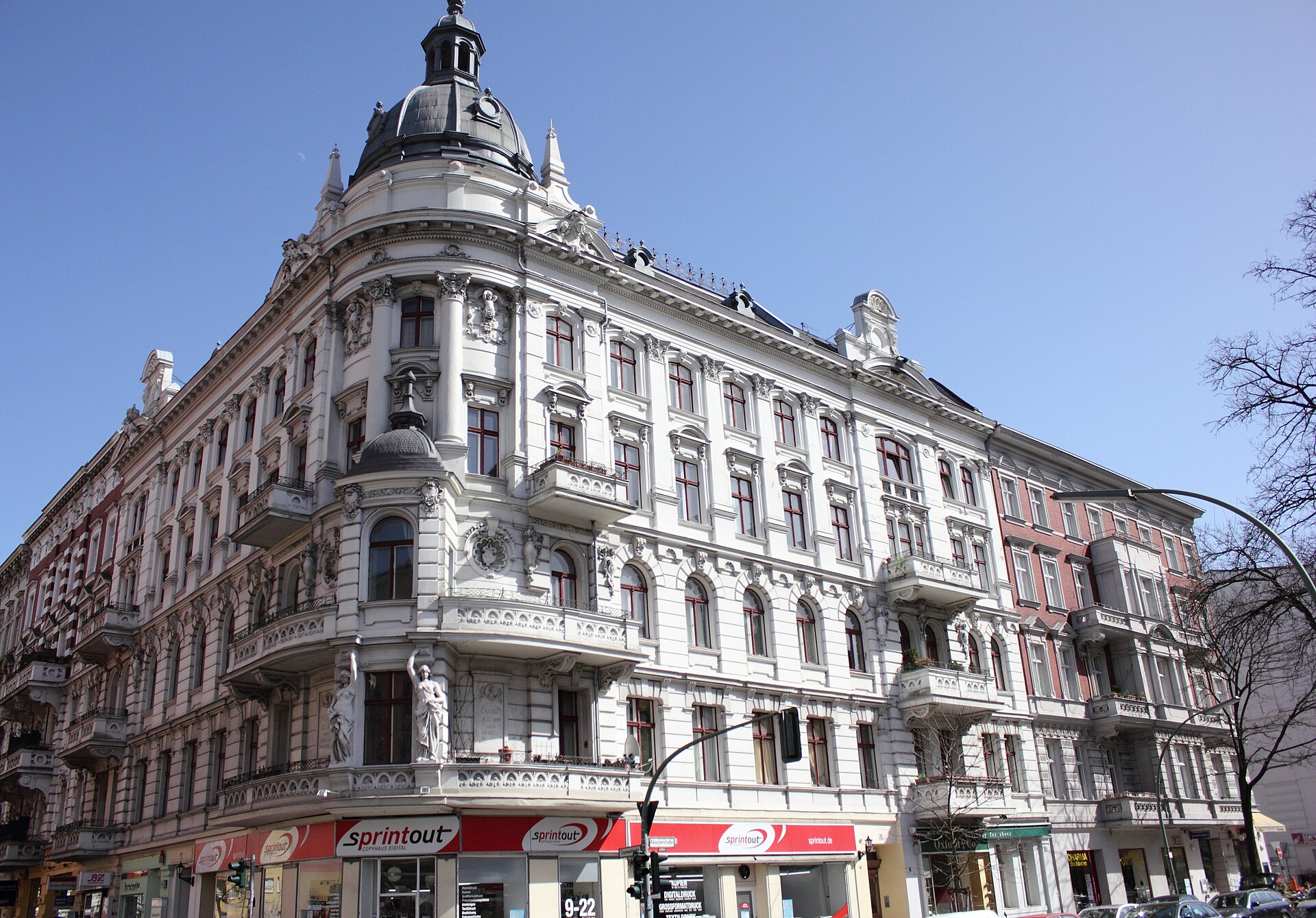
Between German unification and the First World War, Berlin’s population exploded and speculative developers threw up mile after mile of five- and six-storey apartment blocks in a standardised pattern: an ornate street-facing front building, then a sequence of courtyards receding into the block with progressively cheaper flats. Almost all of inner Berlin — Prenzlauer Berg, Kreuzberg, Neukölln, Schöneberg, Friedrichshain — is fundamentally this, and it is why those districts look far more alike than their reputations suggest.
1943–1945: the bombing, unevenly
The destruction was not distributed evenly, and where the bombs fell determines what stands today. The government quarter and the industrial west were flattened; parts of the north-east, including much of Prenzlauer Berg, came through comparatively intact. That accident of aerial geography is the single biggest reason some districts are wall-to-wall nineteenth-century streetscape and others are 1950s reconstruction with wide roads and set-back blocks.
1961–1989: forty years apart
Then the city was divided, and the two halves built according to entirely different theories. The East built monumental boulevards and, later, vast prefabricated estates on the outer edge. The West, cut off and subsidised, rebuilt with modernist social housing and left its inner-city Altbau to decay — which is precisely why Kreuzberg became cheap enough to attract the squatters and immigrants who gave it its character. Neither half planned what it got; both are living with it.
The Central Districts
Mitte — the tourist core, and a real place underneath it
Mitte holds nearly everything a first-time visitor comes for: the Brandenburg Gate, Unter den Linden, Museum Island, the Reichstag, Checkpoint Charlie, Alexanderplatz. It is also, in its central stretch, the least representative part of Berlin — a zone of ministries, embassies, offices, chain hotels and a great many people photographing things. On a Sunday morning around Wilhelmstraße it can feel oddly empty, because almost nobody lives there.
The interesting Mitte starts a few streets north. The area around Hackescher Markt, Rosenthaler Platz and the Scheunenviertel — the old Jewish quarter — has courtyards, small galleries, independent shops and actual residents, though it has become expensive enough that “independent” now covers a lot of very polished retail. Torstraße and Rosa-Luxemburg-Platz are where Mitte still feels like a neighbourhood rather than a display.
What it is like: broad, formal, well-lit and heavily policed in the government quarter; denser, older and more social north of the Spree. Expensive throughout. Full of tourists in a way that no other district is.
Kreuzberg — two neighbourhoods with one name
The single most useful fact about Kreuzberg is that it splits in two, along a line that follows pre-war postal codes nobody has used for decades but everybody still cites.
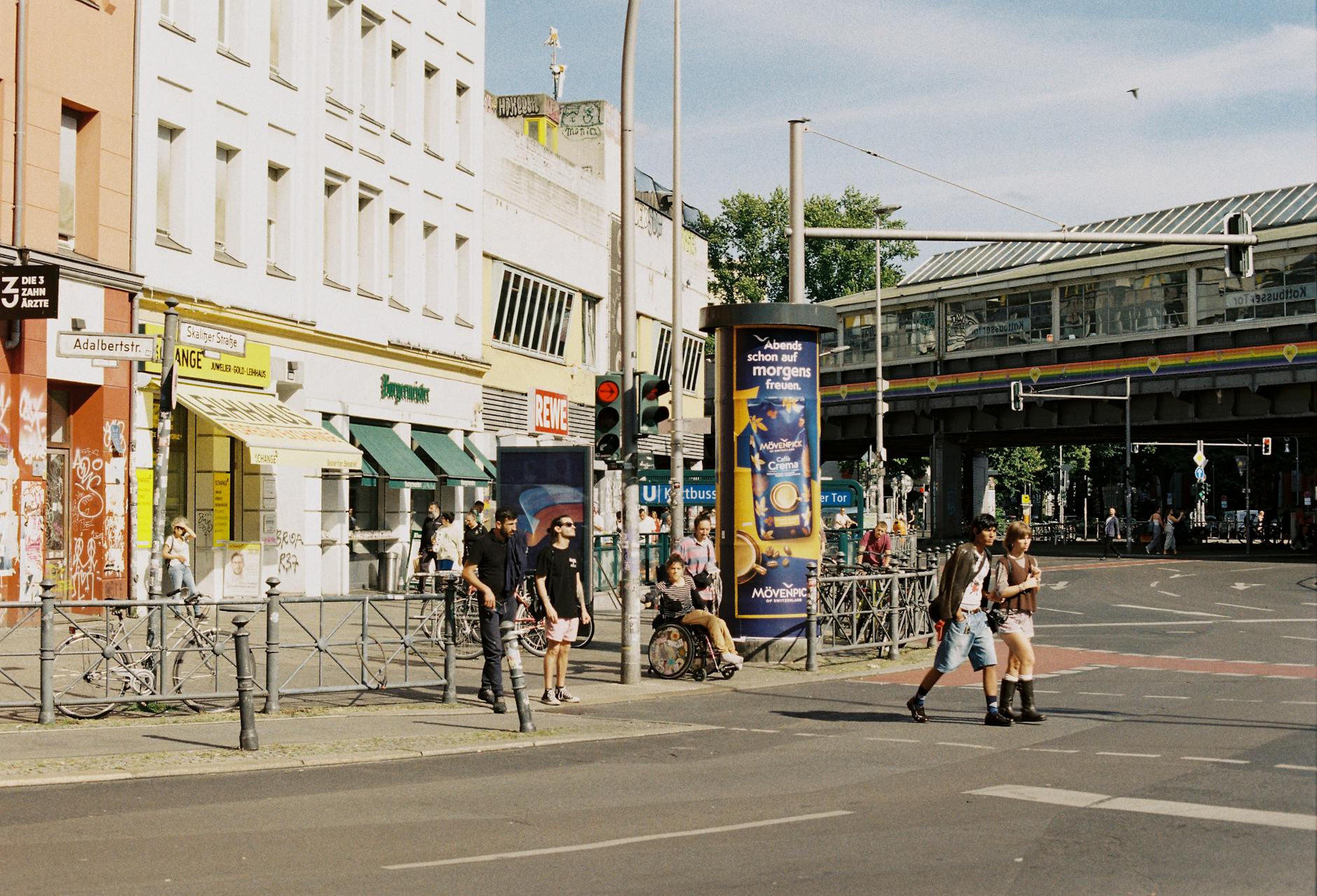
SO36 is the eastern half — Kottbusser Tor, Görlitzer Bahnhof, Schlesisches Tor, Oranienstraße. This was the corner of West Berlin hemmed in on three sides by the Wall, which made it cheap, which brought Turkish guest workers, squatters, punks and draft-dodgers in roughly that order. It is still the loudest, most crowded, most heavily graffitied and most genuinely multicultural part of inner Berlin. Kottbusser Tor at midnight is not a calm place, and it is not trying to be.
Kreuzberg 61 is the western half — Bergmannstraße, Südstern, Chamissoplatz, Viktoriapark. Same borough, entirely different temperature: cobbled streets, restored Altbau, cafés with prams outside, a park with a waterfall and the highest natural point in inner Berlin. People who love SO36 tend to find 61 smug, and vice versa, and both are right.
Between them runs the Landwehrkanal, with the Turkish Market on Maybachufer on Tuesdays and Fridays and, in summer, half the district sitting on the grass along the bank.
What it is like: east half loud, crowded, sometimes edgy, superb food; west half leafy, expensive, family-heavy. Both are very walkable and both are best in the evening.
Friedrichshain — the one that stayed up late
Directly across the Spree from Kreuzberg via the Oberbaumbrücke, and until 1989 in a different country. Friedrichshain is where Berlin’s international reputation for nightlife physically lives: Berghain sits on its southern edge, the RAW-Gelände is a former railway yard full of clubs and bars, and the streets around Warschauer Straße stay busy in a way that nowhere else in Germany does.
It is also the most architecturally schizophrenic district in the city. Karl-Marx-Allee is a two-kilometre socialist boulevard of monumental tiled apartment blocks — the GDR’s “workers’ palaces”, built in the early 1950s and genuinely impressive at the scale they were meant to be seen. Two streets away, around Boxhagener Platz, is ordinary restored nineteenth-century Berlin with a Saturday flea market and a Sunday hangover.
What it is like: young, loud, scruffier than Prenzlauer Berg and cleaner than SO36. Excellent for a Sunday walk and unmanageable at 3am on a Saturday unless that is why you came.
Prenzlauer Berg — restored, expensive, and quietly beautiful
Prenzlauer Berg came through the Second World War with far less damage than most of Berlin, then spent forty years neglected under a state that had no money to modernise it. The result, after reunification, was several square kilometres of intact nineteenth-century apartment blocks that were bought, restored and repopulated at extraordinary speed. It is now the most thoroughly gentrified district in the city and the standing punchline of every Berlin joke about cargo bikes and organic bakeries.
The jokes are earned and the district is still lovely. Kollwitzplatz on a Saturday morning has one of the best farmers’ markets in Berlin. Helmholtzplatz and the streets around it are as good as restored Gründerzeit streetscape gets anywhere in Europe. The Kulturbrauerei, a nineteenth-century brewery complex, holds cinemas, venues and a free museum about everyday life in the GDR. Mauerpark, on the western edge, has the Sunday flea market and the outdoor karaoke.
What it is like: calm, green, handsome, full of children, and expensive. Almost no nightlife by Berlin standards. The best district in the city for simply walking without a destination.
Neukölln — the one that changed fastest
Northern Neukölln — the strip nearest the canal, around Weserstraße, Sonnenallee and Karl-Marx-Straße — went from being the district Berliners warned each other about to the district Berliners could not afford in roughly fifteen years. It has the highest concentration of small bars in the city, an enormous Arab and Turkish presence along Sonnenallee, some of the best cheap food in Berlin, and a permanent low-level argument about what all that change has cost the people who were already there.
Go further south and it changes completely. Rixdorf, around Richardplatz, is a preserved Bohemian village inside the city, founded by religious refugees in the eighteenth century and still with its own village green. Britz has the Hufeisensiedlung, a UNESCO-listed 1920s horseshoe-shaped housing estate by Bruno Taut that is one of the most important pieces of modernist social architecture in Europe and receives almost no visitors.
What it is like: north is dense, young, cheap-ish, noisy and the best bar-hopping in Berlin; south is quiet, residential and full of surprises. The bar guide spends a lot of time here.
The Western Districts
Charlottenburg — the old West, and better than its reputation
For forty years Charlottenburg was the centre of West Berlin: the Kurfürstendamm was its main street, the Kaiser Wilhelm Memorial Church its landmark, Zoologischer Garten its main station. Reunification moved the city’s centre of gravity east and Charlottenburg spent the 1990s and 2000s being written off as somewhere your grandmother shopped.
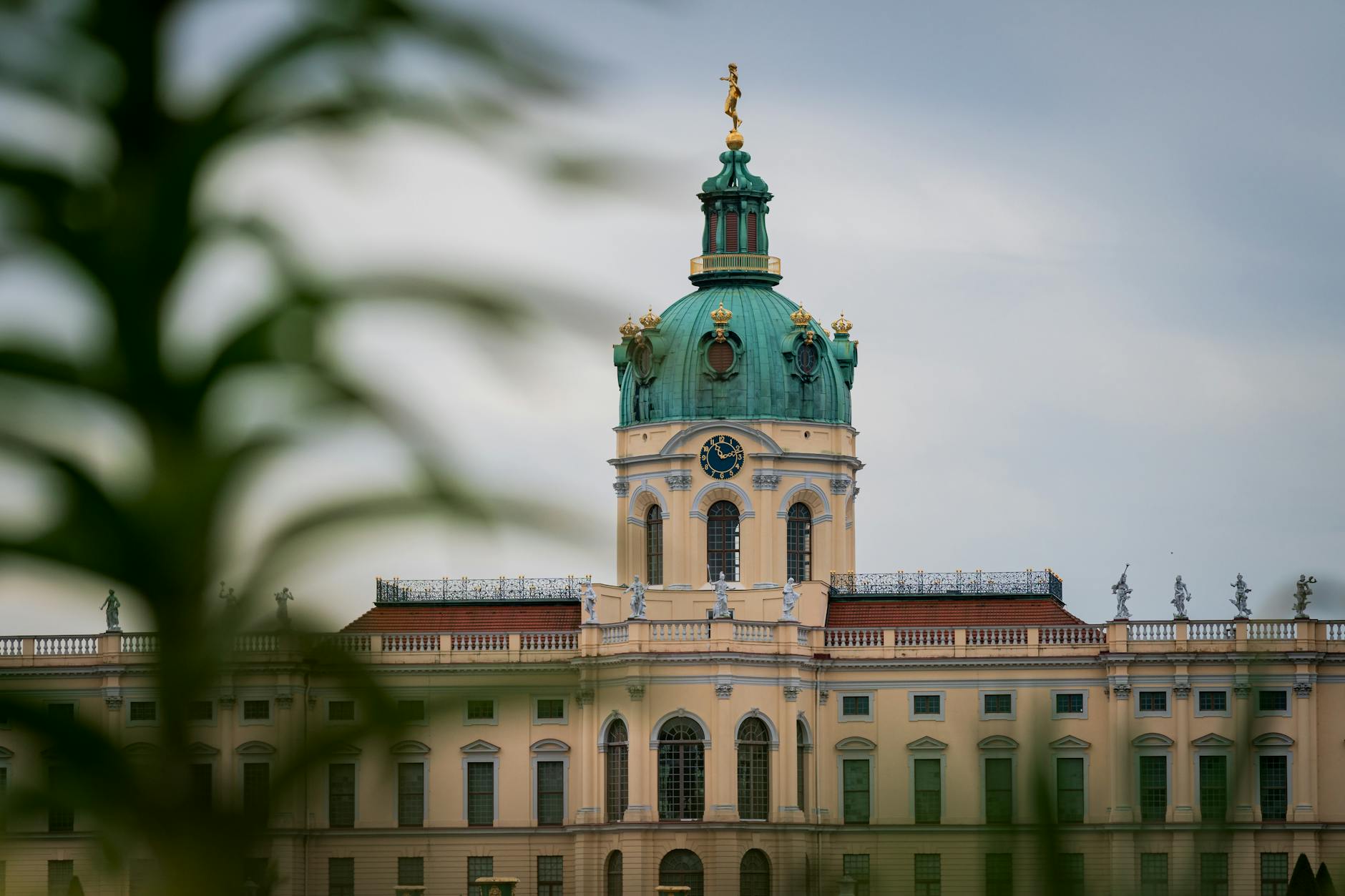
That verdict has aged badly. The Ku’damm and the streets off it hold serious shopping, some of the city’s best-established restaurants, the Theater des Westens, and a run of good bookshops and antique dealers. Charlottenburg Palace and its free gardens are here. Savignyplatz, with its railway-arch restaurants, is the most reliably pleasant place to eat dinner in west Berlin. And the department store everyone calls Charlottenburg’s — KaDeWe — is in fact just over the line in Schöneberg, at the far end of Tauentzienstraße, which is exactly the sort of detail that makes district boundaries useless.
What it is like: older, wealthier, calmer, greener, with wide streets and real pavements. Very little of what people mean by “Berlin nightlife”. Excellent if you have had enough of being twenty-five.
Schöneberg — the district with the longest memory
Schöneberg has two distinct characters and both are historically weighty. Around Nollendorfplatz and Motzstraße is the oldest continuously gay neighbourhood in Europe — the Berlin of Christopher Isherwood in the 1920s and 30s, destroyed by the Nazis, rebuilt from the 1970s, and still the centre of the city’s older LGBTQ+ scene. A pink granite triangle at Nollendorfplatz U-Bahn station commemorates the homosexual victims of National Socialism, and it was one of the first memorials of its kind anywhere.
The other Schöneberg is around Akazienstraße and the Rathaus Schöneberg — bourgeois, quiet, handsome, with a Saturday market, streets of well-kept Altbau and the town hall from whose balcony John F. Kennedy delivered the “Ich bin ein Berliner” speech in 1963. David Bowie and Iggy Pop shared a flat on Hauptstraße during Bowie’s Berlin years; there is a plaque.
What it is like: settled, comfortable, a bit grown-up, with a genuinely distinct nightlife around Nollendorfplatz. Our LGBTQ+ Berlin guide covers that scene in detail.
Wilmersdorf and Moabit — the two you will not hear about
Wilmersdorf is west Berlin at its most residential: broad streets, mansion blocks, embassies, a large park at Volkspark Wilmersdorf, and a Russian history — in the 1920s so many émigrés settled here that the area was nicknamed Charlottengrad. Very little happens. That is the point of it.
Moabit is an island, literally: surrounded on all sides by the Spree and canals, immediately north-west of the government quarter and almost entirely overlooked. It has a nineteenth-century market hall on Arminiusstraße, a working-class history, a large Turkish and Arab population, and rents that were until recently the last affordable ones anywhere near the centre. It is a ten-minute walk from Hauptbahnhof and most visitors never set foot in it.
The Northern and Outer Districts
Wedding — poor, mixed, and the running joke
“Der Wedding kommt” — Wedding is coming — has been a Berlin joke for about thirty years, deployed every time somebody predicts that the district is about to gentrify. It keeps not quite happening. Wedding is one of the poorest parts of the city, heavily immigrant, with a serious industrial history, some superb parks, an excellent public swimming pool in a listed building, and a growing cluster of studios and small venues around Gerichtstraße and the Uferhallen.
It is also the least polished-looking of the inner districts, and visitors who want Berlin as it is rather than Berlin as it presents itself should walk around Leopoldplatz on a weekday afternoon. This is what most of the city actually looks like.
Lichtenberg — Stasi headquarters, a zoo, and Little Hanoi
East Berlin’s administrative and industrial back office, and considerably more interesting than that sounds. The Stasi Museum occupies the original Ministry for State Security headquarters on Normannenstraße, with Erich Mielke’s office preserved exactly as he left it. The Hohenschönhausen memorial, further north, is the Stasi’s main remand prison, and its tours are frequently given by former inmates — it is among the most affecting places in Berlin.
Lichtenberg also has the Tierpark, a vast animal park in the grounds of Friedrichsfelde Palace and much less visited than the Zoo in the west, and the Dong Xuan Center, a set of enormous warehouses on Herzbergstraße that function as the commercial heart of Berlin’s Vietnamese community. Neither is on anybody’s first itinerary and both are excellent.
Treptow — the Soviet memorial and the river
Just south-east of Kreuzberg along the Spree. Treptower Park holds the Soviet War Memorial, a colossal 1949 monument over the graves of some 7,000 Red Army soldiers, built at a scale that has to be walked to be understood. The park itself is a good one, the riverside path connects the whole way back to the Oberbaumbrücke, and the Arena complex on the water has a swimming pool floating in the Spree in summer.
Köpenick and the lakes
Berlin’s largest and greenest district by area, out to the south-east, and the one that most visitors are astonished to learn is still Berlin. Köpenick has a genuine cobbled old town, a baroque palace on an island, and the Müggelsee — the city’s largest lake, with beaches, forest and boats, an hour from Alexanderplatz on the S-Bahn. Friedrichshagen, on the lake’s northern shore, has a long tree-lined main street and the feel of a provincial town.
1. FC Union Berlin come from here, and Köpenick’s identity is bound up with them; the club has been playing at the Olympiastadion while its own ground at the Alte Försterei is remodelled, so check where the fixture actually is before travelling out.
Spandau — the town that never quite joined
Spandau was an independent town older than Berlin and was only absorbed in 1920, and it has never entirely forgiven the arrangement. Locals still say they are “going to Berlin” when they take the U7 into town, and they say it only half as a joke. It has a well-preserved medieval old town, a genuine Renaissance citadel on an island, and a Christmas market that is one of the largest in the city. It is a forty-minute U-Bahn ride from Mitte and feels like another place entirely, which is the reason to go.
Zehlendorf, Wannsee and Dahlem — the green south-west
Villas, forest and water. The Grunewald forest, the Wannsee lido with sand imported from the Baltic, the Pfaueninsel with its peacocks and folly, and the Dahlem museum campus. It is also where the Wannsee Conference House stands — the lakeside villa in which the machinery of the Holocaust was coordinated in January 1942, now a memorial and education centre with free entry. The contrast between what this district looks like and what happened in it is not something the area attempts to soften.
Marzahn-Hellersdorf — the largest Plattenbau estate in Germany
Two hundred thousand people in prefabricated concrete apartment blocks built in the 1970s and 80s, out at the eastern edge of the S-Bahn. It has a reputation in the rest of the city that is largely unfair and partly earned, and it has one genuinely outstanding attraction: the Gärten der Welt, a large park of international themed gardens with a cable car running over it. Most visitors will never go. Anyone interested in what the GDR actually built for its citizens to live in should.
Tempelhof — an airport with no planes
Tempelhof gives its name to a district and to the most remarkable public space in Berlin: Tempelhofer Feld, a decommissioned airport the size of Central Park, in the middle of the city, with its runways intact and no buildings on it. Berliners voted in a 2014 referendum to keep it entirely undeveloped, and the result is 300 hectares of open grass and tarmac used for cycling, kite-buggying, barbecues, urban gardening and doing nothing.
The terminal building itself is one of the largest structures in Europe, built by the Nazis in the 1930s and used for the Berlin Airlift in 1948–49, when Western aircraft landed here around the clock to supply a blockaded city. Guided tours of the building run regularly and are among the more interesting hours you can spend in Berlin. The residential district around it is quiet, unglamorous and largely Turkish and German working-class.
Weißensee, Steglitz and Reinickendorf — the ones that get skipped
Weißensee, north-east of Prenzlauer Berg, holds the largest Jewish cemetery in Europe — 115,000 graves under mature woodland, largely untouched through the Nazi period, and one of the most extraordinary quiet places in the city. It is free to enter; men are asked to cover their heads.
Steglitz is south-west Berlin’s shopping and residential heartland, entirely unremarkable to visit and home to the Botanischer Garten, which is one of the largest botanical gardens in the world and genuinely worth an afternoon.
Reinickendorf, in the north-west, contains Tegel — the former airport, closed in 2020 and now being redeveloped as a research and industrial campus — along with the Tegeler See and a great deal of forest. It also holds Frohnau, a garden suburb of large houses that feels nothing like Berlin at all.
Which District for Which Kind of Day
This is about how to spend your time, not where to sleep — for that question see the accommodation guide.
| If you want… | Go to | Because |
|---|---|---|
| The famous sights, efficiently | Mitte | Almost all of them are within a 30-minute walk of each other |
| To eat extremely well and cheaply | Kreuzberg SO36 or north Neukölln | Turkish, Arab, Vietnamese and Syrian food at prices the centre cannot match |
| A long, aimless, beautiful walk | Prenzlauer Berg | Kilometres of intact nineteenth-century streetscape with cafés on every corner |
| Nightlife that goes past dawn | Friedrichshain | RAW, Warschauer Straße and the clubs on the Spree |
| Small bars, not big clubs | North Neukölln | Weserstraße alone has more good bars than most cities |
| Cold War history at first hand | Lichtenberg | Stasi headquarters and the Hohenschönhausen prison memorial |
| Green space and water | Treptow-Köpenick or Zehlendorf | The Müggelsee and the Wannsee are both inside the city limits |
| Berlin without the tourism | Wedding or Moabit | Ordinary, mixed, unphotogenic and ten minutes from the centre |
| Calm, space and good restaurants | Charlottenburg | Wide streets, established kitchens, and nobody filming anything |
| Something genuinely strange | Spandau or Marzahn | A medieval town and a concrete new town, both technically Berlin |
How to Read a Berlin Street
A few things that tell you where you are, wherever you are:
- Stolpersteine. Small brass cobbles set into the pavement outside buildings, each engraved with the name of a person deported and murdered under the Nazis. There are thousands across the city. They are laid outside the last address the person freely chose. Once you start noticing them you will not stop.
- The double row of cobbles. A line of two cobblestones running across roads and pavements marks the course of the Berlin Wall. It appears without warning, often in places you would not expect. Following it for a few hundred metres is more instructive than most museums.
- Courtyards. Berlin’s nineteenth-century blocks are built around a sequence of interior courtyards, sometimes four or five deep. The front building was for the wealthy; the further back you went, the poorer and darker it got. Many are open — if a gate is ajar and there is no sign, Berliners walk in.
- Späti. The late-night corner shop, an institution with no exact equivalent elsewhere, selling beer, crisps and everything else at hours nothing else is open. The density of Spätis is a reasonable proxy for how much of a district’s life happens outdoors.
Moving Between Them
Berlin is large, and the distances between districts are real — Spandau to Köpenick is well over an hour. What makes it manageable is that the entire public transport network runs on one ticket system, and that almost everything visitors want is inside fare zones A and B.
The U-Bahn is the workhorse in the centre, the S-Bahn covers distance quickly, the trams serve the east, and the buses fill in the rest — the 100 and 200 routes between Zoologischer Garten and Alexanderplatz are effectively sightseeing tours at the price of a normal ticket. Our U-Bahn and S-Bahn guide explains the network and the BVG ticket guide covers which ticket is worth buying, which for most visitors is not the one they expect.
Cycling is the other answer, and in Berlin it is a genuinely good one: the city is flat, the distances between adjacent districts are modest, and much of the inner city has separated lanes. Our Berlin by bike guide covers the routes that actually work.
Frequently Asked Questions
How many neighbourhoods does Berlin have?
Twelve official districts, or Bezirke, subdivided into around ninety-six localities. In everyday use people refer to the localities — Kreuzberg, Prenzlauer Berg, Neukölln, Wedding — rather than the administrative districts they belong to.
What is the difference between Kreuzberg and Friedrichshain?
They face each other across the Spree and share a borough, but until 1989 Kreuzberg was in West Berlin and Friedrichshain was in East Germany. Kreuzberg has the deeper immigrant history and the older counterculture; Friedrichshain has the bigger clubs, the socialist boulevard at Karl-Marx-Allee, and a younger, more transient population.
Which Berlin neighbourhood is the most authentic?
The question does not really work, because the city has no single authentic version. If what you mean is “where do ordinary Berliners live without a tourist industry around them”, the honest answers are Wedding, Moabit, Lichtenberg and the southern half of Neukölln — none of which appear on many itineraries.
Can you still tell East from West Berlin?
Yes, easily, once you know the signals: trams run almost exclusively in the former east, the Ampelmännchen pedestrian figure is an eastern survival, the largest prefabricated housing estates are eastern, and the widest monumental boulevards are eastern. A double line of cobbles in the road marks where the Wall stood.
Is Prenzlauer Berg worth visiting?
For a walk, yes — it has the best-preserved nineteenth-century streetscape in the city, an excellent Saturday market at Kollwitzplatz and the Mauerpark flea market on Sundays. For nightlife, no. It is one of the quietest inner districts after about eleven at night.
Which district has the best food in Berlin?
Kreuzberg SO36 and northern Neukölln, without much argument — Turkish, Arab, Vietnamese and Syrian kitchens at prices central Mitte cannot approach. Charlottenburg has the better established sit-down restaurants, and Mitte the most fine dining.
Are any Berlin neighbourhoods unsafe for visitors?
Berlin is a safe city by international standards and there is nowhere a visitor should avoid on principle. Kottbusser Tor, Görlitzer Park, Alexanderplatz and the Warschauer Straße area at night are the places where ordinary urban wariness is worth applying. Our Berlin safety guide is specific about what that means in practice.
How long do you need to see several Berlin districts?
Realistically one district per half-day if you want to do more than pass through. Four days lets you cover Mitte, Kreuzberg, Prenzlauer Berg and Friedrichshain properly with time left for a lake or an outer district.
If you have only two or three days, the district-per-half-day rule above is the one that matters most — and it is easier to follow with a route already drawn. Our Berlin weekend itinerary picks three neighbourhoods and sequences them so you are never crossing the city twice in a day.
Each of the districts above has its own full guide, with the streets, sights, prices and U-Bahn stops worth knowing: Mitte, Kreuzberg, Friedrichshain, Prenzlauer Berg, Neukölln, Charlottenburg, Schöneberg, and the two slow-changing northern districts in our Wedding and Moabit guide.
Related Berlin Guides
- Best Neighbourhoods in Berlin for Tourists to Stay
- Things to Do in Berlin
- Best Views in Berlin: 12 Viewpoints Ranked
- Oberbaum Bridge: Berlin’s Most Photographed Crossing
- Berlin U-Bahn and S-Bahn Guide
- Stasi Museum Berlin
- Berlin After Reunification
- Hidden Gems in Berlin
Photo Credits
A Gründerzeit corner building in Schöneberg: Akazienstrasse, Grunwaldstrasse, Berlin-Schöneberg by TillF, CC BY-SA 3.0, via Wikimedia Commons.
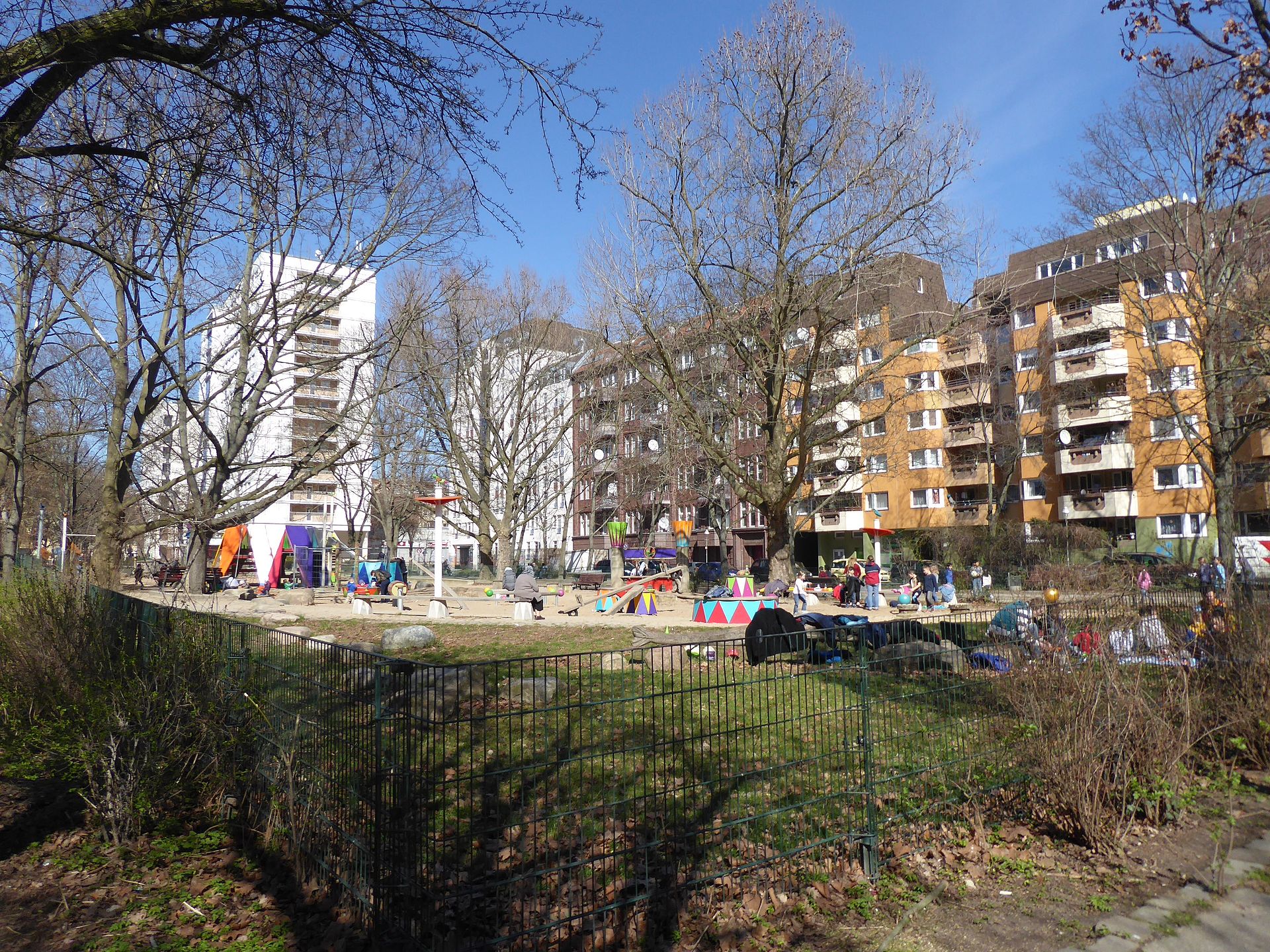
A playground at Sparrplatz in Wedding: Wedding Sparrplatz-002 by Fridolin freudenfett, CC BY-SA 4.0, via Wikimedia Commons.
Final Word
The mistake most visitors make in Berlin is treating it as a city with a centre and a periphery. It is not one. It is a collection of towns that were welded together in 1920, cut in half in 1961, welded back in 1990, and never quite settled into a hierarchy — which is why the best restaurant, the best park and the most interesting museum are frequently in three different districts, none of them Mitte.
The practical consequence is simple. Do not try to see Berlin; pick two or three districts and spend real time in each. A whole afternoon in Neukölln will tell you more about this city than a fortnight of ticking landmarks off a list in Mitte — and it is, incidentally, the version of the trip that costs the least.