Prenzlauer Berg Guide: Cafes, Prams and Pre-War Facades
Berlin's most gentrified district is also its most beautiful streetscape. The markets, the free GDR museum, Mauerpark on a Sunday, and the history under the prettiness.
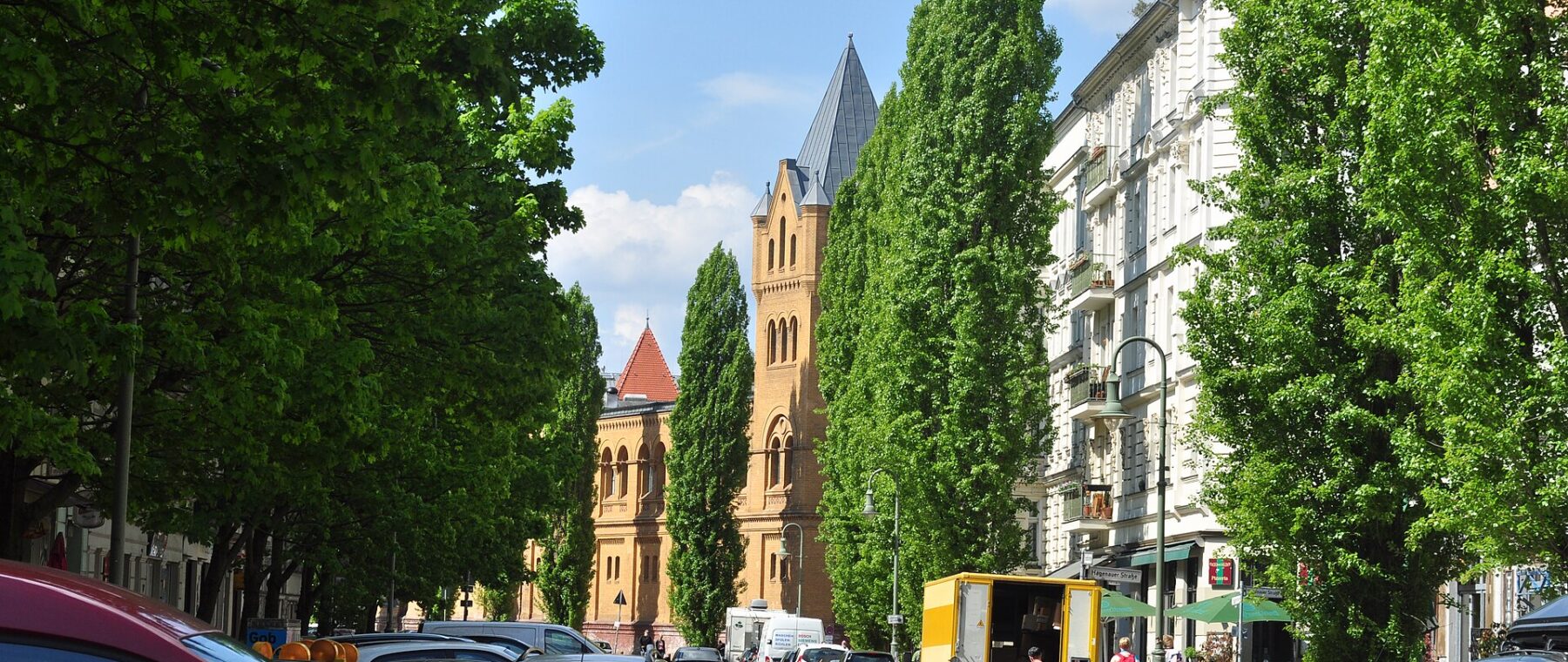
Prenzlauer Berg is the punchline of every joke Berliners tell about gentrification — the cargo bikes, the organic bakeries, the playgrounds full of prams, the sense that a whole district has been power-washed. The jokes are earned. What they leave out is that this is also, by a comfortable margin, the most beautiful streetscape in Berlin: several square kilometres of intact nineteenth-century apartment blocks with plane trees down the middle of the road, which almost no other part of the city can offer. Any honest Prenzlauer Berg Berlin guide has to hold both of those things at once.
This one covers why the district looks the way it does, the squares and streets worth your time, the free museum most visitors miss, the Sunday that everybody spends here, and the harder history buried under the prettiness — including a water tower that was one of the earliest Nazi torture sites and a church that helped bring down a state. Details were checked in September 2026. For the wider map, see our Berlin neighbourhoods guide.
Prenzlauer Berg at a Glance
| Area | What is there | Best time |
|---|---|---|
| Kollwitzkiez | Saturday farmers’ market, the water tower, restored blocks | Saturday morning |
| Helmholtzplatz | Cafés, playgrounds, the district at its most residential | Weekday afternoon |
| Kulturbrauerei | Free GDR everyday-life museum, cinema, venues | Any day; markets in December |
| Mauerpark | Sunday flea market, outdoor karaoke, a Wall remnant | Sunday, from late morning |
| Kastanienallee | Shops, bars, the district’s main promenade | Early evening |
| Schönhauser Allee | The U2 viaduct, the Jewish cemetery, ordinary shopping | Daytime |
| Nightlife | Almost none by Berlin standards | Go to Friedrichshain |
Why It Looks Like This
Three accidents, in sequence.
First, the bombing largely missed it. Prenzlauer Berg was dense working-class housing with no strategic targets in it, and while the district was not untouched, it came through 1943–45 far better than almost anywhere else in inner Berlin. Second, the GDR had no money to modernise it. For forty years the blocks stood with coal heating, shared lavatories on the landings and crumbling stucco — which was miserable to live in, and which meant nobody demolished them or covered them in new façades. Third, after 1990 the entire district was restored in about fifteen years by private money moving very fast into cheap property with clear historic value.
The consequence you can see is the streetscape. The consequence you cannot see is that almost everybody was replaced: studies of the district’s population turnover after reunification have put the figure as high as four in five residents. A neighbourhood that had been poor, East German and elderly became prosperous, largely West German and young, within about a decade. That is the whole gentrification argument in one district, and it is why Berliners are so sharp about it.
Kollwitzplatz and the Kollwitzkiez
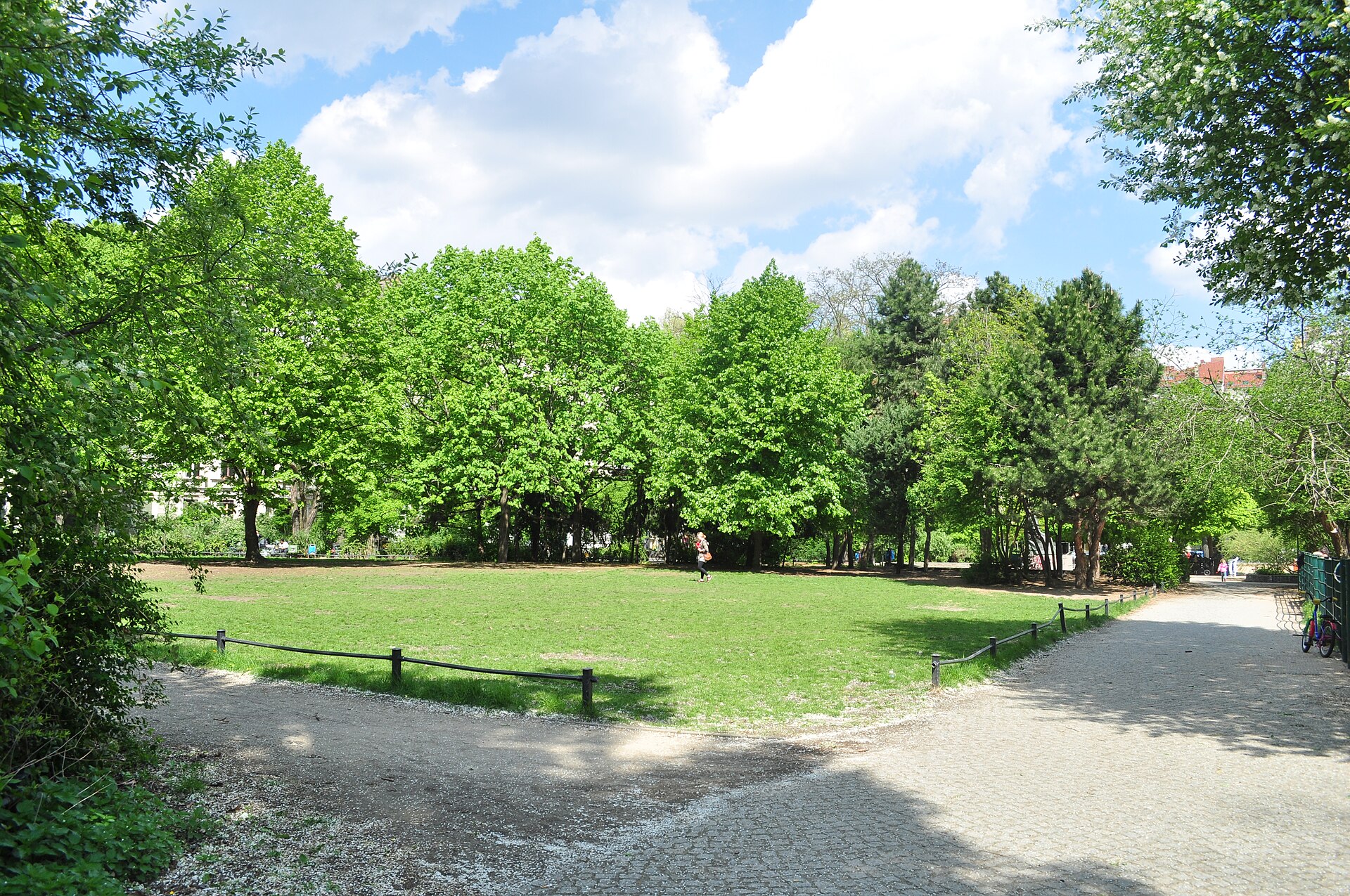
The district’s showpiece square: a triangular green with mature trees, playgrounds at each end, and cafés and restaurants around the edge. It is named after the artist Käthe Kollwitz, who lived on the square for around fifty years and whose prints and sculptures of grief, poverty and war are among the most powerful German art of the twentieth century. A bronze figure of her by Gustav Seitz sits on the green.
The Saturday farmers’ market here is one of the best in Berlin and also one of the most expensive — good cheese, good bread, good vegetables, and prices that are a running local joke. It runs through the morning and into the early afternoon.
The Wasserturm, and what happened in it
A short walk south stands the Wasserturm on Knaackstraße — a round brick water tower of 1877, Berlin’s oldest, nicknamed “Fat Hermann”, converted long ago into flats and ringed by a small park on a mound. It is the district’s most photographed building.
In 1933, the SA used the adjoining machine room as one of the earliest of the Nazis’ improvised detention and torture sites, before the formal camp system existed. Prisoners were held and beaten there and a number were killed. There is a memorial stone. It takes about a minute to read and it changes the character of the pleasant green mound entirely, which is the point of it. Our Nazi history in Berlin guide covers the wider network of these early sites.
Helmholtzplatz, Kastanienallee and the Streets Between
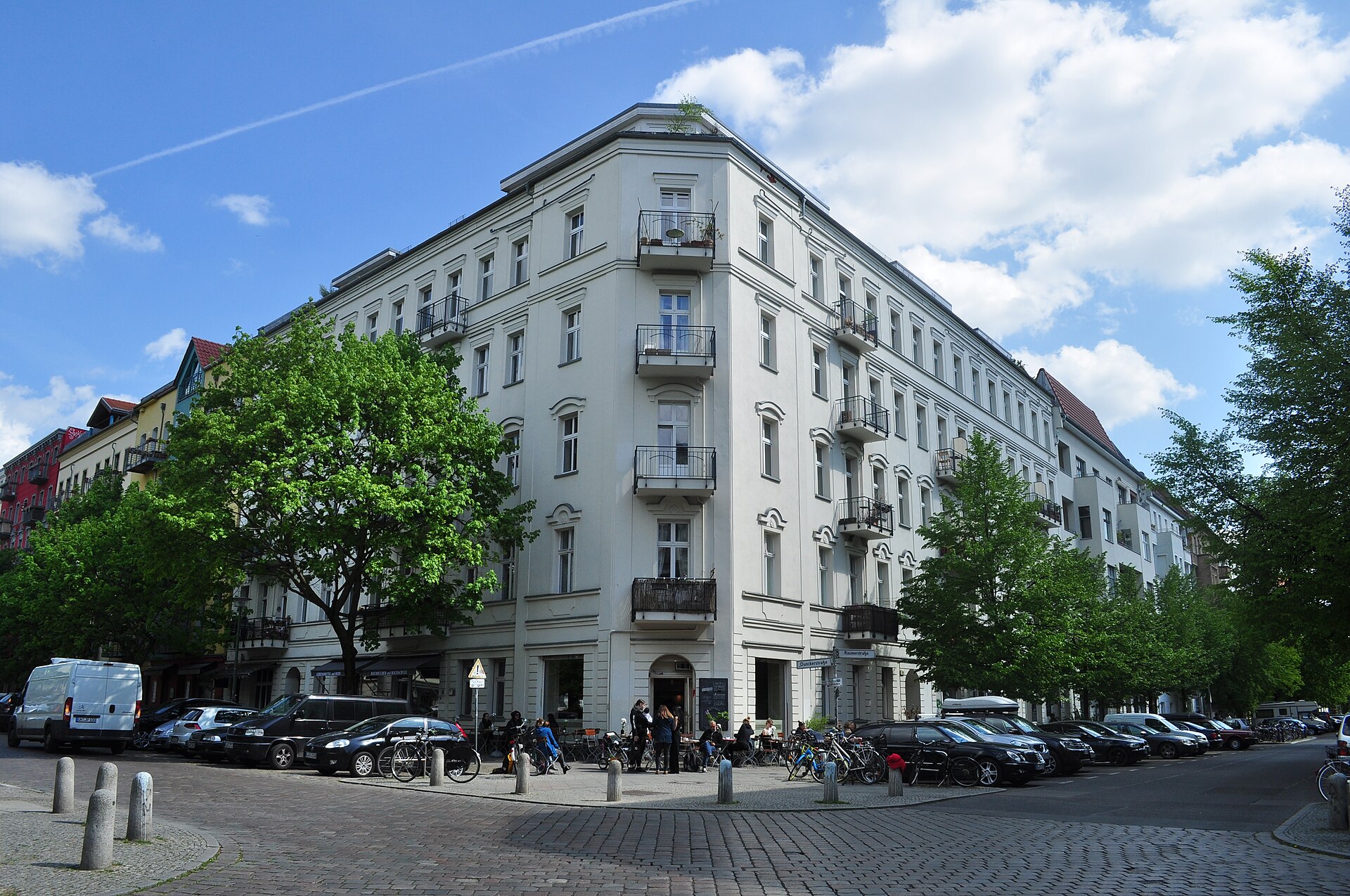
Helmholtzplatz is Kollwitzplatz without the market or the visitors: a square of cafés and playgrounds surrounded by the district’s most consistently intact Gründerzeit blocks. The streets radiating from it — Lychener, Raumerstraße, Dunckerstraße — are where to walk if you want to understand what pre-war Berlin actually looked like at street level.
Kastanienallee, running south-west towards Mitte, is the district’s promenade: independent shops, bars with tables on the pavement, the Prater beer garden (Berlin’s oldest, dating to the 1830s) at the top end, and enough posing that Berliners nicknamed it Casting-Allee years ago. The M1 tram runs down the middle of it.
The Kulturbrauerei and Its Free Museum
An enormous red and yellow brick brewery complex of the 1890s, built for Schultheiss, occupying a whole block between Schönhauser Allee and Knaackstraße. It now holds a cinema, concert venues, restaurants and a courtyard that fills up in summer, and it hosts one of the pleasanter Berlin Christmas markets in December.
The reason to make a point of coming is inside it: a permanent exhibition on everyday life in the GDR, run by the federal foundation that manages Germany’s contemporary history museums, and free to enter. It covers work, holidays, housing, shopping, conformity and dissent, with the objects and the interiors, and it is the best free introduction in Berlin to what living in East Germany was actually like — better, in several respects, than the paid DDR Museum in Mitte, which is more hands-on and considerably more crowded.
Mauerpark on a Sunday
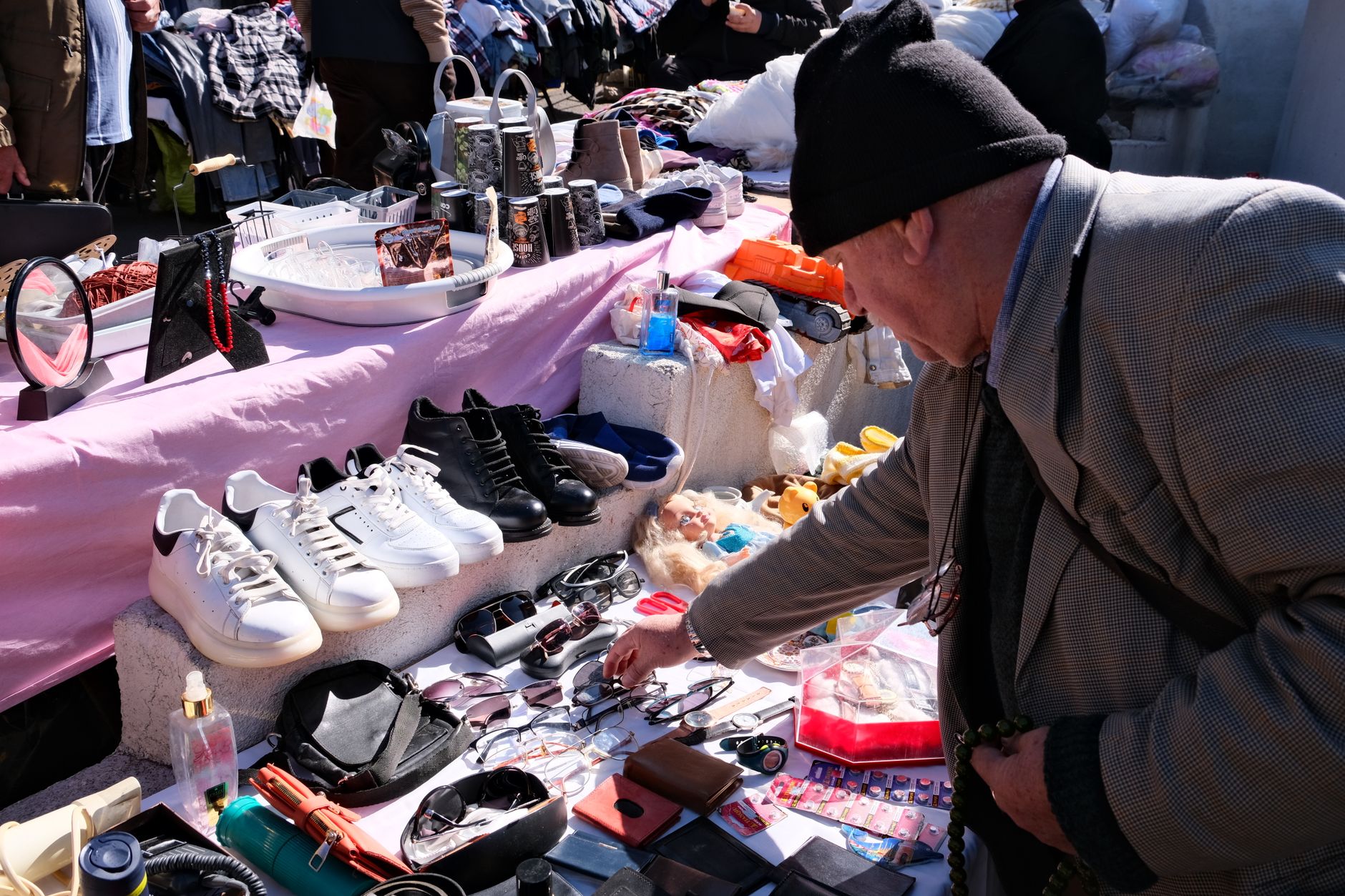
Built on the former death strip between Prenzlauer Berg and Wedding — the name means “Wall Park” and a section of the actual Wall still runs along the top edge, now permanently repainted by anyone with a spray can. On Sundays it holds one of Berlin’s biggest flea markets and, in the warmer months, the open-air karaoke in the stone amphitheatre that has been running for years and regularly draws several hundred people sitting on the steps.
It is crowded, it is a little chaotic, and it is one of the genuinely unmissable Berlin experiences. Go from late morning; bring cash; expect the market to be a mix of real junk, real finds and a certain amount of new stock being sold as vintage. Our flea markets guide is specific about which stalls are worth your time.
Ten minutes west along Bernauer Straße is the Berlin Wall Memorial, which is the serious counterpart to all of this: a preserved section of the full border installation with the death strip, watchtower and documentation centre. Free, and the single best place in the city to understand how the Wall physically worked. See our Berlin Wall sites guide.
The Autumn of 1989
Prenzlauer Berg was one of the centres of the East German opposition, and the Gethsemanekirche on Stargarder Straße was where a good deal of it happened. Through the autumn of 1989 the church held nightly prayers and vigils that spilled into the street, drawing thousands of people at a time when doing so was a serious risk. In early October the Stasi and police moved against the crowds around the church with real violence, days before the regime began to collapse.
The church is still a working parish and is usually open. There is nothing dramatic to see, which is rather the point: an ordinary red-brick neighbourhood church on an ordinary street, where a few hundred people standing outside with candles turned out to matter. Our reunification guide follows what happened next.
Schönhauser Allee and the Jewish Cemetery
The district’s main artery runs north-east with the U2 on an elevated iron viaduct above the middle of the road — noisy, dark underneath, and one of the more atmospheric streets in the city. It is an ordinary shopping street rather than a pretty one, and it is where the district does its actual errands.
Partway along stands the Jewish cemetery, opened in 1827, a densely wooded enclosure holding around 20,000 graves including those of the painter Max Liebermann, the composer Giacomo Meyerbeer and the publisher Leopold Ullstein. It was damaged in the Nazi period and during the war, and it is now quiet, overgrown and almost empty of visitors. Men are asked to cover their heads; opening hours are limited and it is closed on Saturdays.
Further north-east, Thälmannpark holds a colossal bronze head of the communist leader Ernst Thälmann, erected by the GDR in 1986 and now a listed monument that the city has repeatedly discussed and never removed. The Zeiss-Großplanetarium next to it is one of the most technically advanced planetariums in Europe and is a genuinely good rainy-afternoon option.
How to Read the Buildings
Prenzlauer Berg rewards looking up more than any district in Berlin, because the blocks here are unusually complete and the details survived. A few things to notice as you walk:
- The courtyards. Each block is built around a chain of interior yards — the ornate front building faced the street and housed the better-off, and the flats got smaller, darker and cheaper the further back you went. Where gates are open, people walk through. Several of the courtyards here have been turned into gardens, workshops and cafés.
- Stucco, or the absence of it. A great deal of the district’s decorative plasterwork was knocked off in the 1950s and 60s, partly because it was damaged and partly on ideological grounds — ornament was considered bourgeois. Restored blocks have had it rebuilt; unrestored ones are flat-fronted. You can date a renovation by looking at the cornices.
- Stolpersteine. The small brass cobbles in the pavement, each engraved with the name of a person deported and murdered under the Nazis, laid outside their last freely chosen address. Prenzlauer Berg has a great many, and they are easy to miss on a street this pleasant.
- Bullet damage. Look at the ground floors on the less-restored streets. The pockmarks are from 1945, and several buildings have been repaired around them rather than over them.
Three Walks That Work
The Sunday (about four hours)
Eberswalder Straße U-Bahn, Mauerpark flea market and karaoke, south through the Kollwitzkiez to the market square, the Wasserturm, then the Kulturbrauerei for the free GDR exhibition, finishing with a drink at the Prater. This is the day most people should have here.
The quiet weekday (about two hours)
Senefelderplatz, the Jewish cemetery on Schönhauser Allee, north under the U2 viaduct, west to Helmholtzplatz, then the streets around Dunckerstraße and Lychener Straße. Almost no visitors, and the best of the streetscape.
The history walk (about three hours)
Bernauer Straße and the Berlin Wall Memorial, east into Mauerpark to see the surviving Wall section, then the Gethsemanekirche on Stargarder Straße, and finally the Wasserturm memorial. Three regimes, one district, under two miles of walking. Our Berlin history itinerary extends it across the city.
Eating, Drinking and the Brunch Question
Prenzlauer Berg is the capital of Berlin brunch, and that is both a recommendation and a warning. On a Sunday, every café around Kollwitzplatz, Helmholtzplatz and Kastanienallee is full from about eleven, the buffets are extensive, and you will wait. It is genuinely enjoyable and it is genuinely expensive by Berlin standards — our brunch guide covers where it is worth the queue.
Beyond brunch: the district has good bakeries, a very high density of coffee places that take coffee extremely seriously, excellent ice cream, and a solid but unspectacular restaurant scene. What it does not have is cheap eating — for that, go one district south or east. Our coffee and cafés guide is largely set here, and the cheap food guide is largely set elsewhere.
For beer, the Prater beer garden on Kastanienallee has been operating since the 1830s and is the oldest in the city — chestnut trees, long tables, self-service at the counter. See our beer gardens guide.
Nightlife: Manage Your Expectations
There isn’t much, and that is deliberate. Prenzlauer Berg had a serious alternative scene in the 1990s, when the district was still half-derelict, and residents’ noise complaints, rising rents and a large child population have steadily removed it. There are good bars, particularly around Helmholtzplatz and Kastanienallee, and they mostly close at a civilised hour.
If you want a Berlin night out, take the M10 tram to Warschauer Straße and read our Friedrichshain guide. Twelve minutes away, entirely different city.
With Children
This is the best district in Berlin to be in with small children, by some distance. Playgrounds are everywhere and they are good ones — the district has among the highest densities in the city. Cafés expect prams and are not irritated by them. The streets are quiet, the pavements are wide, and there are several traffic-calmed play streets.
Specific stops: the planetarium at Thälmannpark, the Kulturbrauerei’s cinema, the playgrounds at both ends of Kollwitzplatz, and Mauerpark’s enormous slope for running down. Our Berlin with kids guide and playgrounds guide have more.
Getting Around
The U2 runs up Schönhauser Allee — Senefelderplatz, Eberswalder Straße, Schönhauser Allee — and is the fastest way in from Alexanderplatz. The M1 tram runs from Museum Island up through Mitte and the length of Kastanienallee, and is the most scenic approach. The M10 connects across to Friedrichshain and west to Hauptbahnhof. The S-Bahn ring stops at Schönhauser Allee and Prenzlauer Allee.
All fare zone A — see our BVG ticket guide. The district is flat and compact, and walking or cycling is the right way to see it; the whole area from Mauerpark to Kollwitzplatz is a twenty-minute walk.
Frequently Asked Questions
Is Prenzlauer Berg worth visiting?
For a walk, a Saturday market and a Sunday at Mauerpark, yes — it has the best-preserved nineteenth-century streetscape in Berlin and the free GDR everyday-life museum at the Kulturbrauerei. For nightlife, no. It is one of the quietest inner districts after about eleven.
Why is Prenzlauer Berg so gentrified?
Because it came through the war largely intact, was left unmodernised for forty years under the GDR, and was then restored very quickly by private money after 1990. Studies have put the resulting turnover of residents at as much as four in five. The buildings survived; the population largely did not.
What is there to do in Prenzlauer Berg?
The Kulturbrauerei’s free exhibition on everyday life in the GDR, the Saturday market at Kollwitzplatz, the Sunday flea market and karaoke at Mauerpark, the Jewish cemetery on Schönhauser Allee, the Zeiss planetarium, and several hours of simply walking the streets around Helmholtzplatz.
Is the Mauerpark flea market worth it?
Yes, on a Sunday, from late morning. It is large, crowded and a mix of genuine finds and new stock sold as vintage. The outdoor karaoke in the amphitheatre runs in the warmer months and is worth staying for even if you have no intention of singing.
Is Prenzlauer Berg good for families?
It is the best district in Berlin for visiting with small children — high playground density, quiet streets, pram-tolerant cafés, and the planetarium and Kulturbrauerei cinema for wet days.
How long do you need in Prenzlauer Berg?
Half a day for the Kollwitzkiez, the water tower and the Kulturbrauerei. A full day if you add Mauerpark, which realistically means coming on a Sunday. It combines naturally with the Berlin Wall Memorial on Bernauer Straße, ten minutes west.
What is the Wasserturm in Prenzlauer Berg?
Berlin’s oldest water tower, built in 1877 and converted into flats. It is also the site of one of the earliest Nazi improvised detention and torture facilities, used by the SA in 1933 before the formal camp system existed. A memorial stone stands at the base.
Related Berlin Guides
- Berlin Neighbourhoods: What Each District Is Actually Like
- Friedrichshain Guide: Clubs, Karl-Marx-Allee & the RAW Site
- Mitte Guide: The Tourist Core, Minus the Tourist Traps
- Best Flea Markets in Berlin
- Berlin Wall Sites and Memorials
- Best Brunch in Berlin
- Berlin Coffee and Cafés
- Berlin With Kids
Photo Credits
Sredzkistraße towards the Kulturbrauerei: Berlin – Prenzlauer Berg – Looking along Sredzkistraße toward the KulturBrauerei by Joe Mabel, CC BY-SA 4.0, via Wikimedia Commons.
Kollwitzplatz: Berlin-Prenzlauer Berg – Kollwitzplatz 01 by Joe Mabel, CC BY-SA 4.0, via Wikimedia Commons.
Streets beside Helmholtzplatz: Berlin-Prenzlauer Berg – Apartment building and cafe at the corner of Dunckerstraße & Raumerstraße, 2018 by Joe Mabel, CC BY-SA 4.0, via Wikimedia Commons.
Final Word
It is easy to be sniffy about Prenzlauer Berg, and Berliners do it constantly. But the district is quietly one of the most instructive places in the city, precisely because it looks so untroubled. A water tower that was a torture site. A parish church whose congregation helped end a state. A cemetery full of people whose descendants were murdered. A park built on a death strip, now full of people singing. All of it inside twenty minutes’ walk, under plane trees, next to a very good bakery.
Come on a Sunday. Do Mauerpark in the morning, walk south through the Kollwitzkiez, stop at the water tower and read the stone, and finish at the Kulturbrauerei in the free museum about how ordinary people lived on this side of the Wall. It is one of the best days in Berlin and it will cost you the price of breakfast.