Neukoelln Guide: Berlin’s Fastest-Changing District
Kreuzkölln bars, Sonnenallee's Arab bakeries, Tempelhofer Feld at sunset and a 1737 Bohemian village off Karl-Marx-Straße — what Neukölln is really like, street by street.
Stand at the top of the steps at Hermannplatz on a Friday afternoon and you can see most of Neukölln’s arguments with itself in one sweep. A women’s headscarf shop next to a natural-wine bar. A Turkish grandmother with a shopping trolley overtaken by a twenty-six-year-old from Melbourne on a rented bike. A queue outside a bakery selling knafeh, a queue outside a café selling flat whites, and not a single person in either queue looking at the other. Neukölln is where Berlin’s newest arrivals and its longest-settled immigrant communities share the same pavements, and any Neukölln Berlin guide that pretends the district is only one of those things is selling you a postcard.
This guide covers what Neukölln is actually like, street by street: the canal-side Reuterkiez that everyone calls Kreuzkölln, Sonnenallee and the Arab Berlin that grew up along it, the Schillerkiez on the edge of Tempelhofer Feld, the eighteenth-century Bohemian village hiding off Karl-Marx-Straße, and the two genuinely remarkable things out in the south of the district that almost no visitor reaches. Prices and opening hours were checked in September 2026; treat them as the right order of magnitude and confirm before you go. If you are still deciding which district to explore first, start with our Berlin neighbourhoods guide.
Neukölln at a Glance
| Area | What it is like | Best time | Cost |
|---|---|---|---|
| Reuterkiez (“Kreuzkölln”) | Canal, bars, young internationals, the Turkish Market | Tuesday or Friday afternoon, then evening | Free; drinks €4–7 |
| Sonnenallee | Arab Berlin: bakeries, grills, sweet shops, shisha cafés | Early evening, hungry | A full meal under €12 |
| Schillerkiez | Residential, cafés, the Neukölln edge of Tempelhofer Feld | Late afternoon into sunset | Free |
| Tempelhofer Feld | A former airport, now open ground with runways intact | Summer evening; any dry day | Free |
| Rixdorf / Böhmisches Dorf | Cobbled 1730s village of Bohemian refugees | Weekday morning; Advent market | Free |
| Körnerpark | Sunken formal garden with a free gallery | Summer Sunday concert | Free |
| Klunkerkranich | Rooftop bar on a shopping-centre car park | Sunset, dry weather | Small door charge at peak times |
| Hufeisensiedlung, Britz | UNESCO-listed 1920s housing estate | Daytime, any season | Free |
| Britzer Garten | Big landscaped park, the south’s day out | Spring bulbs, autumn colour | €5 (Mar–Oct), €2 (Nov–Feb) |
What Kind of Place Neukölln Is
Neukölln is a big district — over 300,000 people — and most of it is not what the travel features describe. The part those features mean is the northern third, inside the S-Bahn Ring: a dense grid of five-storey tenement blocks between the Landwehr Canal, Tempelhofer Feld and the railway. South of the Ring the district turns into something else entirely — Britz, Buckow and Rudow, with garden-city estates, allotments, detached houses and the 1960s tower blocks of Gropiusstadt. You can spend a week in the north and never know the south exists.
For most of the twentieth century North Neukölln was a working-class district with a bad name. It was home to the Kindl brewery and a great many factory workers, it voted red, and after 1961 it sat hard against the Wall on its eastern side, which made it a cul-de-sac of West Berlin. From the late 1960s it became one of the centres of Turkish Berlin, and from the 1980s onwards Arabic-speaking families — many of them Palestinians and Lebanese who had fled the civil war in Lebanon — settled along Sonnenallee. More recently Syrian arrivals after 2015 have given that street a second wave of bakeries and restaurants.
Then, somewhere around 2008, the rents in Kreuzberg and Friedrichshain went up far enough that students, artists and English-speaking newcomers started crossing the canal. Within a decade the Reuterkiez had become one of the most talked-about neighbourhoods in Europe. Rents rose steeply, long-standing shops were replaced, and “Neukölln” went from a word Berlin tabloids used for crime stories to a word lifestyle magazines used for cool. Both versions were always exaggerated. What you will actually find is a crowded, noisy, very mixed part of the city that is still in the middle of changing, which is precisely what makes it interesting.
The name tells you something
Until 1912 the town was called Rixdorf, and Rixdorf had a reputation. Its dance halls and beer gardens drew Berliners out for weekends of cheerful excess, and a popular song — “In Rixdorf ist Musike” — made it a byword for exactly that. The town council, keen to be taken seriously as it grew into a city, renamed itself after the medieval Cölln on the Spree, the twin town of old Berlin. “New Cölln” was an attempt at respectability. A century later the district is famous for nightlife again, which would probably amuse the people who changed the name.
Reuterkiez: The Part Everyone Calls Kreuzkölln
The triangle between the Landwehr Canal, Sonnenallee and Kottbusser Damm is the Neukölln most visitors come for. Estate agents invented the name Kreuzkölln for it, which Berliners mock and then use anyway, because it does describe the place: a continuation of Kreuzberg’s canal-side life across the water, a little rougher and a little younger.
Maybachufer and the Turkish Market
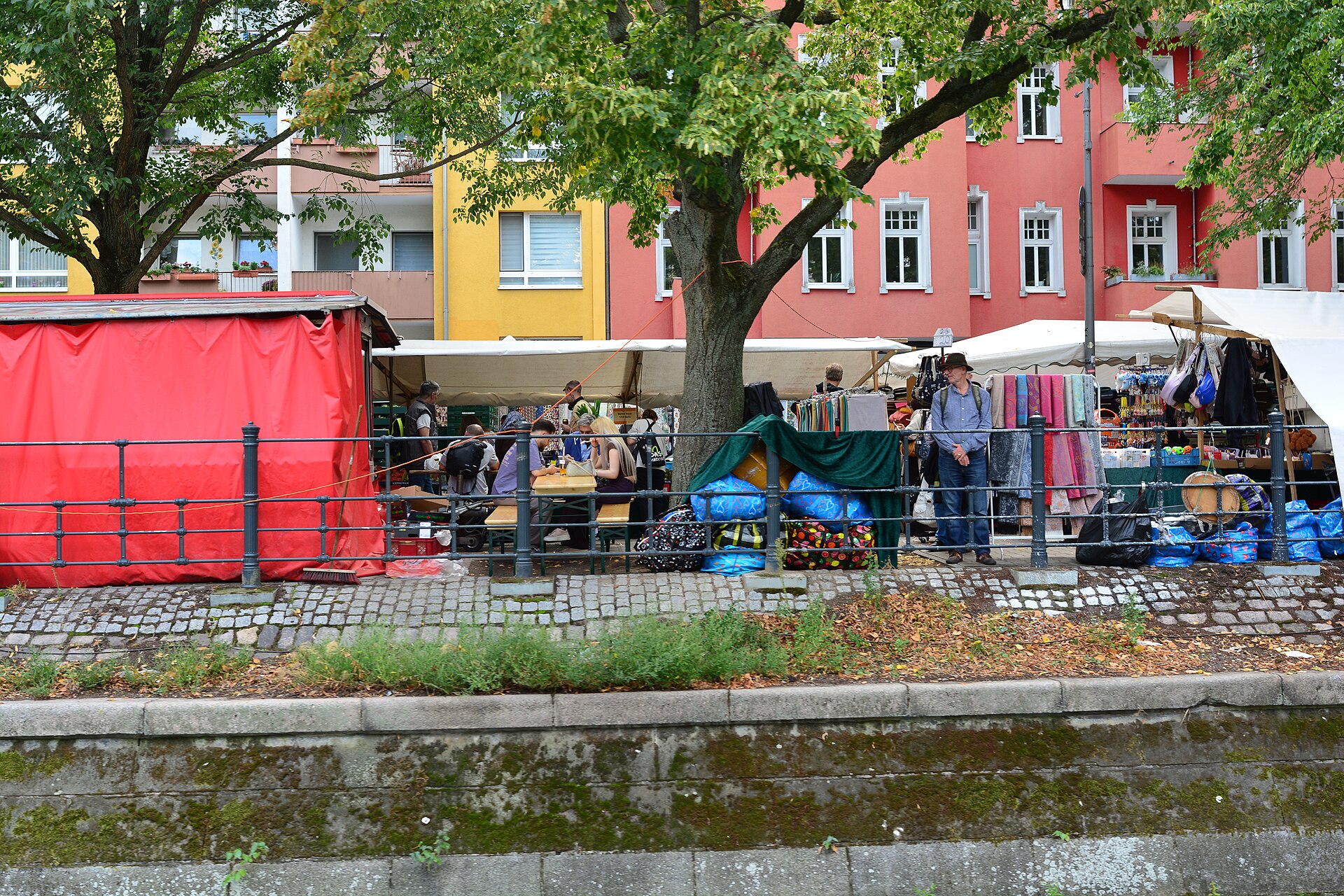
The canal bank along Maybachufer is the district’s front garden. On Tuesdays and Fridays it hosts the Turkish Market, a long double row of stalls selling vegetables by the bowl, olives, cheeses, fabric, flatbread and gözleme cooked in front of you. Friday is busier, louder and more fun; Tuesday is quieter and better if you actually want to buy things. Our Turkish Market guide goes stall by stall. On the other days the same stretch is simply a lovely place to sit with your legs over the water, which on a warm evening is what several hundred people are doing.
Weserstraße, Pannierstraße and the bar grid
Weserstraße is the spine of Neukölln’s bar scene: a long, unglamorous street where a surprising proportion of ground-floor units are now small bars, most of them dim, smoky in the tolerated Berlin way, cash-friendly and busy from about ten. The side streets around Pannierstraße and Reuterplatz add wine bars, natural-wine shops that pour glasses at the counter, and the kind of café where the menu is in English first. None of it is dressy. A beer runs €4–5, a glass of wine €6–7. If you are after clubs rather than bars, Neukölln has a few, but it is not the district for them — our best bars in Berlin guide and the Berlin nightlife guide put it in context.
The honest verdict: Weserstraße is excellent on a Thursday and somewhat exhausting on a Saturday, when it feels as if every twenty-something in Europe has arrived at once. If you want to see the neighbourhood rather than the party, come in daylight and walk the side streets, where the bakeries and hardware shops and Turkish social clubs that were here first are still very much trading.
Sonnenallee: Arab Berlin
Walk south-east from Hermannplatz along Sonnenallee and within five minutes the shop signs are mostly in Arabic. This is the heart of Arab Berlin — sometimes called “Arab Street” in guidebooks, never by the people who live there — a long, straight, traffic-heavy road lined with grills, falafel counters, sweet shops stacked with baklava, juice bars, wedding-dress boutiques, phone shops and bakeries turning out man’ouche and knafeh through the day.
It is the best cheap eating in Berlin, and the argument for that is not close. A falafel wrap costs roughly €4–5, a plate of hummus with warm bread and pickles not much more, and a mixed grill for two with salads will rarely clear €30. The hummus places towards the Hermannplatz end have long waiting lists of devotees; the Syrian bakeries further along are where to buy a box of sweets to carry home. For the wider cheap-eats picture see our cheap food in Berlin guide, and for the döner debate that inevitably follows, Berlin döner kebab.
Sonnenallee has also had a hard few years in the headlines, and it is worth being straight about that rather than pretending otherwise. The street has been the focus of police operations against organised crime families, and since October 2023 it has been the site of heated and sometimes confrontational demonstrations over the war in Gaza. For a visitor walking through in daylight to eat, none of this translates into personal risk. It does mean you may see a heavy police presence, and on days of planned protest it is sensible to eat somewhere else. Our Berlin safety tips page gives the city-wide picture.
The film and the far end
The street’s name has a second life for Germans. Its south-eastern end ran straight into the Berlin Wall at the Treptow border, where a crossing point for West Berliners stood, and Leander Haußmann’s 1999 comedy Sonnenallee is set on the short East Berlin stretch beyond it. The film is a cult classic about growing up in the GDR within earshot of the West. There is almost nothing to see of the border now, but it is a good reminder of how close all this was to the edge.
Schillerkiez and Tempelhofer Feld
West of Hermannstraße, the Schillerkiez is the residential grid that backs straight onto the old airfield. Ten years ago it was one of the cheapest corners of inner Berlin; now it is a place of cafés with oat milk and very long weekend brunches, grouped around Herrfurthplatz and the red-brick Genezareth church. It is quieter than the Reuterkiez and in many ways nicer, but it exists as a neighbourhood mostly because of what is at the end of its streets.
Tempelhofer Feld
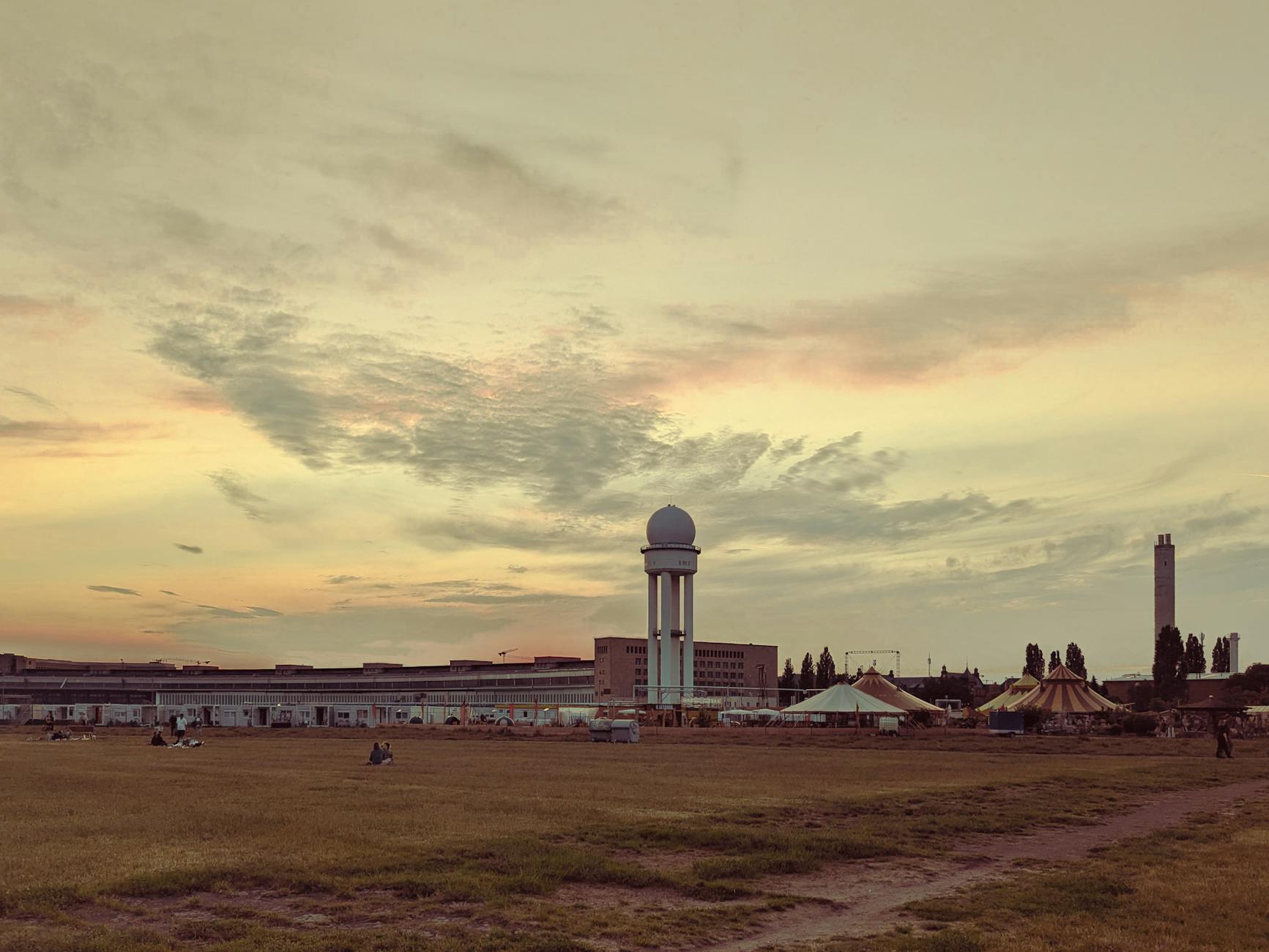
Tempelhof Airport closed in 2008. Instead of building over the site, Berlin opened the entire airfield to the public in 2010, and in 2014 its citizens voted in a referendum to keep it that way. The result is one of the strangest and best public spaces in any European capital: more than 300 hectares of open grass and sky, criss-crossed by the original runways, where people cycle, skate, kite-surf on wheels, grill, fly kites, garden in a community plot and simply walk for an hour in a straight line. The terminal building, one of the largest in the world when it was built in the 1930s, sits on the far Tempelhof side.
The Neukölln side is the lively one. The main entrance at Oderstraße/Herrfurthstraße is five to seven minutes’ walk from U8 Leinestraße or Boddinstraße, and there are five further gates along Oderstraße. Entry is free. The field closes at night, and the hours move with the daylight:
| Months | Opening hours |
|---|---|
| June, July | 06:00–22:30 |
| May, August | 06:00–21:30 |
| April, September | 06:00–20:30 |
| March | 06:00–19:00 |
| October | 07:00–19:00 |
| February, November | 07:00–18:00 |
| January, December | 07:30–17:00 |
If you are caught inside at closing time, the gates at Oderstraße/Herrfurthstraße and at the Oderstraße crash gate have revolving exits. Bring a jacket: there is no shelter on the field at all, and the wind across an airfield is a very particular kind of cold. Summer sunsets here are spectacular and entirely free, which is why half the district has the same idea. For bike rental and routes, see Berlin by bike, and for more green space around the city our outdoor activities guide.
Hasenheide: Worth It, With Eyes Open
The Volkspark Hasenheide, between Hermannplatz and Columbiadamm, is the district’s older park — hilly, wooded, with an outdoor cinema in summer, a small free animal enclosure that children love, and a claim to be the birthplace of German gymnastics, since Friedrich Ludwig Jahn opened his first open-air gymnastics ground here in 1811.
It is also Berlin’s best-known place for small-scale drug dealing, with men stationed along the paths near the entrances. They will murmur an offer and they will leave you alone when you ignore them; they are not a danger to anyone passing through in daylight. But it changes the feel of the park, particularly around the Hermannplatz side, and after dark it is not where you want to be walking. Go in the afternoon, head for the Rixdorfer Höhe hill and the animal enclosure, and you will have a perfectly pleasant time.
Karl-Marx-Straße and Rixdorf
Karl-Marx-Straße is Neukölln’s high street — not pretty, but real: discount stores, Turkish jewellers, mobile-phone repair shops, the Neukölln Arcaden shopping centre and the imposing Rathaus with its clock tower. It also holds two good cultural addresses. The Neuköllner Oper puts on inventive, often very funny contemporary music theatre in the Passage on Karl-Marx-Straße, and the Heimathafen Neukölln uses the grand old Saalbau for theatre, concerts and readings. Check programmes online; both are good value compared with the big houses in Mitte.
Klunkerkranich
On top of the Neukölln Arcaden, the Klunkerkranich is a sprawling, planted, cheerfully improvised rooftop bar built across a car-park deck. To find it, take the lift near the library and post office to level 5, then walk up the ramp. It opens most days from around 17:00, sometimes with a small door charge at busy times, and there is live music and DJs through the warmer months. It is a bar with a view rather than a viewing platform, and the view — west across the Neukölln roofs to the TV Tower and the sunset — is one of the best free-to-cheap ones in the city. It features in our best views in Berlin guide for that reason. Arrive before sunset in summer or you will not get a seat.
Böhmisches Dorf and Richardplatz
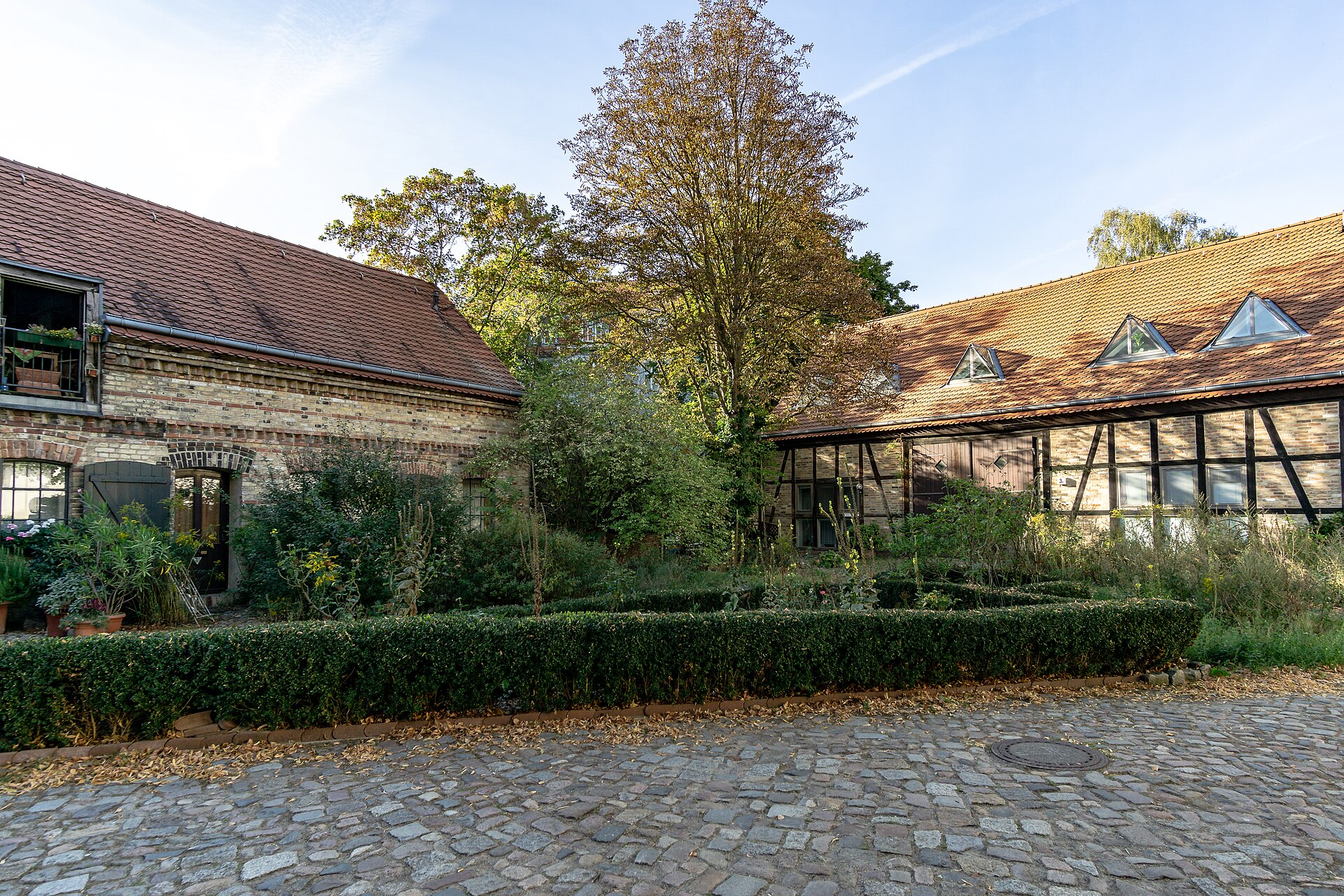
Two minutes east of U7 Karl-Marx-Straße, the city simply stops. Around Richardplatz and along Kirchgasse the streets are cobbled, the houses are low, there is a working smithy, a village church and farm buildings with gardens in front of them. This is Böhmisches Dorf, the Bohemian village, settled in 1737 by Protestant refugees from Bohemia who had fled religious persecution and been invited to Prussia by King Frederick William I. Their descendants kept a distinct community here for generations, and the layout of the village survived everything the twentieth century did to the land around it.
It is small — you can walk round it in twenty minutes — and it is a residential area, not an open-air museum, so be considerate with cameras. Look for the statue of the king on Kirchgasse, put up by grateful Bohemians, and the Comenius-Garten, a contemplative garden named after the seventeenth-century Czech educator Jan Amos Comenius, which visitors can usually wander into during the day. On the second weekend of Advent, Richardplatz holds the Alt-Rixdorfer Weihnachtsmarkt, a small, crowded, lantern-lit Christmas market run by local associations with a genuine village feel. It runs for just one weekend, so check the dates for the current year; our Berlin Christmas markets guide covers the bigger ones.
Körnerpark and the Stadtbad
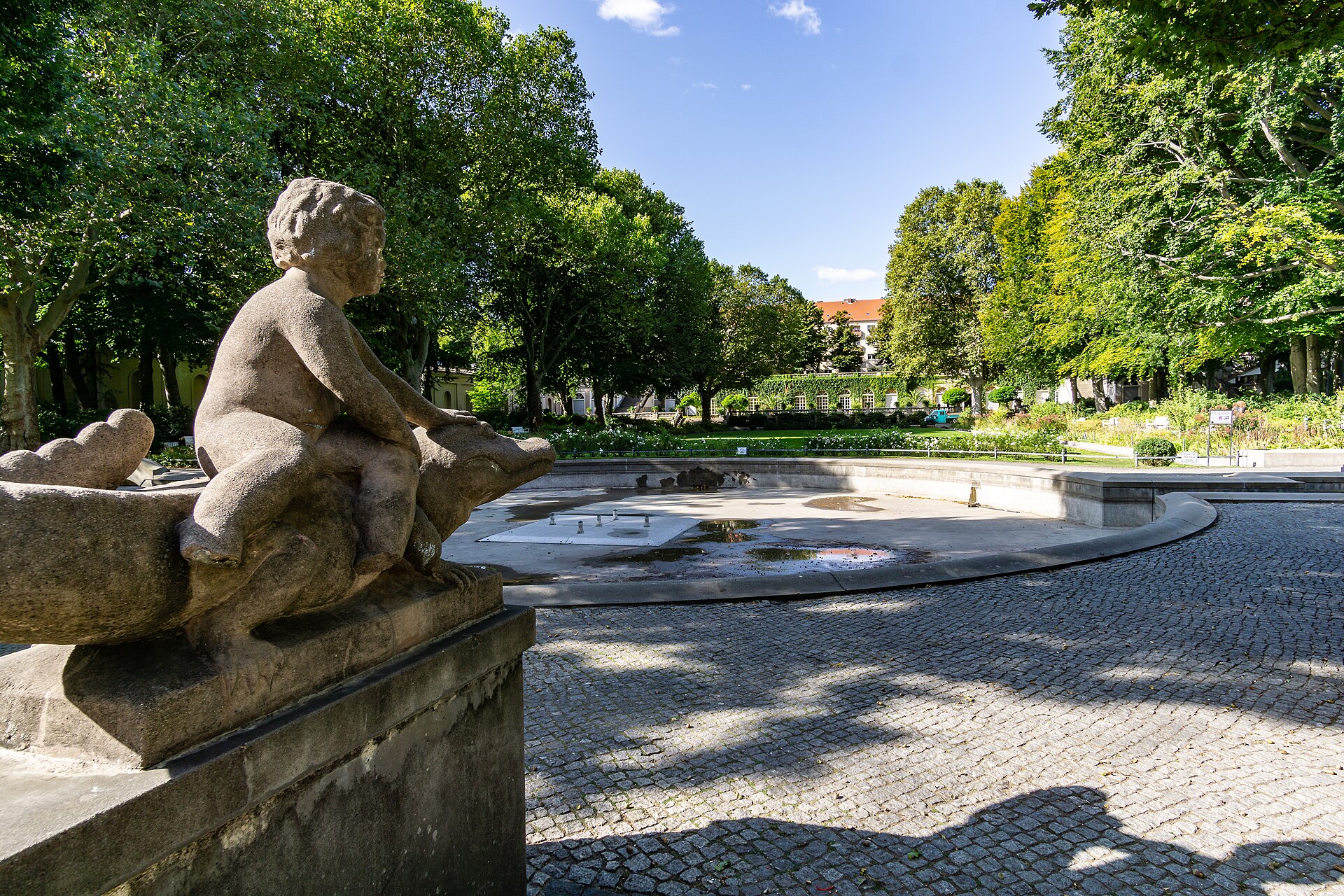
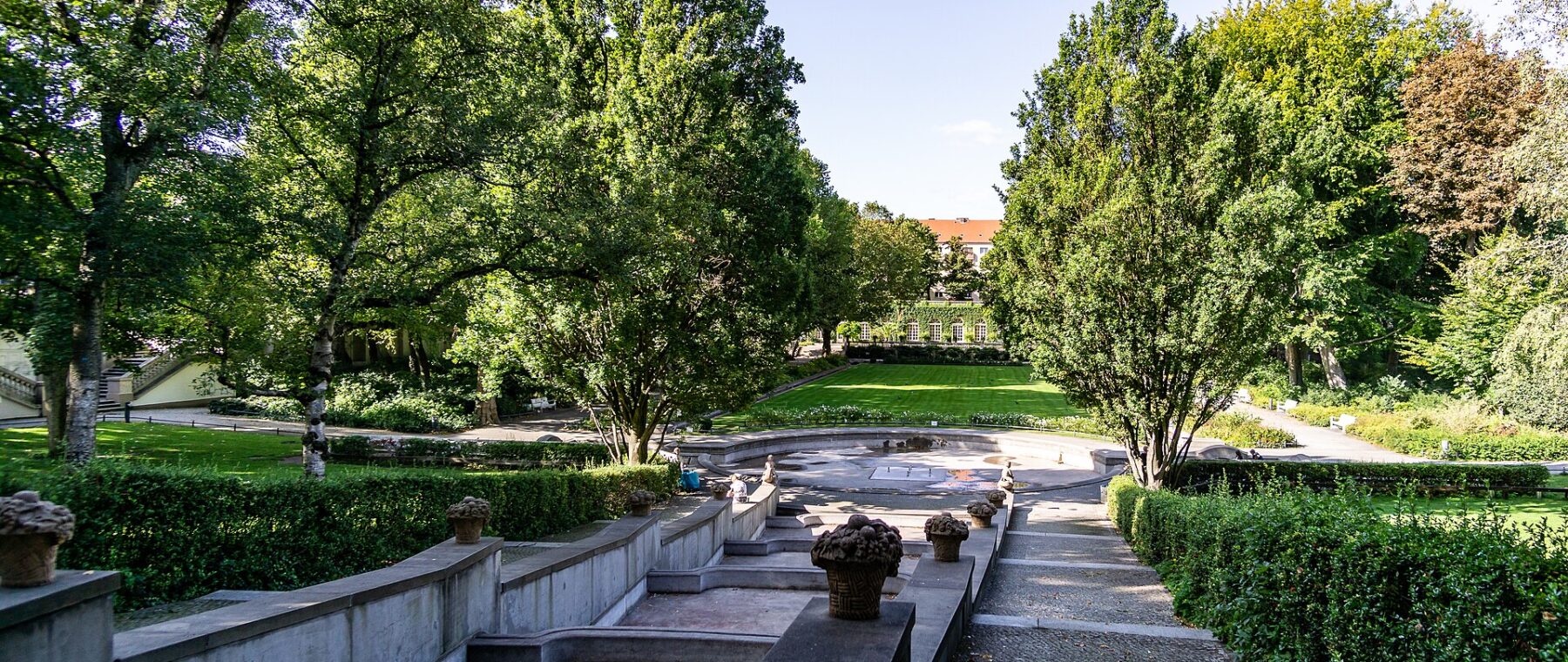
Körnerpark is one of the city’s best-kept secrets and one of its strangest parks. Laid out between 1912 and 1916 in a disused gravel pit, it is sunk below street level and designed in a formal neo-baroque style, with a water cascade, balustrades, stairs, clipped hedges and a long lawn ending at an orangery. The effect, after the traffic of Hermannstraße ten minutes away, is like stepping into a much richer city. The orangery houses the Galerie im Körnerpark, a municipal gallery with free contemporary exhibitions, and in summer there are free Sunday concerts on the lawn. It is ten minutes’ walk from S+U Neukölln. Do not expect the fountains to be running out of season.
Near the Rathaus, the Stadtbad Neukölln on Ganghoferstraße is the other public building the district should be prouder of: a swimming hall opened in 1914 in the style of a Roman bath, with columns, mosaics and coffered ceilings over the pool. Swimming in it is a proper Berlin experience rather than a tourist one. Adult entry has been around €7.50. The pool closes to the public for a summer break — in 2026 until the end of September — so check berlinerbaeder.de for the current timetable before you pack a towel.
South Neukölln: Two Reasons to Take the U7 Further
Almost nobody who visits Neukölln goes south of the Ring. Two places make the trip worthwhile, and they combine well into a single afternoon.
Hufeisensiedlung, Britz
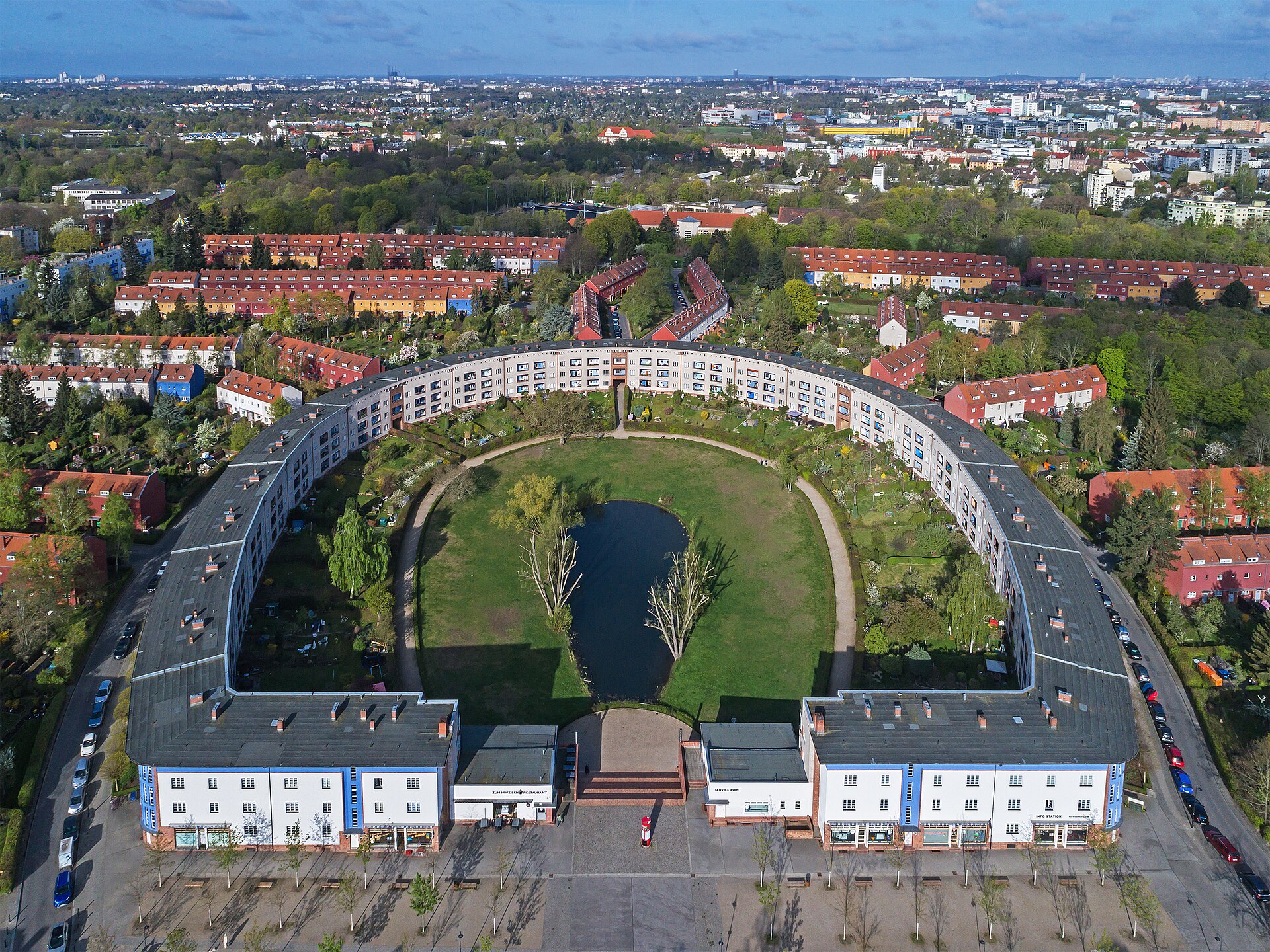
Between 1925 and 1933 the architect Bruno Taut and city planner Martin Wagner built one of the landmark housing estates of the twentieth century here: more than a thousand homes, the centrepiece a three-storey block bent into a horseshoe around a pond and a communal lawn. Every flat had light, air, a balcony or garden, and a proper kitchen and bathroom — ordinary now, radical for working-class Berliners then. The colours are deliberate and part of the design; Taut used bold blues, reds and yellows at a time when most of Berlin was grey.
In 2008 the estate was inscribed by UNESCO as one of the six Berlin Modernism Housing Estates. It is still lived in, so you are walking through someone’s neighbourhood, but the horseshoe itself is freely accessible. There is an info station in the ground floor of the horseshoe with material on the estate’s history, and a small restaurant beside it. Take the U7 to Parchimer Allee and walk five minutes. Unless modern architecture leaves you completely cold, this is the most significant building in Neukölln, and it takes less than an hour.
Britzer Garten
Further south, the Britzer Garten is a 90-hectare landscaped park created for the 1985 Federal Garden Show, with a lake, themed gardens, a huge spring tulip display, playgrounds, a working windmill and cafés. It is where south Berlin families spend Sunday. Admission is €5 for adults (€2.50 reduced) from March to October and €2 (€1 reduced) from November to February; under-sixes are free. It opens daily from 09:00 until dusk, with online tickets letting you through the automatic gates from 07:00. The main entrance is on Buckower Damm and the park is a bus ride from the southern stretch of the U7. It is worth it in April and May and in October, less so on a flat grey day in February.
And the one you can skip: Gropiusstadt
At the far southern end of the U7 stands Gropiusstadt, a 1960s and 70s high-rise estate planned by Walter Gropius’s office for around 50,000 people. It is known to most Germans as the setting of Christiane F.‘s account of teenage heroin addiction, and architecture students occasionally make the pilgrimage. For anyone else there is little to see beyond a lot of large concrete buildings with more green space between them than their reputation suggests. It is not worth the forty minutes from Hermannplatz.
A Day in Neukölln
If you want to do the district properly in one go, this route works in any season, and best on a Tuesday or Friday:
- 10:00 — Start at the Böhmisches Dorf on Richardplatz and walk the village streets before anyone else is about.
- 11:00 — Körnerpark, fifteen minutes’ walk south-west; look in at the free gallery.
- 12:30 — Lunch on Sonnenallee: hummus, falafel and fresh bread for under €10.
- 14:00 — Walk up to the Maybachufer for the Turkish Market (Tuesday or Friday), or sit by the canal on other days.
- 16:00 — Coffee in the Reuterkiez, then wander Weserstraße and the side streets.
- 17:30 — U8 two stops to Boddinstraße and on to Tempelhofer Feld through the Oderstraße gate; walk out onto the runway for the evening light.
- Sunset — Either stay on the field or head to Klunkerkranich for a drink on the roof.
- 21:00 — Dinner and drinks back on Weserstraße.
If you have an extra half-day, add the U7 trip south to the Hufeisensiedlung. For more ideas away from the obvious circuit, see unusual things to do in Berlin and hidden gems in Berlin.
Shopping: Secondhand, Vintage and Markets
North Neukölln is one of the best districts in Berlin for secondhand clothes and records. Kilo-price vintage shops, small curated boutiques and charity-style Humana branches sit within a short walk of Hermannplatz and along Weserstraße and Flughafenstraße, alongside record shops that keep student hours. On summer weekends, flea markets pop up in courtyards and on squares; the big regular one nearby is the Nowkoelln Flowmarkt on the Maybachufer, held on selected Sundays through the warmer months. Our Berlin thrift and vintage shopping guide names the best shops, and best flea markets in Berlin covers dates.
Getting Around Neukölln
North Neukölln is extremely well connected and entirely walkable once you are in it.
- U7 runs under Karl-Marx-Straße: Hermannplatz, Rathaus Neukölln, Karl-Marx-Straße, Neukölln, then south to Grenzallee, Blaschkoallee, Parchimer Allee (for the Hufeisensiedlung) and on towards Rudow.
- U8 runs under Hermannstraße: Schönleinstraße (for the Maybachufer), Hermannplatz, Boddinstraße, Leinestraße (both for Tempelhofer Feld) and Hermannstraße.
- S-Bahn Ring (S41/S42) stops at Neukölln and Hermannstraße, which link directly to the U7 and U8 respectively.
- Hermannplatz is the hub where the U7 and U8 cross, and the natural starting point for the north.
Everything in this guide sits in fare zone A or B, so a standard AB ticket covers you. For how the tickets work, see our BVG tickets guide and the U-Bahn and S-Bahn guide.
What It Costs
| Item | Typical price (September 2026) |
|---|---|
| Falafel wrap on Sonnenallee | €4–5 |
| Hummus plate with bread | €7–10 |
| Beer in a Weserstraße bar | €4–5 |
| Flat white in the Reuterkiez | €3.50–4.50 |
| Tempelhofer Feld, Körnerpark, Böhmisches Dorf, Hufeisensiedlung | Free |
| Stadtbad Neukölln swim | Around €7.50 adult |
| Britzer Garten | €5 adult (Mar–Oct), €2 (Nov–Feb) |
| Single BVG ticket, zone AB | Check the current fare before you travel |
A full day in Neukölln — two meals, coffee, a couple of drinks, public transport — is easily done for €40–50, which is a big part of its appeal. For a free itinerary across the whole city, see free things to do in Berlin.
Is Neukölln Safe?
Yes, for a visitor using common sense, and considerably safer than its old tabloid reputation. The practical points are the ones you would apply in any dense inner-city area. Watch your phone and bag around Hermannplatz, which is crowded and has pickpockets. Expect to be offered drugs at the Hasenheide entrances and walk on. Avoid Sonnenallee on days of announced demonstrations. Late at night, the bar streets of the Reuterkiez are busy and fine; the emptier residential streets are simply quiet.
Frequently Asked Questions
Is Neukölln worth visiting?
Yes, if you want to see a lived-in, multicultural, rapidly changing part of Berlin rather than monuments. It has the best cheap food in the city, Tempelhofer Feld, the canal, a very good bar scene and a handful of genuine surprises like the Böhmisches Dorf and Körnerpark. If you only want the headline sights, it will seem like an ordinary busy district.
What is Kreuzkölln?
An informal name for the Reuterkiez in North Neukölln, the area between the Landwehr Canal, Sonnenallee and Kottbusser Damm, where Kreuzberg’s canal-side scene spilled over into Neukölln from around 2008. It is where most of the district’s bars and cafés are.
What is the best way to get to Neukölln?
Take the U7 or U8 to Hermannplatz, which is where the two lines meet. For the canal and the Turkish Market use U8 Schönleinstraße; for Tempelhofer Feld use U8 Boddinstraße or Leinestraße; for the Böhmisches Dorf use U7 Karl-Marx-Straße.
When is the Turkish Market in Neukölln?
Tuesdays and Fridays on the Maybachufer, along the Landwehr Canal. Friday is livelier; Tuesday is calmer and easier for shopping.
Is Tempelhofer Feld in Neukölln?
The field straddles the line between Tempelhof and Neukölln, and its whole eastern edge runs along Neukölln streets, and the Oderstraße entrances in the Schillerkiez are the busiest way in. Entry is free and the hours follow the daylight, from 07:30–17:00 in midwinter to 06:00–22:30 in midsummer.
How long do I need in Neukölln?
Half a day covers the canal, Sonnenallee and the Reuterkiez. A full day adds Tempelhofer Feld, Körnerpark and the Böhmisches Dorf. Add another half-day for the Hufeisensiedlung and Britzer Garten in the south.
Is Neukölln good for nightlife?
For bars, very. For clubs, it has a few but Friedrichshain and Kreuzberg are the stronger bets. The bar strip is Weserstraße and the streets around it, busiest from around 22:00 Thursday to Saturday.
Related Berlin Guides
- Berlin Neighbourhoods: What Each District Is Actually Like
- Kreuzberg Guide
- Friedrichshain Guide
- The Turkish Market on Maybachufer
- Cheap Food in Berlin
- Best Views in Berlin
- Berlin Thrift and Vintage Shopping
- Unusual Things to Do in Berlin
Photo Credits
Körnerpark cascade and lawn: Berlin-Neukölln-Körnerpark DSC6905 by Rainer Halama, CC BY-SA 4.0, via Wikimedia Commons.
Körnerpark fountain and orangery: Berlin-Neukölln-Körnerpark DSC6906 by Rainer Halama, CC BY-SA 4.0, via Wikimedia Commons.
Böhmisches Dorf courtyard: Berlin-Neukölln-Böhmisches Dorf DSC6977 by Rainer Halama, CC BY-SA 4.0, via Wikimedia Commons.
Hufeisensiedlung from the air: Berlin Hufeisensiedlung UAV 04-2017 by A.Savin, FAL, via Wikimedia Commons.
Fabric stalls at Maybachufer: Berlin – Maybachufer market from the Landwehrkanal 04 by Joe Mabel, CC BY-SA 4.0, via Wikimedia Commons.
Final Word
Neukölln does not reward a checklist. There is no single sight here you would cross the city for, with the arguable exception of Tempelhofer Feld, and the district’s famous “cool” is mostly just young people drinking cheap beer in plain rooms. What it rewards is time: an afternoon that starts in a village of Bohemian refugees, moves through a Roman bathhouse and a sunken garden, stops for the best hummus of your trip, and ends on an airport runway watching the sun go down with several thousand strangers.
It is also the part of Berlin where you can see the city’s future being argued about in real time — who gets to live here, who gets priced out, whose shops survive. You do not need to take a side to find that worth seeing. Just eat on Sonnenallee rather than in the new brunch place, now and again, and you will be doing your bit.