Pergamon Museum Berlin: Closure, Alternatives, Reopening (2026 Guide)
The Pergamon Museum has been closed since October 2023. Here's the full 2027/2037 reopening timeline, what to see instead, and how to book the Pergamon Panorama.
Most travel guides still treat the Pergamon Museum as if you can walk in and see the Pergamon Altar and the Ishtar Gate. You can’t. The museum has been completely closed since October 23, 2023 and most of its galleries won’t reopen until the 2030s. The north wing is expected to reopen partially in 2027; the south wing — including the Ishtar Gate, the Processional Way of Babylon, the Mshatta Façade, and the Aleppo Room — isn’t scheduled to reopen until around 2037, with some reporting suggesting 2043 as a worst case. If you’re planning a Berlin trip in 2026, this is the single most important museum fact to absorb. This guide covers the closure timeline, why the renovation is taking so long, what you can see instead (the Asisi Pergamon Panorama is the closest substitute), and how to plan a museum trip when the most famous building on Museum Island is behind hoardings.
Is the Pergamon Museum Open Right Now?
No. The full Pergamon Museum has been closed to the public since October 23, 2023. The Pergamon Altar Hall — the single most famous gallery in the building — has been closed since 2014 for an earlier phase of renovation. The current closure covers the entire building and all collections.
There is, separately, a building called Pergamonmuseum. Das Panorama across the Kupfergraben canal from Museum Island, which is open and substitutes for the Pergamon experience in a partial way. We’ll come to that below.
Pergamon Museum Reopening Timeline (2026–2037)
- September 2014: Pergamon Altar Hall closes for renovation. Marketed at the time as a several-year closure.
- October 23, 2023: The entire museum closes.
- 2025–2026: Construction phase. Occasional public “Besuchertage” (visitor days) at the south wing for limited views.
- 2027 (target): North wing partial reopening. Returns: Pergamon Altar, Market Gate of Miletus, the Classical Antiquities collection, the redesigned Museum für Islamische Kunst.
- ~2037 (target): South wing full reopening. Returns: Ishtar Gate of Babylon, Processional Way, Mshatta Façade, Aleppo Room, the wider Islamic art collections. Der Spiegel has reported 2043 as a worst-case scenario.
Treat 2027 and 2037 as targets, not promises. Berlin construction projects routinely slip — see, for example, our guide to Berlin after reunification, which covers the BER airport saga as the local benchmark for how long these things can run over.
Why Is It Closed So Long?
Three reasons interact.
Structural decay. The Pergamon Museum was built between 1910 and 1930 on the soft, water-saturated ground of the Spree island. The foundations have been settling unevenly for nearly a century. During the current renovation, engineers discovered two previously unknown buried pump houses from the 1910s — buildings the original architects had constructed to drain the site and then sealed over. The discoveries triggered design changes and added budget. The renovation cost is now estimated above €477 million.
Climate control. The new mechanical systems are designed to control humidity and temperature to museum-quality standards for another century. The Pergamon Altar in particular needs strict environmental control to prevent further deterioration of its marble surfaces.
The masterplan. The renovation isn’t just a refresh; the Stiftung Preussischer Kulturbesitz is also closing the open horseshoe shape of the original Messel building by adding a fourth wing (proposed in Oswald Mathias Ungers’s 2000 competition-winning design), creating an enclosed museum complex with the new Archaeological Promenade running underneath connecting it to the rest of Museum Island. It’s not a small project. It’s a near-complete reconception of how the building works.
A Brief History of the Museum
The building was conceived by Wilhelm von Bode, the powerful founding director-general of the Berlin state museums, to house oversized excavated architecture that wouldn’t fit in the existing Museum Island buildings. Alfred Messel designed the structure in 1906; he died in 1909 with only a small portion built. Ludwig Hoffmann completed the design and construction, which ran 1910 to 1930. The opening was repeatedly delayed by WWI, hyperinflation, and political turmoil; the building only opened publicly in 1930 as the largest archaeological museum in the world.
WWII brought severe damage. Allied bombing in 1944–45 destroyed parts of the building and many objects. The Soviet army removed thousands of items in 1945; most were returned to East Germany in 1958, but some — including parts of the Trojan Gold — remain in Russian collections (Pushkin Museum in Moscow, Hermitage in Saint Petersburg). The DDR partially restored the building and reopened the museum in 1959. UNESCO inscribed the whole Museum Island ensemble in 1999.
What’s Inside (and What You’ll See When It Reopens)
Pergamon Altar — Reopens 2027
The signature object of the entire museum. A Hellenistic monumental altar built around 180–160 BC in the ancient Greek city of Pergamon (modern Bergama, Turkey), excavated by German archaeologists in the late nineteenth century and shipped to Berlin under late-Ottoman antiquities permits. The 113-metre Gigantomachy Frieze depicts the mythological battle between the Olympian gods and the giants in spectacular high relief; the smaller Telephos Frieze inside the altar’s enclosure tells the founding myth of Pergamon. The reconstructed altar is one of the most important Hellenistic monuments outside Greece itself. Closed to the public since 2014.
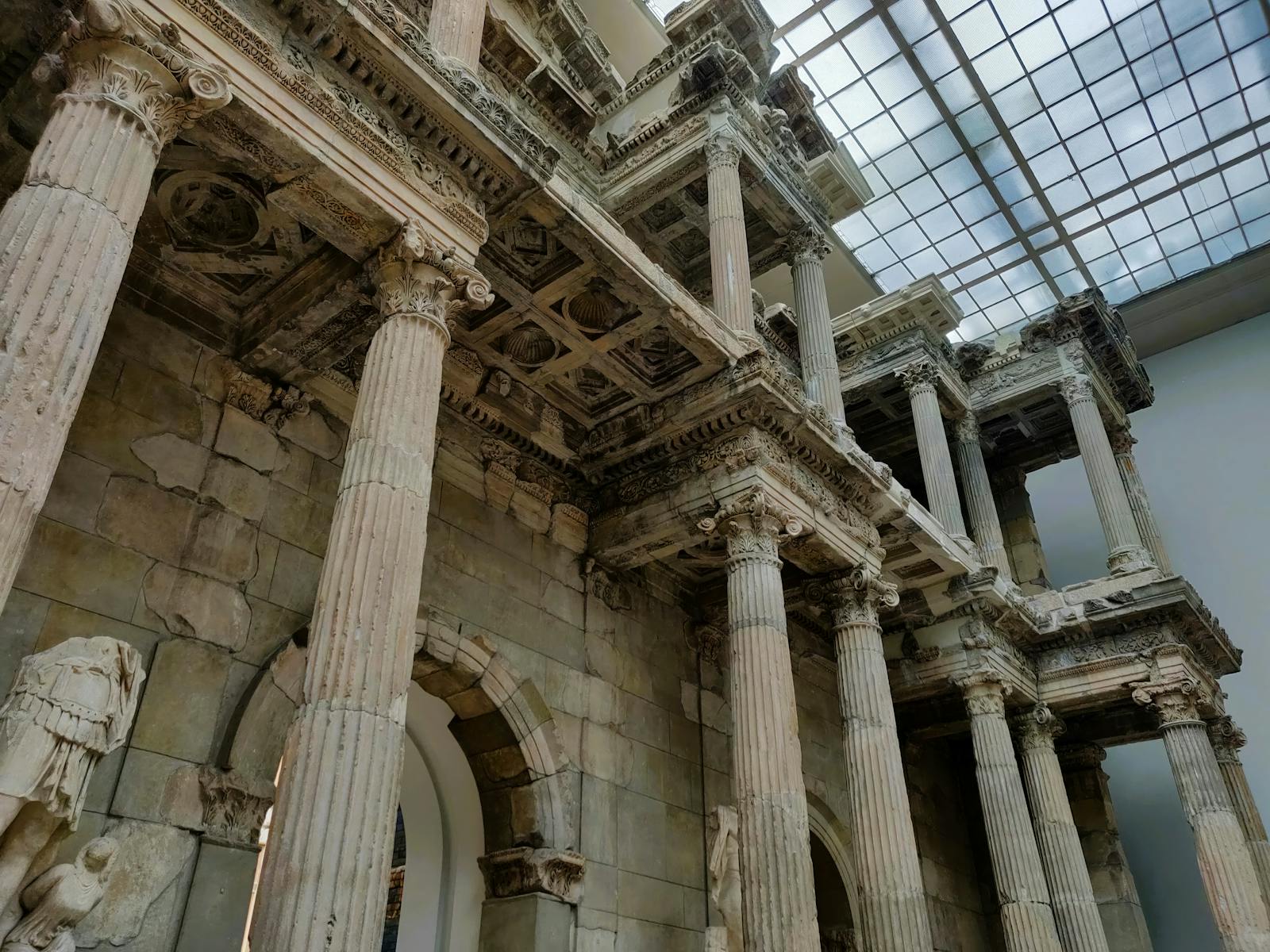
Market Gate of Miletus — Reopens 2027
A Roman gate from the 2nd century AD, originally the entrance to the market of Miletus in Asia Minor (modern western Turkey), about seventeen metres tall. Excavated and partially reconstructed in Berlin in the 1900s. One of the largest reconstructed Roman monuments anywhere.
Ishtar Gate of Babylon — Reopens ~2037
The most photographed object in the museum and one of the most extraordinary surviving pieces of ancient Mesopotamian architecture. The Ishtar Gate was the eighth gate of the inner city of Babylon, commissioned by King Nebuchadnezzar II around 575 BC and dedicated to the goddess Ishtar. The reconstructed gate in Berlin is made of glazed blue brick with relief images of bulls, dragons (mušḫuššu), and lions; the surrounding Processional Way (Ai-ibur-shabu) ran from the gate into the city. Excavated by Robert Koldewey between 1899 and 1917 and reconstructed in Berlin from the recovered fragments.
Mshatta Façade — Reopens ~2037
The carved limestone facade of an Umayyad desert palace from the 8th century AD, originally located near modern-day Amman, Jordan. Donated to Kaiser Wilhelm II by the Ottoman sultan in 1903. One of the most important pieces of early Islamic art in any Western collection.
Aleppo Room — Reopens ~2037
The painted wooden interior of a wealthy seventeenth-century Aleppine Christian merchant’s house — every wall surface covered in intricate floral and figurative painting. Acquired in 1912. The most complete surviving Ottoman-era domestic interior in any museum.
Other Collections — Reopens 2027–2037 depending on wing
Ancient Near Eastern collection (Assyrian reliefs, the Meissner fragment of the Epic of Gilgamesh), Islamic art collection (carpets, ceramics, calligraphy), Roman antiquities, Hellenistic sculpture, and a substantial study collection in storage.
The Pergamon Panorama — Your One Pergamon Option in 2026
Am Kupfergraben 2, 10117 Berlin · Tue–Sun 10:00–18:00, closed Monday · €12 adults / €6 reduced; combined Museumsinsel + Panorama ticket €24 / €12; under 18 free.
Across the canal from the closed Pergamonmuseum, the Asisi Panorama building houses Yadegar Asisi’s 360-degree painted reconstruction of the ancient city of Pergamon as it would have looked in 129 AD, the height of its prosperity under Roman rule. The painting is about 30 metres wide and 25 metres tall; visitors stand on a viewing tower in the centre and look around. The building also houses a selection of original objects from the Pergamon collection — including fragments of the Telephos Frieze from the Great Altar and the Fraunhofer 3D digital reconstruction of the altar itself.
An honest verdict: the Panorama is not the museum. It does not replace standing in front of the Ishtar Gate. But it’s the only piece of the Pergamon experience available in Berlin for the next several years, and if you’re already on Museum Island it’s worth the additional hour. Book online; the building is smaller than the museums on the island and time slots can sell out, especially on weekends.
Where Are the Pergamon Artifacts Now?
Most are in climate-controlled storage during the renovation. A small selection rotates through other Museum Island museums:
- Some Pergamon classical pieces are currently shown at the Altes Museum‘s classical antiquities galleries.
- Some Islamic art pieces have been integrated into temporary exhibitions at the Bode-Museum.
- Parts of the Pergamon Altar (Telephos Frieze segments) are on display at the Pergamon Panorama.
- Some pieces are on international loan to museums abroad — check smb.museum for current locations.
- The portion held in Russia since 1945 (Pushkin Museum, Hermitage) remains there.
The Politics of Return
Several of the Pergamon Museum’s most famous objects have active provenance debates attached to them. Turkey has, at various points, formally requested the return of the Pergamon Altar — pointing out that the late-Ottoman permits under which it was excavated and exported are no longer recognised as a fair legal basis by contemporary standards. Iraq has formally requested the return of the Ishtar Gate. (The nearby Neues Museum holds the Nefertiti bust, which Egypt has periodically requested return of.) Germany’s official position is that the objects were acquired legally under the laws of the time; restitution debates are ongoing, and the question of where these objects “belong” is one of the most active conversations in European museum policy in 2026.
When you stand in front of these objects after the museum reopens, the conversation will be part of the experience. The museum’s new permanent displays are expected to engage more openly with the provenance question than the previous installation did.
The Telephos Frieze — The Pergamon Object You Can Still See
Worth knowing about specifically because fragments of it are visible at the Pergamon Panorama. The Telephos Frieze is the smaller, inner frieze of the Pergamon Altar — running around the inside walls of the altar’s enclosure, where the larger Gigantomachy Frieze ran around the outside. It tells the story of Telephos, the mythological founder of Pergamon and son of Heracles. In low relief and a quieter narrative register than the violent outer frieze, the Telephos sequence runs as a continuous story from his birth through his adventures to his arrival in Pergamon. The Asisi Panorama displays several panels of the original Telephos Frieze in the gallery surrounding the panoramic painting itself — so the Pergamon Panorama isn’t just an artistic recreation, it’s a real Pergamon-collection experience with selected original masterpieces. Don’t skip this part of the Panorama on your way to the central viewing tower.
How to Plan a Berlin Trip With the Pergamon Closed
If you’ve come to Berlin for the Pergamon and only the Pergamon, change your plan. But you have plenty of options for a substantive Museum Island day even with the main attraction closed.
- Visit the Pergamon Panorama first — sets up the historical context.
- Neues Museum next door — Nefertiti, Egyptian collection, the magnificent Chipperfield restoration.
- Bode-Museum — sculpture, Byzantine art, the Münzkabinett.
- Altes Museum — Greek and Roman antiquities (sister collection to the Pergamon’s).
- Alte Nationalgalerie — nineteenth-century painting (Caspar David Friedrich, Menzel, Liebermann, Manet, Monet).
- Pair with Humboldt Forum across the bridge for non-European collections.
See our Museum Island guide for the full visit plan.
Architecture — Messel’s Three-Wing Horseshoe
For visitors arriving in 2026 to find the building behind hoardings, the architecture is worth knowing about even if you can’t enter. Alfred Messel designed the museum in a stripped neoclassical style that sits between Schinkel’s earlier classicism and the modernism that came later — austere monumental forms with very little ornament, deliberately quiet so that the antiquities inside would speak more loudly. The plan is a three-wing horseshoe opening to the Kupfergraben canal on the west side, with the open courtyard originally intended for sculpture display. The current renovation is closing that horseshoe with a fourth wing, designed by Oswald Mathias Ungers in his 2000 competition-winning proposal. The transformation has been controversial among preservationists; the original Messel design is seen by many as one of the most important works of stripped classicism in Germany, and altering its character is not a small intervention. You can see the exterior of the building from the bridge over the Kupfergraben canal — even with the hoardings, the scale and the stripped detailing give a sense of what’s inside.
Practical Info (For When It Reopens in 2027)
- Address: Bodestrasse 1–3, 10178 Berlin
- Nearest U-Bahn: Museumsinsel (U5)
- Nearest S-Bahn: Hackescher Markt or Friedrichstrasse
- Operated by: Staatliche Museen zu Berlin (SMB), Stiftung Preussischer Kulturbesitz
- Expected hours when reopened: Tue–Sun 10:00–18:00, Thursday until 20:00, closed Monday (standard SMB hours)
- Expected ticket structure: single museum entry €12–€14, or included in the €24 Museumsinsel day pass and the €32 Berlin Museum Pass
- Photography: permitted without flash or tripod in the permanent collection at all SMB houses, expected to continue at the Pergamon
Frequently Asked Questions
Is the Pergamon Museum open right now?
No. The museum has been closed since October 23, 2023.
When will the Pergamon Museum reopen?
The north wing (Pergamon Altar, Market Gate of Miletus, Classical Antiquities, Islamic Art with Mshatta Façade) is expected to reopen in 2027. The south wing (Ishtar Gate, Processional Way) is not scheduled to reopen until around 2037, with some reports suggesting 2043 as a worst case.
Can you still see the Pergamon Altar?
Not until 2027. Selected fragments of the Telephos Frieze are on display at the Pergamon Panorama building.
Where is the Ishtar Gate now?
In climate-controlled storage at the Pergamon Museum during the renovation. Not currently visitable. Reopening around 2037.
What’s the Pergamon Panorama?
Yadegar Asisi’s 360-degree painted reconstruction of ancient Pergamon, in a building at Am Kupfergraben 2 across the canal from the closed museum. Includes a selection of original Pergamon-collection objects. Open Tue–Sun 10:00–18:00. €12 / €6 reduced.
How much is the Pergamon Panorama?
€12 adults, €6 reduced, free under 18. The €24 Museumsinsel combined ticket includes the Panorama plus all four open Museum Island museums.
Should I visit Berlin if Pergamon is closed?
Yes. Museum Island has four other major museums open and the Humboldt Forum across the bridge. Berlin’s broader museum landscape (Jewish Museum, DDR Museum, Hamburger Bahnhof, Topography of Terror, Berlin Wall Memorial) is unaffected.
What can I see instead of the Pergamon Museum?
Start with the Pergamon Panorama. Pair with the Neues Museum (Nefertiti), Bode-Museum (sculpture and coins), Altes Museum (classical antiquities), and Alte Nationalgalerie (nineteenth-century painting). The Humboldt Forum across the bridge complements with non-European collections.
Where can I see Pergamon collection artifacts?
Pergamon Panorama (selected fragments of the Telephos Frieze and other pieces), occasional rotations at the Bode-Museum and Altes Museum, occasional international loan exhibitions. Check smb.museum for current locations.
Final Word
The Pergamon Museum is, in 2026, the most famous closed building in Germany. The objects inside are some of the most important monuments of antiquity outside their countries of origin. The renovation is taking a long time — by some measures, an embarrassingly long time — and the wait for the full reopening will be measured in decades. The right response, as a visitor, is to accept the reality, visit the Panorama for the partial substitute, spend a full day on the rest of Museum Island, and come back in 2027 to see the north wing when it reopens.
For the rest of Museum Island in 2026, see our Museum Island guide. For the wider museum landscape: Hamburger Bahnhof, contemporary art museums, Jewish Museum, and DDR Museum.