Schoeneberg Guide: Queer History, Markets & Bowie’s Berlin
Isherwood's Nollendorfplatz, the Saturday Winterfeldtmarkt, Bowie's flat on Hauptstraße, the town hall where Kennedy spoke, and a memorial written on lampposts — Schöneberg, walked.
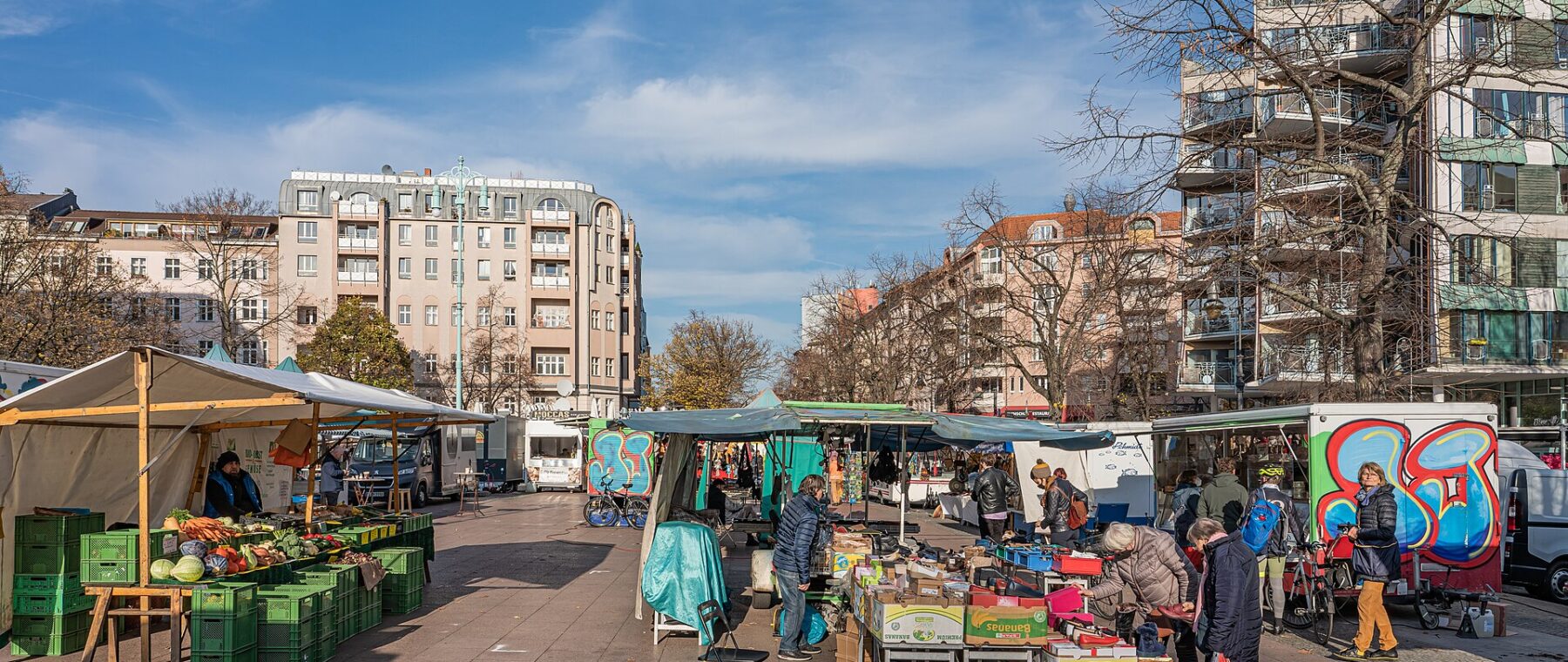
On a Saturday morning at Winterfeldtplatz, the queue at the cheese van includes a pensioner in a fur hat, two men in matching running gear holding hands, a mother with twins and a bike trailer, and a very tired young man who has plainly not been to bed. Nobody looks twice at anybody. That, in one line, is Schöneberg: a comfortable, grown-up, quietly liberal district that has been doing tolerance for a hundred years without making a fuss about it. This Schöneberg Berlin guide is for visitors who have heard the name in connection with Bowie, Kennedy or the gay scene, and want to know what the place is actually like to walk through.
It covers the Nollendorfplatz and Regenbogenkiez, the Saturday market, the Akazienkiez and Bowie’s old flat on Hauptstraße, the town hall where Kennedy spoke, the Bavarian Quarter’s extraordinary street-sign memorial, KaDeWe, and a railway yard turned wild park on the district’s southern edge. Opening hours and prices were checked in September 2026 — treat them as the right order of magnitude and confirm before you go. For how Schöneberg fits among Berlin’s other districts, see our Berlin neighbourhoods guide.
Schöneberg at a Glance
| Area or sight | Why go | Best time | Cost (Sept 2026) |
|---|---|---|---|
| Nollendorfplatz and Motzstraße | Historic heart of queer Berlin; Isherwood’s street | Evening; mid-July for the Stadtfest | Free |
| Winterfeldtmarkt | One of Berlin’s best weekly markets | Saturday 08:00–16:00 | Free; lunch €6–10 |
| Akazienkiez | Cafés, small shops, Bowie’s building | Weekday afternoon | Free |
| Rathaus Schöneberg | Where JFK said “Ich bin ein Berliner” | Weekend flea market | Free |
| Bayerisches Viertel | Street-sign memorial to persecuted Jewish residents | Daytime | Free |
| KaDeWe | Continental Europe’s most famous department store | Weekday morning | Free to browse |
| Natur-Park Südgelände | Old railway yard reclaimed by forest | Spring and autumn | €1 adults |
What Kind of Place Schöneberg Is
Schöneberg was a village of farmers until the late nineteenth century, when the families who owned its fields sold them to developers at the height of Berlin’s building boom and became, overnight, the “millionaire farmers” of local legend. The apartment blocks that went up were solid, handsome and middle-class, and they still define most of the district: five-storey façades, tall ceilings, generous courtyards and trees along every other street.
By the 1920s the streets around Nollendorfplatz had become the centre of the most open gay and lesbian scene in the world, with bars, dance halls, magazines and cabarets that drew visitors from across Europe. The Nazis destroyed it within weeks of taking power in 1933. After the war, in divided Berlin, Schöneberg’s town hall became the seat of West Berlin’s government — which is why the most famous speech of the Cold War was given on its steps — and the district was also home to a scatter of artists, students and people who did not fit in anywhere else, including, for a couple of years in the 1970s, David Bowie.
Today Schöneberg is less fashionable than Kreuzberg or Neukölln and far more comfortable than either. It is where many of the people who were young in those districts in the 1990s now live. It has almost no big-ticket sights, which is exactly why visitors who find it tend to like it: the history is set into ordinary streets, the cafés are for locals, and you can walk for an afternoon without seeing a tour group.
Nollendorfplatz and the Regenbogenkiez
Start at Nollendorfplatz, where four U-Bahn lines meet under a reconstructed glass dome. The square itself is a busy, traffic-bound junction; its significance is in the streets leading south and east. The stretch around Motzstraße, Fuggerstraße and Eisenacher Straße is known as the Regenbogenkiez, the rainbow neighbourhood, and it has been the centre of gay Berlin — with one terrible twelve-year gap — for about a century.
The Berlin of Isherwood and the Eldorado
From 1929 to 1933 the English writer Christopher Isherwood rented a room at Nollendorfstraße 17, a couple of minutes’ walk from the square. What he saw there became Goodbye to Berlin, which became the play I Am a Camera and eventually the musical and film Cabaret. A plaque on the building marks the address. The streets around it were full of the clubs he wrote about, the most famous of which, the Eldorado on Motzstraße, was a glamorous drag cabaret patronised by everyone from Marlene Dietrich to Nazi SA men. It was closed in 1932, and the premises were used by the Nazis soon afterwards.
The pink triangle plaque
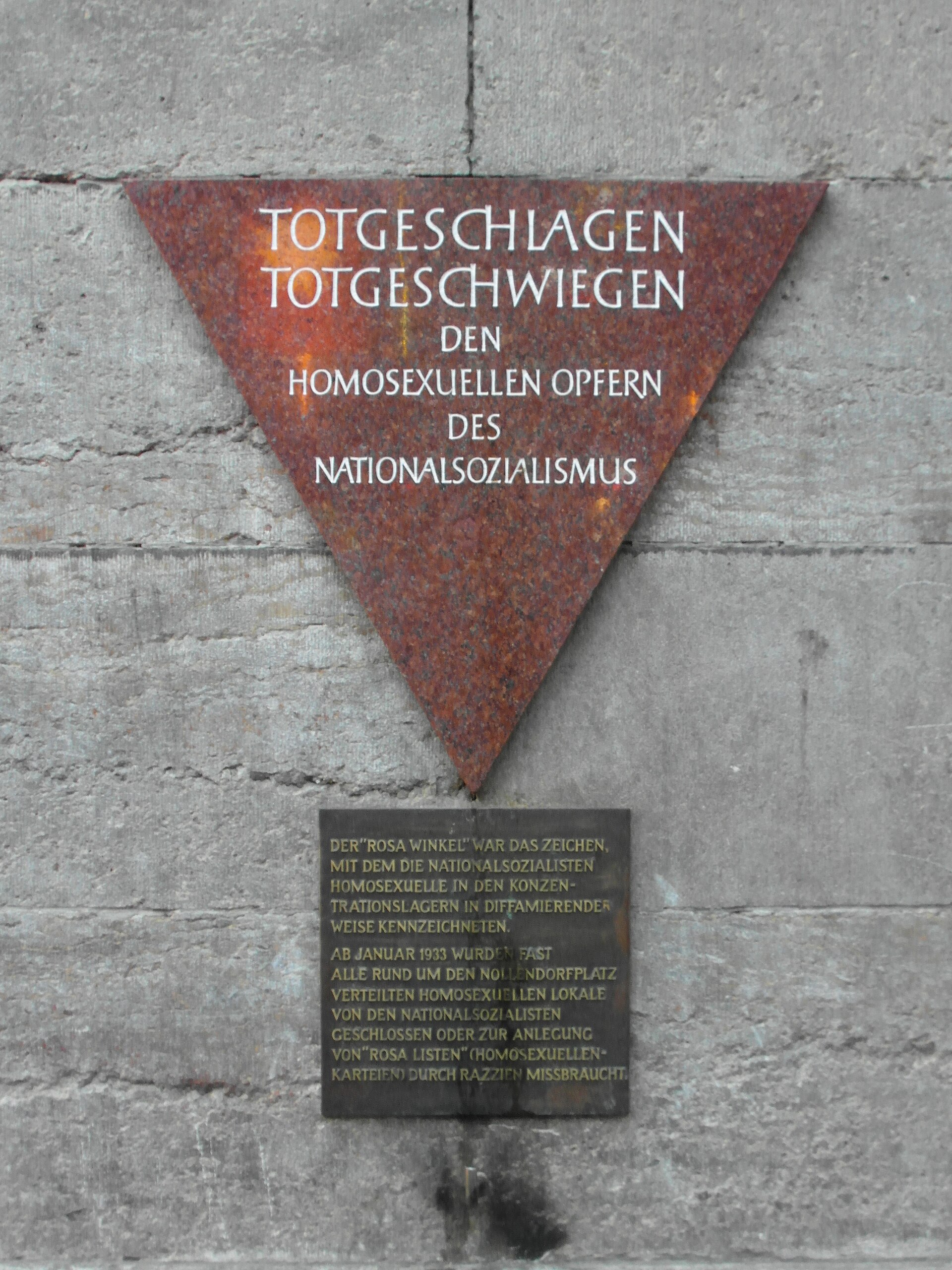
On the outer wall of Nollendorfplatz U-Bahn station, facing the square, a small triangular plaque in pink granite commemorates the gay men and lesbians persecuted and murdered under the Nazis. Put up in 1989, it was one of the very first memorials of its kind in Germany. The inscription reads, in translation, “Beaten to death, silenced to death”. Thousands of gay men were sent to concentration camps after 1933, and many died there — and the Nazi-era version of the law used against them, Paragraph 175, stayed on the books in West Germany until 1969 in that form, and was only fully abolished in 1994. It takes a minute to read and it is worth making the stop. For the wider story, see our Nazi history in Berlin guide.
The scene today
The Regenbogenkiez is still the densest concentration of gay bars in Berlin, although it is the older, more relaxed end of the scene: long-running men’s bars along Motzstraße and Fuggerstraße, cafés and neighbourhood pubs with mixed crowds, a couple of shops, and some darker, cruisier places that are exactly what their doors suggest. It is friendly and unpretentious, and many of the bars are busier on a weeknight than you might expect. If you are looking for the big queer club nights, most of those are in Kreuzberg, Friedrichshain and Neukölln; our LGBTQ nightlife guide covers the whole city.
The Schwules Museum — one of the world’s largest museums of queer history and culture — is a ten-minute walk north of Nollendorfplatz, over the border in Tiergarten on Lützowstraße. Check its website for current exhibitions and entry prices.
The Lesbian and Gay City Festival
Every July, the weekend before Berlin’s Christopher Street Day parade, the streets around Nollendorfplatz close to traffic for the Lesbisch-schwules Stadtfest, which bills itself as Europe’s largest queer street festival. In 2026 the 32nd edition ran on 18 and 19 July, with six stages, free entry, and programmes from 11:00 until late on the Saturday and into the evening on the Sunday. If your trip falls on that weekend, it is one of the best-natured big street parties in the city, and very welcoming to straight visitors. Our Berlin events calendar lists the dates each year.
Winterfeldtplatz and Maaßenstraße
Five minutes south of Nollendorfplatz, along the café terraces of Maaßenstraße, the neo-Gothic St. Matthias church looks over Winterfeldtplatz — for most of the week a plain, slightly scruffy square, and twice a week home to one of the best markets in Berlin.
The Winterfeldtmarkt runs on Wednesdays 08:00–14:00 and Saturdays 08:00–16:00. Wednesday is a good, ordinary neighbourhood market. Saturday is the real thing: several hundred stalls, farmers from Brandenburg with vegetables and eggs, cheese vans, fishmongers, olive and antipasti stalls, flowers, bakers, a handful of clothes and craft stands, and a whole lane of food stalls cooking for the crowd. It is where half of western Berlin does its weekly shop, and there is nothing staged about it.
Go hungry and go before midday. Around the square, the cafés of Goltzstraße and Maaßenstraße fill up with people carrying bags of vegetables, and a long, lazy Saturday breakfast afterwards is the district’s defining ritual. For other markets around the city see our Berlin street food markets guide.
The Akazienkiez and Bowie’s Berlin
Follow Goltzstraße south and it becomes Akazienstraße, the backbone of the Akazienkiez — Schöneberg’s most likeable neighbourhood. It is a long, low-key strip of independent cafés, bakeries, small restaurants from half the countries in the world, second-hand bookshops, wine shops and the kind of hardware store that still sells single screws. There is no single thing to see, which is its charm. Come for coffee and a walk, and let the side streets surprise you.
Hauptstraße 155
At the southern end of the Akazienkiez, Akazienstraße runs into the busy Hauptstraße, and a few doors along, at Hauptstraße 155, is an unremarkable apartment building with a plaque by the door. David Bowie lived here, in a large first-floor flat, from 1976 to 1978, trying to get away from cocaine and Los Angeles. Iggy Pop moved in too, before getting his own place in the back building. The pair spent those years walking the city, sitting in cafés, going to galleries and clubs, and making records. Bowie’s Low, “Heroes” and Lodger — the so-called Berlin Trilogy — and Iggy Pop’s The Idiot and Lust for Life all come out of this period.
The plaque went up in August 2016, seven months after Bowie’s death, and fans still leave flowers and notes. Please remember that people live in the building. Next door, the café then called Anderes Ufer — one of Berlin’s first openly gay cafés — was a regular haunt of Bowie’s; it has traded since as Neues Ufer. Note that the studio where much of the music was recorded, Hansa, is not in Schöneberg at all but in Kreuzberg, by the Potsdamer Platz end of Köthener Straße; for the city’s music venues today, see our live music venues guide.
Rathaus Schöneberg: Kennedy, the Bell and the Flea Market
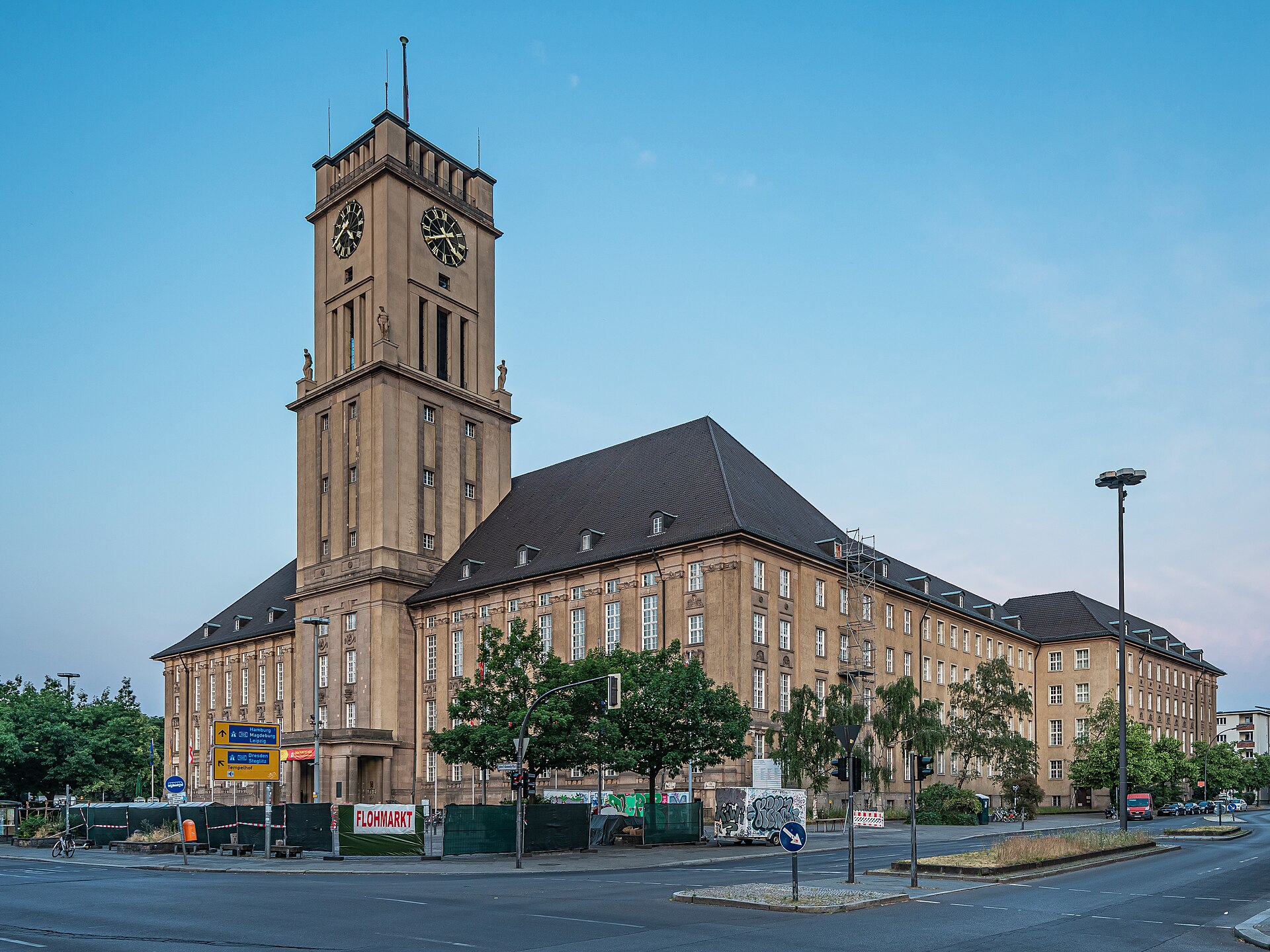
For almost four decades the Rathaus Schöneberg, a heavy stone town hall of 1914 with a tall clock tower, was the seat of West Berlin’s mayor and parliament. On 26 June 1963, John F. Kennedy stood in front of it before a crowd that some estimates put at 450,000 and said the four words that every German schoolchild still knows: “Ich bin ein Berliner.” The square is now called John-F.-Kennedy-Platz, and there is a plaque by the entrance.
The tower holds the Freiheitsglocke, the Liberty Bell, a gift from the United States in 1950, paid for by millions of Americans’ donations in a campaign against Communism, and modelled on the Liberty Bell in Philadelphia. It rings every day at noon. The town hall also hosts a permanent exhibition, Wir waren Nachbarn (“We Were Neighbours”), which tells the stories of Jewish residents of the district through personal documents and family albums; entry is free, and it is quietly one of the most affecting small exhibitions in Berlin. Check current opening days before you go.
On Saturdays and Sundays, the square in front of the town hall hosts a sprawling, entirely unglamorous flea market: old tools, tableware, records, clothes, military badges and a great deal of junk, with dealers rather than hipsters. It is the opposite of Mauerpark and, for anybody who likes rummaging, rather better. See our best flea markets in Berlin for how it compares.
The Bayerisches Viertel: A Memorial on the Lampposts
West of the town hall, the Bayerisches Viertel, the Bavarian Quarter, is a well-to-do grid of streets named after Bavarian towns. Before 1933, so many Jewish families lived here — Albert Einstein among them, at Haberlandstraße 5 until he left Germany — that it was nicknamed “Jewish Switzerland”.
Walk its streets today and you will notice signs fixed to lampposts, about eighty of them. On one side there is a simple, almost cheerful picture: a loaf of bread, a cat, a thermometer, a pair of swimming trunks. On the other, a short text quoting one of the anti-Jewish laws and decrees passed between 1933 and 1945. “Jews may no longer keep pets.” “Jews may only buy food in the afternoon between four and five.” “Jewish doctors may no longer practise.” The installation, Orte des Erinnerns (Places of Remembrance), by the artists Renata Stih and Frieder Schnock, was unveiled in 1993. It works precisely because it is so ordinary: it shows how persecution crept into every normal part of daily life, on the same streets, one rule at a time.
Look for the information board near Bayerischer Platz, which maps the signs. Allow an hour and walk slowly. It is one of the most powerful memorials in Berlin and very few visitors see it. For more, see our Jewish history in Berlin guide.
Wittenbergplatz and KaDeWe
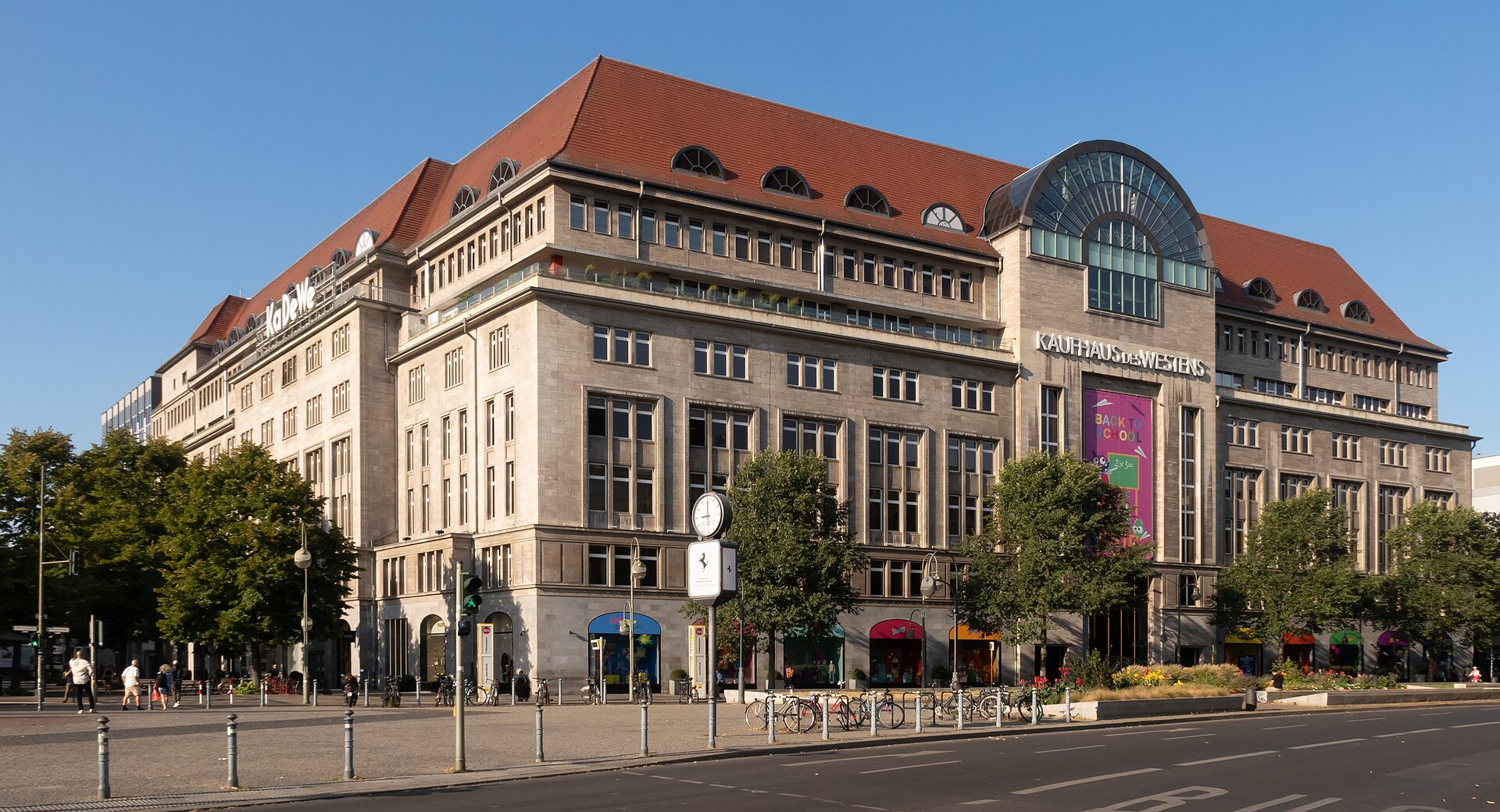
At the north-western corner of the district, on Tauentzienstraße by Wittenbergplatz, stands the Kaufhaus des Westens, known to everyone as KaDeWe. Opened in 1907, it is the largest department store in continental Europe and, for West Berliners during the division, was a symbol of everything the city had that the East did not. The sixth-floor food hall is the famous part — a vast, gleaming spread of delicatessen counters, champagne bars and a range of foods that is genuinely extraordinary to walk around, even if you buy nothing. Prices on that floor are as high as you would expect. Our Kurfürstendamm and KaDeWe shopping guide covers it floor by floor.
The honest verdict: the food hall is worth half an hour; the rest of the store is a luxury department store like any other. Look too at the Wittenbergplatz U-Bahn station, a lovely 1913 building in the middle of the square with a restored, wood-panelled ticket hall.
From here, the Kurfürstendamm and the Kaiser Wilhelm Memorial Church are ten minutes’ walk west — see our Charlottenburg guide. Heading east along Kurfürstenstraße, be aware that the stretch towards Potsdamer Straße has long been one of Berlin’s street prostitution areas. It is not dangerous in daylight, but it is not a pleasant walk either.
Red Island, Kleistpark and Marlene Dietrich
South of Kleistpark, the Rote Insel — “Red Island”, named for being boxed in by railway lines and for its socialist voting habits — is a small working-class neighbourhood around Leberstraße. Marlene Dietrich was born at Leberstraße 65 in 1901, and a plaque marks the building. She left for Hollywood in 1930, refused every Nazi invitation to return, and entertained Allied troops during the war; many Germans never forgave her. She died in Paris in 1992 and chose to be buried in Berlin, in the Städtischer Friedhof III on Stubenrauchstraße in Friedenau, a short walk from S-Bahn Friedenau. Her grave is simple. The photographer Helmut Newton is buried in the same cemetery.
Back north, Heinrich-von-Kleist-Park is framed at its entrance by the baroque Königskolonnaden, royal colonnades moved here from Alexanderplatz in 1910. Behind the park stands the grand Kammergericht, the Prussian supreme court, which after the war housed the Allied Control Council and the four-power air safety centre that managed flights through the air corridors to West Berlin. It has an unusually dramatic history for a building most Berliners pass without a second look.
Natur-Park Südgelände
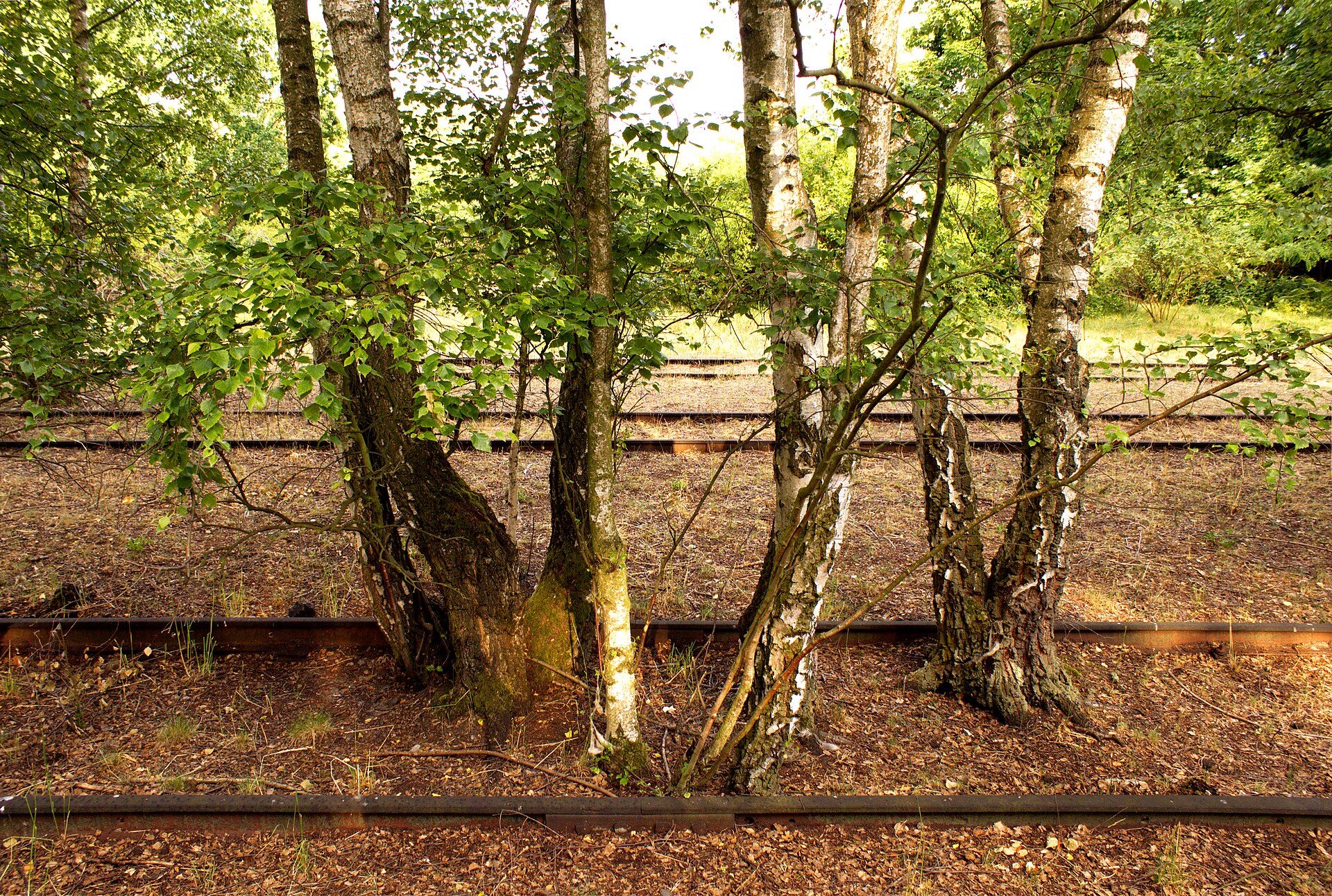
At the southern tip of the district lies one of Berlin’s strangest and loveliest green spaces. The Natur-Park Schöneberger Südgelände was once the Tempelhof marshalling yard. After the war it fell into disuse, and because of the politics of divided Berlin — the railway land was controlled by the East German Reichsbahn — nobody touched it for decades. A forest grew up between the tracks. When the city finally took it over, instead of clearing it, it opened it in 2000 as a nature park.
Raised metal walkways lead you through birch woods that have grown up out of the sidings, past rusting rails and signals, an old turntable, a restored steam locomotive and a tall water tower, with sculptures and metalwork by an artist group dotted along the way. In spring and autumn it is magical. Entry is €1 for adults, free for under-14s, and it is open daily from 09:00 until dusk. The entrance is right beside S-Bahn Priesterweg (S2, S25, S26). Our outdoor activities guide has more green escapes like it.
A Day in Schöneberg
This works best on a Saturday.
- 09:30 — Winterfeldtmarkt. Browse, snack, buy nothing you cannot carry.
- 11:00 — Breakfast on Goltzstraße or Maaßenstraße.
- 12:00 — Walk north to Nollendorfplatz: Isherwood’s house, the pink triangle plaque, Motzstraße.
- 13:00 — U4 two stops to Bayerischer Platz. Walk the Orte des Erinnerns signs for an hour.
- 14:30 — Rathaus Schöneberg: the flea market and the Wir waren Nachbarn exhibition.
- 16:00 — Walk or take the bus east to Hauptstraße 155 and the Akazienkiez for coffee.
- Evening — Dinner in the Akazienkiez, then drinks back in the Regenbogenkiez.
On a weekday, swap the market and the flea market for KaDeWe and the Natur-Park Südgelände. For more walks off the usual circuit, see hidden gems in Berlin.
Getting Around Schöneberg
- Nollendorfplatz is served by the U1, U2, U3 and U4 — the natural starting point for the Regenbogenkiez and Winterfeldtplatz.
- Wittenbergplatz (U1, U2, U3) is the stop for KaDeWe.
- U4, a short line from Nollendorfplatz, runs through the Bavarian Quarter: Viktoria-Luise-Platz, Bayerischer Platz, Rathaus Schöneberg and Innsbrucker Platz.
- U7 stops at Kleistpark, Eisenacher Straße (closest to the Akazienkiez) and Bayerischer Platz.
- S-Bahn: the S1 serves Julius-Leber-Brücke and Friedenau; the Ring (S41/S42) stops at Schöneberg and Innsbrucker Platz; S2/S25/S26 stop at Priesterweg for the Südgelände. Yorckstraße links the S1, S2 and U7.
Everything in this guide is in fare zone AB. See our BVG tickets guide for fares.
What It Costs
| Item | Typical price (September 2026) |
|---|---|
| Street food at the Winterfeldtmarkt | €6–10 |
| Café breakfast on Goltzstraße | €12–18 |
| Beer in a Motzstraße bar | €4–5.50 |
| Natur-Park Südgelände | €1 adult, under-14s free |
| Rathaus flea market, Wir waren Nachbarn, Orte des Erinnerns | Free |
| Lesbisch-schwules Stadtfest | Free |
Schöneberg sits between the cheap east and the expensive west on price: dearer than Neukölln, noticeably cheaper than Charlottenburg. See how much Berlin costs per day for budgeting.
Frequently Asked Questions
Is Schöneberg worth visiting?
Yes, particularly on a Saturday and particularly if you are interested in twentieth-century history, queer history or music. It has few headline sights but some of the most rewarding streets and memorials in the city, one of Berlin’s best markets, and a relaxed, lived-in atmosphere.
Where did David Bowie live in Berlin?
At Hauptstraße 155 in Schöneberg, from 1976 to 1978, with Iggy Pop living in the same building for part of that time. A plaque was put up in 2016. The Hansa recording studio he used is in Kreuzberg, near Potsdamer Platz.
Where did Kennedy give the “Ich bin ein Berliner” speech?
In front of Rathaus Schöneberg, West Berlin’s town hall, on 26 June 1963. The square is now called John-F.-Kennedy-Platz. Take the U4 to Rathaus Schöneberg.
Is Schöneberg the gay district of Berlin?
It is the historic one. Schöneberg was a centre of queer nightlife in the 1920s until Nazi persecution destroyed the prewar scene, and the Regenbogenkiez around Nollendorfplatz, Motzstraße and Fuggerstraße is an important LGBTQ+ neighbourhood again today. Much of the city’s queer club scene is now spread across Kreuzberg, Friedrichshain and Neukölln too.
When is the Winterfeldtplatz market?
Wednesdays 08:00–14:00 and Saturdays 08:00–16:00. Saturday is much bigger and the one to go to.
Is KaDeWe in Schöneberg or Charlottenburg?
Schöneberg, on Tauentzienstraße at Wittenbergplatz, just east of the Charlottenburg border. Most visitors combine it with the Kurfürstendamm, which is a ten-minute walk away.
Is Schöneberg safe?
Yes. It is a calm, residential district. The one area visitors notice is Kurfürstenstraße near Potsdamer Straße, a long-standing street prostitution area that is unpleasant rather than dangerous. See our Berlin safety tips.
Related Berlin Guides
- Berlin Neighbourhoods: What Each District Is Actually Like
- LGBTQ Nightlife in Berlin
- Charlottenburg Guide
- Kreuzberg Guide
- Kurfürstendamm and KaDeWe Shopping
- Best Flea Markets in Berlin
- Jewish History in Berlin
- Live Music Venues in Berlin
Photo Credits
Saturday market on Winterfeldtplatz: Berlin Winterfeldtplatz asv2021-11 img4 by A.Savin, FAL, via Wikimedia Commons.
Rathaus Schöneberg: Berlin Rathaus Schöneberg asv2021-06 by A.Savin, FAL, via Wikimedia Commons.
Natur-Park Südgelände: 0002- 1LCPCr1+ Natur-Park Schöneberger Südgelände, Berlin by Jacobo.ka, CC BY-SA 4.0, via Wikimedia Commons.
KaDeWe on Tauentzienstraße: Berlin-Schöneberg, Kaufhaus des Westens Dm IMG 5518 2024-09-06 09.06 by Michielverbeek, CC BY 4.0, via Wikimedia Commons.
The pink-triangle memorial at Nollendorfplatz: Berlin – U-Bahnhof Nollendorfplatz – Linien U1,U2,U3,U4 (7599986406) by IngolfBLN, CC BY-SA 2.0, via Wikimedia Commons.
Final Word
Schöneberg does not shout, and it is easy to underrate for that reason. But few districts anywhere hold so much of the twentieth century in such ordinary-looking streets: the club where Weimar Berlin danced and the plaque for the men who were killed after it closed; the flat where a burnt-out rock star got himself well; the steps where an American president told a walled-in city it was not alone; the lampposts that spell out, one rule at a time, how neighbours were turned into outcasts.
Come on a Saturday. Eat your way round the market, walk the Bavarian Quarter slowly, stop at Hauptstraße 155, and finish with a drink on Motzstraße. You will have seen a Berlin most visitors miss, and you will not have queued for anything.