Alexanderplatz: What to Actually Do at Berlin’s Busiest Square
Berlin's least loved and most used square, honestly assessed: the World Clock, the medieval church nobody notices, what to skip, and where to walk when you have had enough concrete.
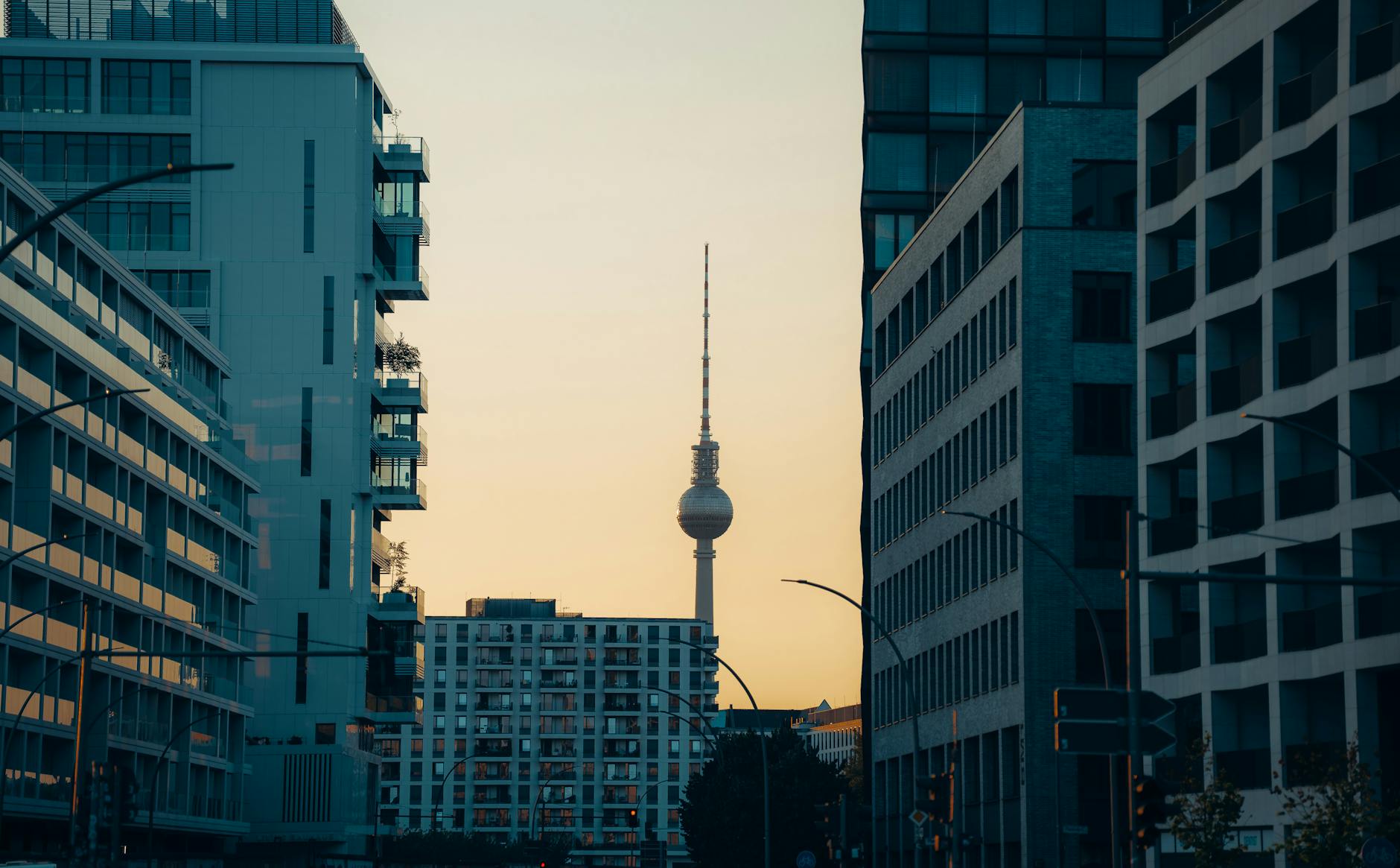
Ask a Berliner about Alexanderplatz and you will usually get a shrug and the word “hässlich” — ugly. Ask them where to meet and there is a decent chance they will say “at the clock”, meaning the Weltzeituhr, which is on Alexanderplatz. That contradiction is the honest position on alexanderplatz berlin: a square nobody defends aesthetically that everybody uses constantly, and which happens to sit on top of the busiest transport interchange in eastern Germany.
This guide is about what is actually worth doing there, rather than a list of everything visible from the middle of it. What the square is, why it looks the way it does, the handful of genuinely good things on and immediately around it, where to eat that is not a chain, and what to skip. Prices were checked in September 2026 and are the right order of magnitude rather than a promise.
The essentials
| Question | Answer |
|---|---|
| Cost | Free. The square is public space. |
| Time to allow | 30–45 minutes, or half a day with the TV Tower and Nikolaiviertel |
| Stations | Alexanderplatz — U2, U5, U8, S3, S5, S7, S9, regional trains, trams M2/M4/M5/M6, many buses |
| Best time | Dusk, or December for the Christmas market |
| Worst time | Saturday afternoon, when the retail crowd peaks |
| Paid attraction | The Fernsehturm, from about €25 |
| Free things | Weltzeituhr, Neptunbrunnen, Marienkirche, Rotes Rathaus exterior, Nikolaiviertel |
| Safety | Fine by day; keep an eye on your bag at night, as at any big interchange |
Why it looks like this
The square is named after Tsar Alexander I, who visited Berlin in 1805 — before that it was a cattle market and a parade ground. By the 1920s it was one of the busiest and most notorious corners of the city, the setting for Alfred Döblin’s novel Berlin Alexanderplatz, all traffic and trams and low life. Almost none of that survives.
The war flattened it. What replaced it, between 1964 and 1971, was a comprehensive East German redesign: a vast pedestrian plaza surrounded by slab blocks, with the Fernsehturm as its exclamation mark and the Haus des Lehrers and the Kongresshalle at its edges. It was designed to hold a hundred thousand people at a rally, which explains the scale, and the scale is exactly why it feels bleak on a normal Tuesday.
It also produced Berlin’s largest single act of public defiance. On 4 November 1989, five days before the Wall opened, around half a million people gathered here in the biggest demonstration in East German history. The speeches from that day are the reason the square matters historically, and there is nothing on the ground to tell you it happened, which is a shame. Our reunification guide covers the sequence.
Since 1990 there has been a long-running plan to fill the square with towers, which has never quite happened. The result is a place perpetually half-redeveloped: some new glass, a lot of GDR-era concrete, hoardings that have been up for years.
The things actually worth stopping for
The Weltzeituhr
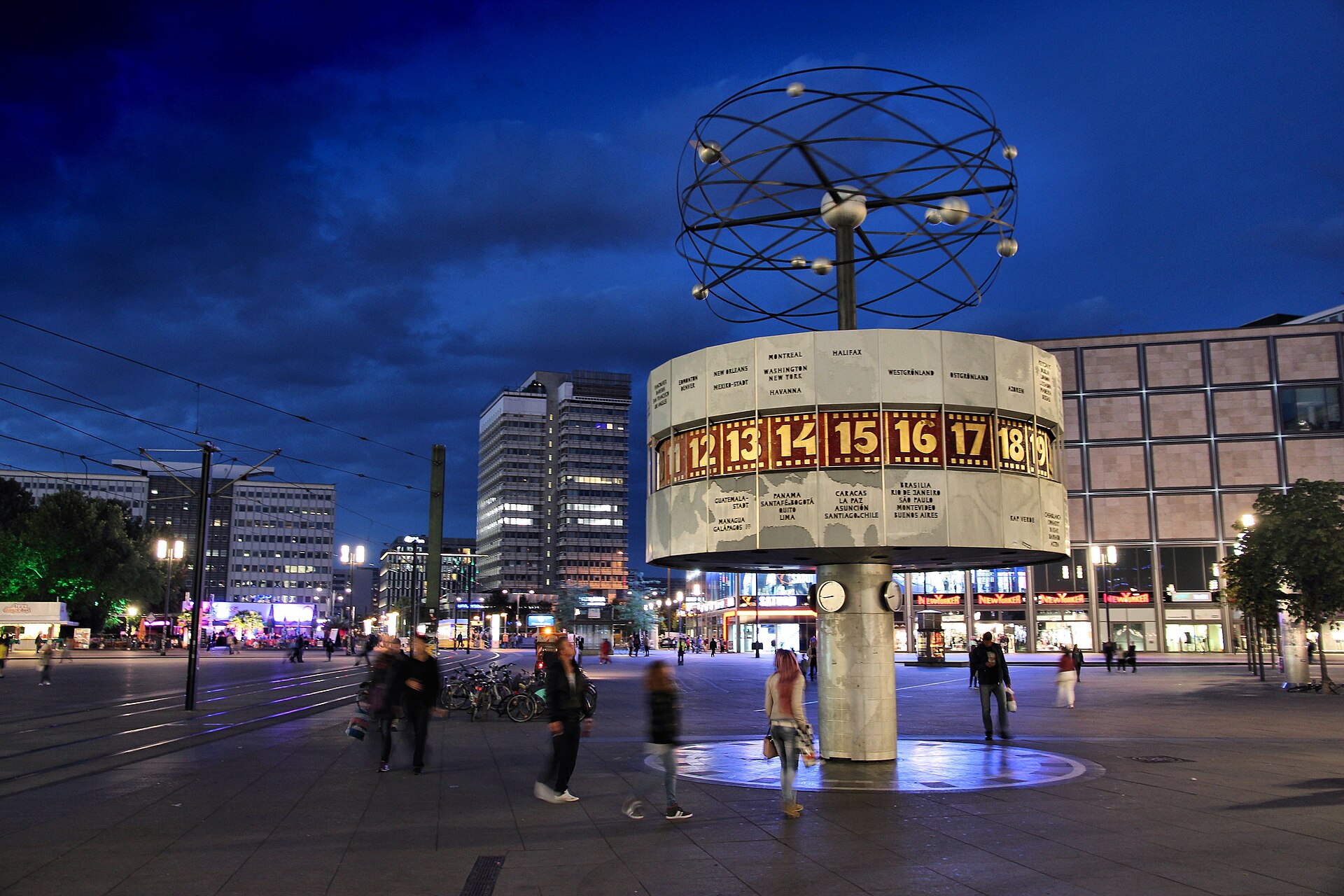
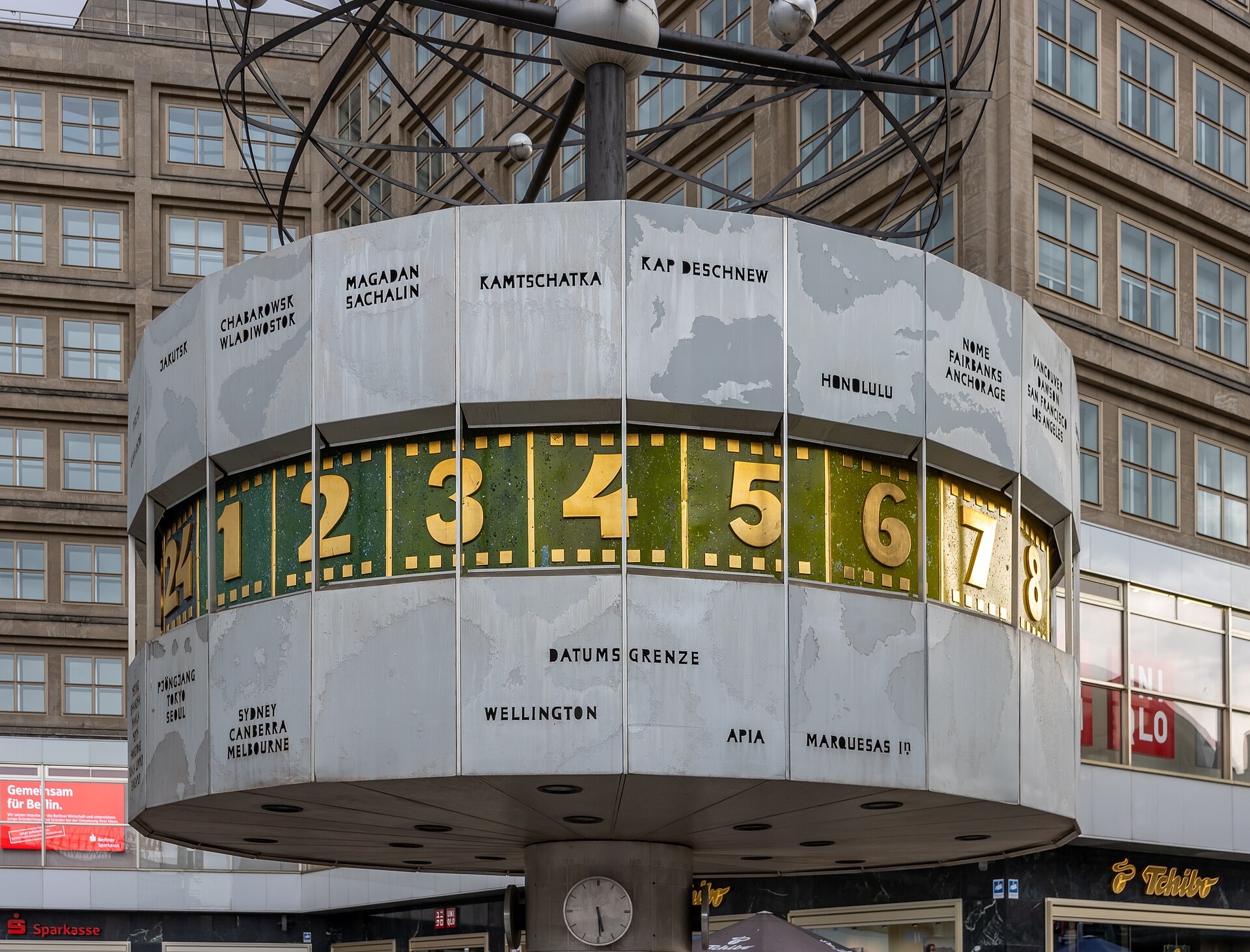
The World Time Clock, installed in 1969 for the GDR’s twentieth anniversary. A rotating aluminium cylinder listing 148 cities in 24 time zones, topped by a simplified model of the solar system that turns once a minute. It is genuinely handsome, in the specific way that mid-century engineering-as-sculpture often is, and it is the one object on the square that everyone photographs and nobody regrets.
It is also a functioning social institution. “Treffen wir uns an der Weltzeituhr” — let’s meet at the world clock — has been Berlin shorthand for fifty years, and on any evening you will see a dozen small groups waiting under it. It is a listed monument now.
The Fernsehturm
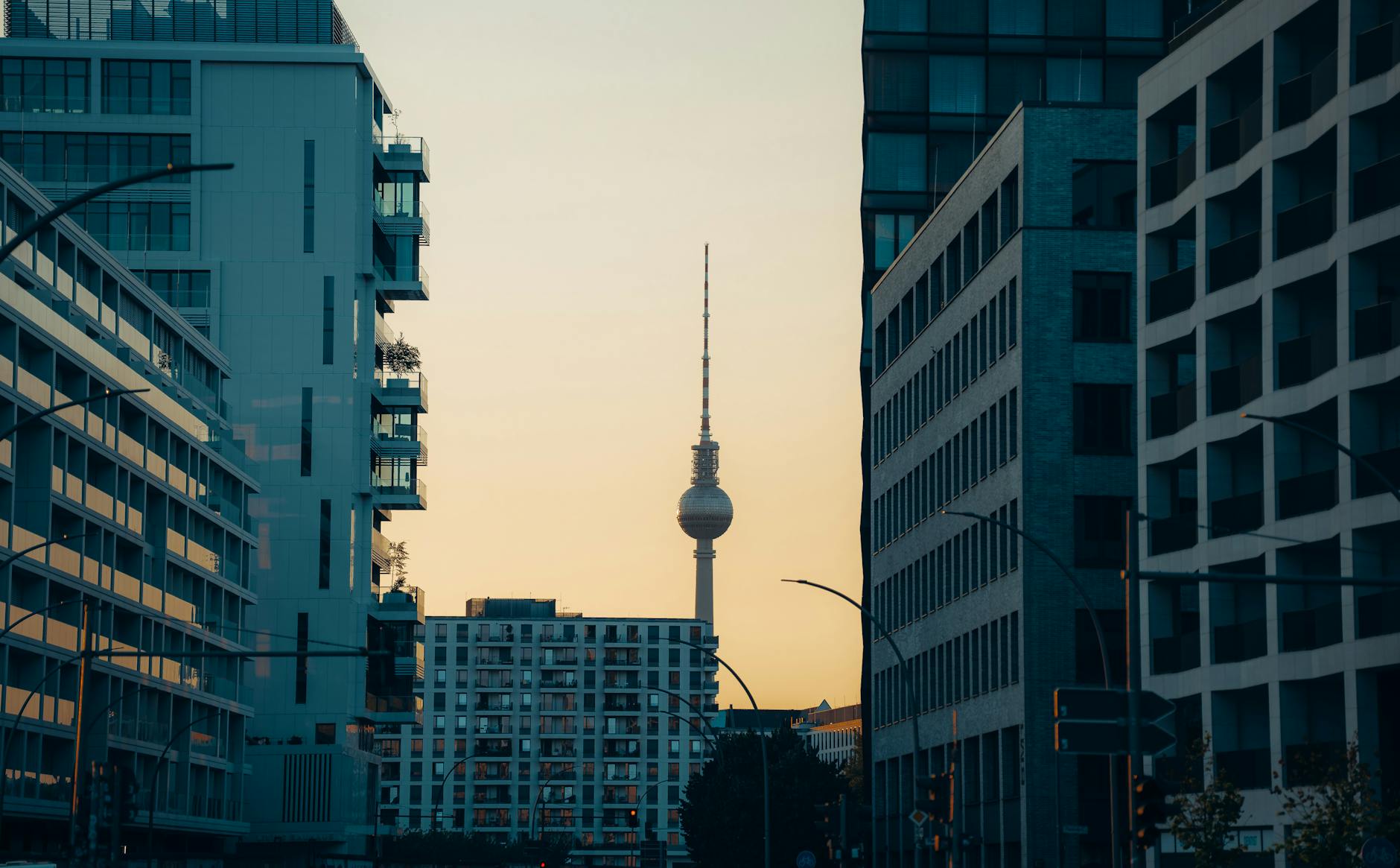
The tower is the reason most visitors come. Standard entry starts around €25, the lift takes forty seconds and the viewing platform is at 203 metres. Whether that is money well spent depends heavily on the weather and the hour — we go through every tier and give an honest verdict in our TV Tower tickets guide.
What is free, and what almost nobody looks for: when the sun hits the steel sphere, the reflection forms a cross. West Berliners called it the Pope’s Revenge, and you can see it from the square on any bright day without buying anything.
The Neptunbrunnen
Between the tower and the Rotes Rathaus, and the prettiest object in the area by a distance. Reinhold Begas built it in 1891: Neptune on a shell surrounded by four reclining women representing the Rhine, the Elbe, the Oder and the Vistula, the four great rivers of the Prussian state. In summer people sit on the rim with a beer and their feet up. It is a completely different register from everything around it.
The Marienkirche
Tucked between the tower and Karl-Liebknecht-Straße, and easy to miss entirely. It is one of the two oldest churches in Berlin, thirteenth-century in origin, and inside there is a fifteenth-century Totentanz — a Dance of Death fresco, twenty-two metres of it, running along the wall of the tower hall. Entry is free. On a square this aggressively modern, walking into a medieval church is a genuine jolt.
The Rotes Rathaus
Berlin’s town hall, five minutes south-west, red brick and a clock tower, built in the 1860s. It is the working seat of the Governing Mayor and the Senate. You cannot wander freely but the ground floor and the courtyard are usually accessible on weekdays, and there are occasional public exhibitions. The exterior frieze — thirty-six terracotta panels running round the building telling Berlin’s history — is worth two minutes from the pavement.
The Nikolaiviertel
Seven or eight minutes’ walk south-west, and the best single reason to leave the square. The Nikolaiviertel is a reconstruction of Berlin’s medieval quarter, built by East Germany in the 1980s for the city’s 750th anniversary, wrapped around the genuinely old Nikolaikirche — Berlin’s oldest building, thirteenth-century.
Purists find it dishonest, and they have a point: most of what you are walking through is 1980s concrete with a historicist skin, and some of the “old” buildings were moved here from elsewhere. But the lanes are narrow, the Spree is at the bottom of them, the restaurants serve the sort of German food that is getting harder to find, and after twenty minutes on Alexanderplatz the change of scale is a relief. There is more in our hidden gems guide and the traditional German food guide.
What to skip
- The souvenir stalls. Same fridge magnets, higher prices than two streets away. See the best souvenirs from Berlin for where to buy things worth keeping.
- The chain restaurants on the square. You are in Berlin. Walk five minutes.
- Petition clipboards and the “found ring” approach. Both operate here. Neither is dangerous, both are a waste of your afternoon. Our safety tips guide covers the standard repertoire.
- Paying for a view from the Park Inn’s rooftop when the bar on an upper floor gets you most of the height for the price of a drink.
- Trying to photograph the square itself. It does not photograph. Photograph the clock, the tower and the fountain, which do.
Eating and drinking without settling
The square proper is chains — that is simply what it is. The good options are all a short walk off it.
Rosenthaler Platz and the Mitte side
Ten minutes north-west on the M1 tram or on foot, and a different world: independent cafés, döner counters with queues, natural wine bars. This is where you go if you have an hour and want to eat properly. Our coffee and cafés guide and the döner guide both have addresses in this direction.
Hackescher Markt
One S-Bahn stop or a twelve-minute walk west. Courtyards, restaurants, and a considerably nicer place to spend an evening than Alexanderplatz. It is also busy and priced accordingly.
The Nikolaiviertel
For old-school German cooking — Eisbein, Königsberger Klopse, a proper Berliner Weisse — this is the nearest place that takes it seriously.
Street food
There is a Currywurst stand near the station that does the job, and the Christmas market in December fills the square with Glühwein and Bratwurst. Our currywurst guide ranks the ones worth crossing town for, and street food markets covers the rest.
Shopping, if that is why you are here
Alexanderplatz is one of Berlin’s main retail concentrations, and it is mid-market rather than luxury. Alexa is the large pink mall on the south side; Galeria occupies the western edge; the Rathauspassagen and the surrounding streets fill in around them. Nothing here is a reason to visit Berlin, but on a wet afternoon it is dry and it is open.
For anything more interesting — the vintage shops of Friedrichshain, the concept stores of Mitte, KaDeWe out west — see our shopping in Berlin guide and the Alexa and Mall of Berlin comparison. Remember that shops close on Sundays across Germany, which regularly catches visitors out.
When to go
Dusk
The clock lights up, the tower lights up, and the concrete stops being the dominant note. It is the only hour when the square is actively good-looking.
December
The Christmas market fills the whole plaza — stalls, an ice rink at the foot of the tower, a big wheel some years. It is commercial rather than quaint, and it is genuinely enjoyable if you go in expecting scale rather than charm. Our Christmas markets guide ranks it against the prettier ones at Gendarmenmarkt and Charlottenburg.
Early morning
Quiet, and the light on the tower is good. There is nothing open, which is the point.
Saturday afternoon
Avoid. Retail crowds, buskers, tour groups and a general sense of being in everyone’s way.
Is Alexanderplatz safe?
By day, entirely. It is one of the most heavily used public spaces in Germany with a constant police presence and thousands of people crossing it every hour.
At night it is a large transport interchange and behaves like one anywhere in Europe: pickpocketing around the station entrances, some late-night drinking, occasional aggressive begging. None of this is unusual and none of it should change your plans. Keep your phone out of your back pocket, do not leave a bag on the ground at a bar table, and use the station’s main exits rather than the quieter underpasses after midnight. Our Berlin safety guide and the night transport guide cover the details.
Getting there and moving on
Alexanderplatz is the best-connected point in eastern Berlin: U2, U5 and U8, the S3, S5, S7 and S9, regional trains, four tram lines and a long list of buses. If you are staying anywhere central you can get here without changing. The U-Bahn and S-Bahn guide explains the network and the BVG tickets guide the fares.
The single most useful thing to know: the 100 and 300 buses both start here. The 100 runs to Zoologischer Garten via Unter den Linden, the Brandenburg Gate and the Tiergarten, on a normal transport ticket, and it passes most of central Berlin’s landmarks. It is the cheapest sightseeing tour in the city and it is not marketed as one.
On foot from the square: Museum Island and the Berliner Dom in ten minutes west, the Nikolaiviertel in eight south-west, Hackescher Markt in twelve north-west, the DDR Museum in ten. Our one day in Berlin itinerary uses Alexanderplatz as a hinge for exactly this reason.
The buildings around the edge
Most visitors register the square as an undifferentiated wall of concrete. It is not — several of the buildings are significant, and knowing which is which makes the twenty minutes considerably more interesting.
Haus des Lehrers
The Teachers’ House on the south-east side, built 1962–64, wrapped in a 125-metre mural band by Walter Womacka called Unser Leben — Our Life. Scientists, engineers, mothers, doves of peace: socialist realism at its most confident, and one of the largest artworks of its kind in Europe. It is a listed monument now and it is free to look at, which is more than can be said for most of what the square offers.
The Kongresshalle
The domed drum next to it, from the same period, now an events venue. Together the two form the most coherent surviving piece of the GDR’s Alexanderplatz.
Park Inn
The 125-metre slab on the north side, built as the Hotel Stadt Berlin in 1970 and the tallest hotel in Germany. There is a bar high up and a rooftop platform; the bar is the better deal, since a drink buys you most of the same height.
Berolinahaus and Alexanderhaus
The two Peter Behrens buildings flanking the station, from 1932 — the only substantial pre-war architecture left on the square, and a reminder of what the whole place looked like before 1945. Sober, horizontal, restrained. Worth a glance precisely because everything around them is so unlike them.
The Brunnen der Völkerfreundschaft
The Fountain of Friendship Among Peoples, 1970, a stepped cascade of coloured ceramic in the middle of the plaza. It runs in the warmer months and children play in it. Like the World Clock, it is listed.
Half a day built around the square
If you want a route rather than a list, this is the one we would walk. It takes about four hours at a reasonable pace and costs nothing beyond one optional ticket.
- 09:30 — arrive at the Weltzeituhr while the square is still quiet. Look for the cross on the Fernsehturm sphere if the sun is out.
- 09:45 — Marienkirche. Free, five minutes, and the Dance of Death is the last thing you expect on this square.
- 10:15 — the Neptunbrunnen and the Rotes Rathaus frieze.
- 10:45 — walk south-west into the Nikolaiviertel. Nikolaikirche, the lanes, the river frontage. Coffee here rather than on the square.
- 11:45 — cross the Spree to the DDR Museum, or continue west to Museum Island and the Berliner Dom.
- 13:00 — lunch at Hackescher Markt or in the Mitte streets north of it.
Add the Fernsehturm at the start if you have booked a slot, or at dusk at the end if you would rather see the city lit. Our three-day itinerary folds this into a longer plan, and the free things to do guide covers the no-ticket version.
Frequently Asked Questions
Is Alexanderplatz worth visiting?
Yes, but as a transit point with three or four good things on it rather than as a destination. Give it thirty to forty-five minutes for the World Clock, the Neptune Fountain and the Marienkirche, then walk to the Nikolaiviertel or Museum Island. If you are going up the TV Tower, budget another hour and a quarter.
What is there to do at Alexanderplatz?
The Fernsehturm viewing platform is the paid attraction. Free: the Weltzeituhr, the Neptunbrunnen, the medieval Marienkirche with its Dance of Death fresco, the Rotes Rathaus exterior, and the Nikolaiviertel a few minutes’ walk away. In December, one of Berlin’s largest Christmas markets fills the square.
Why is Alexanderplatz so ugly?
Because it was rebuilt from scratch by East Germany between 1964 and 1971 as a socialist showpiece designed to hold a hundred thousand people at a rally. The scale is deliberate and the materials are of their time. Post-1990 redevelopment plans have only ever been half carried out, which leaves it perpetually unfinished.
Is Alexanderplatz safe at night?
Broadly yes, with normal big-interchange caution. Pickpocketing around the station entrances is the main risk. Stick to the main exits rather than quiet underpasses late at night and keep your bag in sight. There is a permanent police presence.
What is the World Clock at Alexanderplatz?
The Weltzeituhr, installed in 1969: a rotating cylinder showing the time in 148 cities across 24 zones, topped by a model of the solar system that turns once a minute. It is a listed monument and Berlin’s default meeting point — “at the clock” needs no further explanation here.
How do I get to Alexanderplatz?
Almost any way you like. U2, U5 and U8; S3, S5, S7 and S9; regional trains; trams M2, M4, M5 and M6; and a dozen bus routes including the 100 and 300, which run past most of the central landmarks on an ordinary ticket.
How long should I spend at Alexanderplatz?
Thirty to forty-five minutes for the square itself. Half a day if you are adding the TV Tower, the Marienkirche and the Nikolaiviertel, which is a sensible way to spend a morning.
One thing worth knowing before you join the queue under the tower: the Park Inn hotel across the square runs an open-air roof terrace at around €6, and unlike the Fernsehturm it has the Fernsehturm in the view. We compare it against every other option in our guide to the best views in Berlin, including the free ones that most visitors never hear about.
Related Berlin Guides
- Berlin Attractions & Tickets
- Berlin TV Tower Tickets
- Museum Island Berlin
- Berlin Christmas Markets
- Shopping in Berlin
- One Day in Berlin
Final Word
Alexanderplatz is not a beautiful square and no amount of guidebook enthusiasm will make it one. It is a concrete plaza built for rallies, surrounded by mid-market retail, with a television tower stuck in the middle of it and a permanent air of being between redevelopments.
What it is, though, is a working piece of the city rather than a preserved one — and it holds three genuinely good things: a 1969 clock that is still how Berliners arrange to meet, a medieval church with a Dance of Death on the wall, and a fountain with the four rivers of Prussia lying round it. Half a million people stood here in November 1989 and changed the country, and nothing marks the spot.
Give it three-quarters of an hour, go at dusk when the lights come on, and then walk south-west into the Nikolaiviertel where the streets get narrow again. That is the shape of a good visit. Treating the square as a destination in itself is how people end up writing “hässlich” in their own notes.
Photo Credits
The World Clock at dusk: 001 Weltzeituhr Alexanderplatz by Marek Ślusarczyk, CC BY 3.0, via Wikimedia Commons.
World Clock detail: At Berlin 2024 178 by Mike Peel, CC BY-SA 4.0, via Wikimedia Commons.