Oberbaum Bridge: Berlin’s Most Photographed Crossing
Where to stand for the shot everyone wants, why a Victorian bridge was built to look medieval, and the Cold War border that ran down the middle of it.
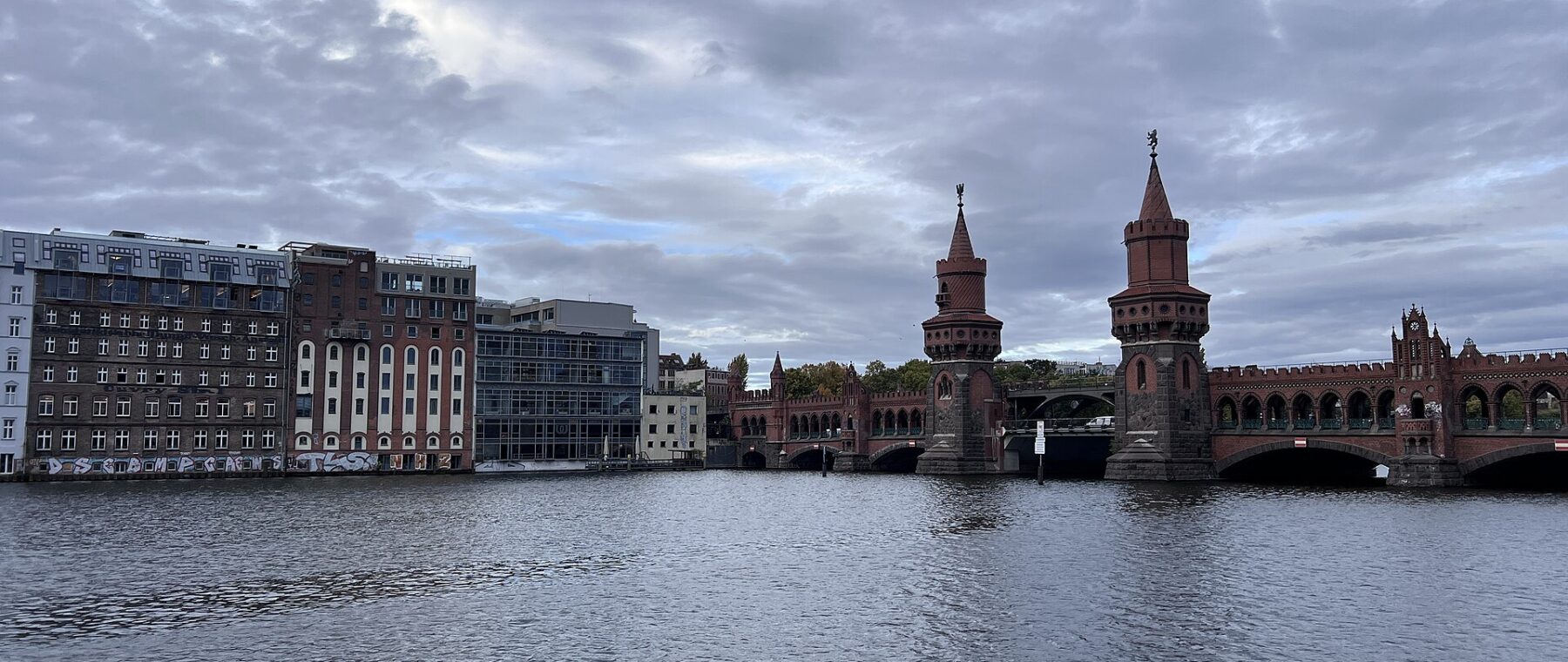
It looks like a castle gatehouse someone dropped across a river, and it was built to look exactly that way. Two red-brick towers with conical spires, a double row of pointed arches, crenellations along the parapet, and a yellow U-Bahn train clattering along the top deck every three minutes at sunset. Spelled without the umlaut, as Oberbaumbruecke Berlin, it is the most photographed structure in the city that is not the Brandenburg Gate — and almost nobody photographing it knows that the middle section is modern steel, that the bridge was blown up in 1945, or that for twenty-eight years it was a border crossing between two countries.
This guide covers where to stand for the photograph everyone wants, what the bridge actually is and why a nineteenth-century engineer made it look medieval, the Cold War history under your feet, and what is worth doing on each bank once you have crossed. It is free, it is open at every hour, and it is one of the very few genuinely great things in Berlin that costs nothing at all.
The Bridge at a Glance
| Detail | What to know |
|---|---|
| Cost | Free — it is a public road bridge |
| Open | 24 hours, every day |
| Connects | Kreuzberg (south bank) and Friedrichshain (north bank) |
| Built | 1894–1896, architect Otto Stahn |
| Upper deck | U1 and U3 lines, above the road |
| Nearest stations | U1/U3 Schlesisches Tor · U1/U3/S-Bahn Warschauer Straße |
| Best photograph | From the Warschauer Brücke or the north bank path, 30 min before sunset |
| Time needed | 15 minutes to cross and photograph; half a day for both banks |
Where to Stand for the Photograph
This matters more than anything else on this page, because the shot people have in their heads cannot be taken from the bridge itself.
The classic composition
Walk east to the Warschauer Brücke, the plain road bridge over the railway lines a few hundred metres away, or better, drop down to the riverside path on the Friedrichshain bank. From there you get the bridge side-on across the Spree, both towers, the arcade, the Molecule Man sculpture standing in the water beyond, and the towers of Mitte in the distance. Face roughly west and go about thirty minutes before sunset. That is the postcard, and it takes about ten minutes of walking to reach.
The train shot
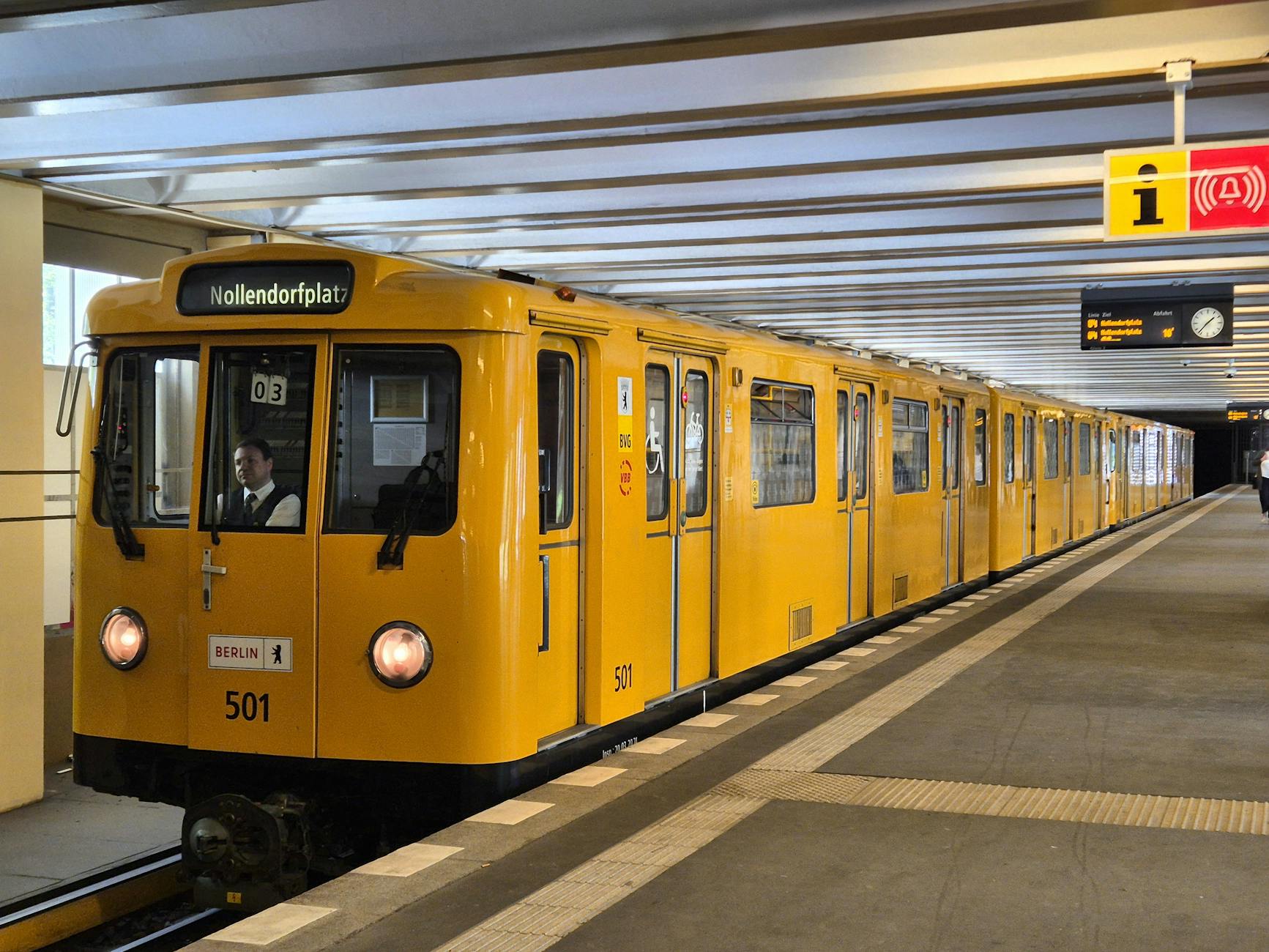
For the U-Bahn crossing the upper deck — yellow train, red brick, orange sky — you want to be on the river bank rather than on the bridge, and you want patience. Trains run every few minutes, so you will get several attempts. The southern (Kreuzberg) bank works in the morning; the northern (Friedrichshain) bank works at sunset.
From the water
Almost every Spree boat tour passes under it, and the approach from downstream — two towers rising out of the river as you come round the bend — is genuinely the best angle there is. If you were going to do a river cruise anyway, sit on the open deck and have the camera ready. Our ranking of the best views in Berlin puts this bridge in the top ten precisely because it does not require a ticket or a lift.
What the Bridge Actually Is
The name is a boom, not a tree
An Oberbaum was a floating barrier — a chained line of tree trunks drawn across the Spree at night to stop boats slipping into the city without paying duty. There was an Oberbaum at the upstream end of Berlin and an Unterbaum downstream, and the bridge built here in the 1890s inherited the name of the customs barrier it replaced. Nothing about it has anything to do with a tree.
Mock-medieval on purpose
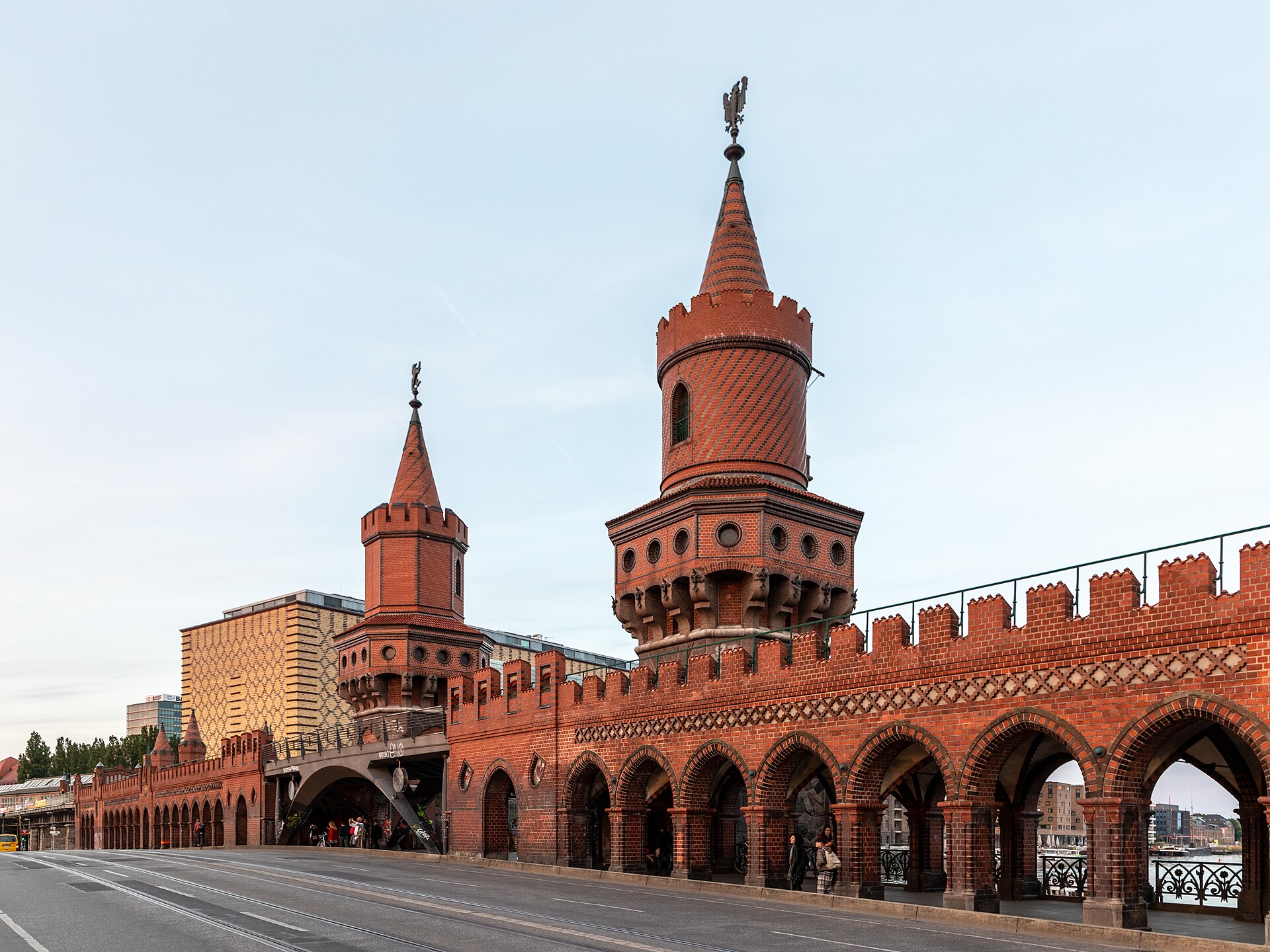
Otto Stahn’s bridge went up between 1894 and 1896, and its towers, arches and battlements are pure north German brick Gothic revival — that is to say, entirely fake. It is a bridge of the industrial age, carrying an electric railway, wearing the costume of a fortified city gate. The Kaiserreich liked to build that way: a new imperial capital dressing its brand-new infrastructure in borrowed medieval clothing to suggest a continuity it did not have.
The arcaded walkway along the road deck is not decoration. It is a covered pedestrian passage, and it is much the more pleasant way to cross, particularly in rain — most visitors walk along the exposed kerb without noticing the arcade is there for them.
Blown up, then rebuilt twice
In April 1945 the Wehrmacht destroyed the central span in an attempt to slow the Red Army’s advance into the city. The bridge was patched up after the war, and after reunification it was properly restored, with the Spanish architect Santiago Calatrava designing a new steel middle section to replace the lost span. Look at the centre of the bridge and you can see it: a clean modern structure between two pieces of nineteenth-century brick theatre. The U-Bahn resumed running across the upper deck in 1995.
The Border Ran Down the Middle
This is the part that changes how the bridge feels, and it is not signposted anywhere near as clearly as it should be. Between 1961 and 1989 the Spree here was the frontier. Kreuzberg, on the south bank, was West Berlin. Friedrichshain, on the north bank, was the capital of the German Democratic Republic. The bridge in between was cut, walled and turned into a checkpoint.
For most of that period it functioned as a pedestrian-only crossing — West Berliners on foot could pass into East Berlin here under particular conditions, and the U-Bahn above simply stopped, its line severed. The riverbank you now walk along on the Friedrichshain side was death strip. The water itself belonged to the East, which had lethal consequences for several people who drowned within metres of West Berlin while West Berlin police were forbidden to enter the river.
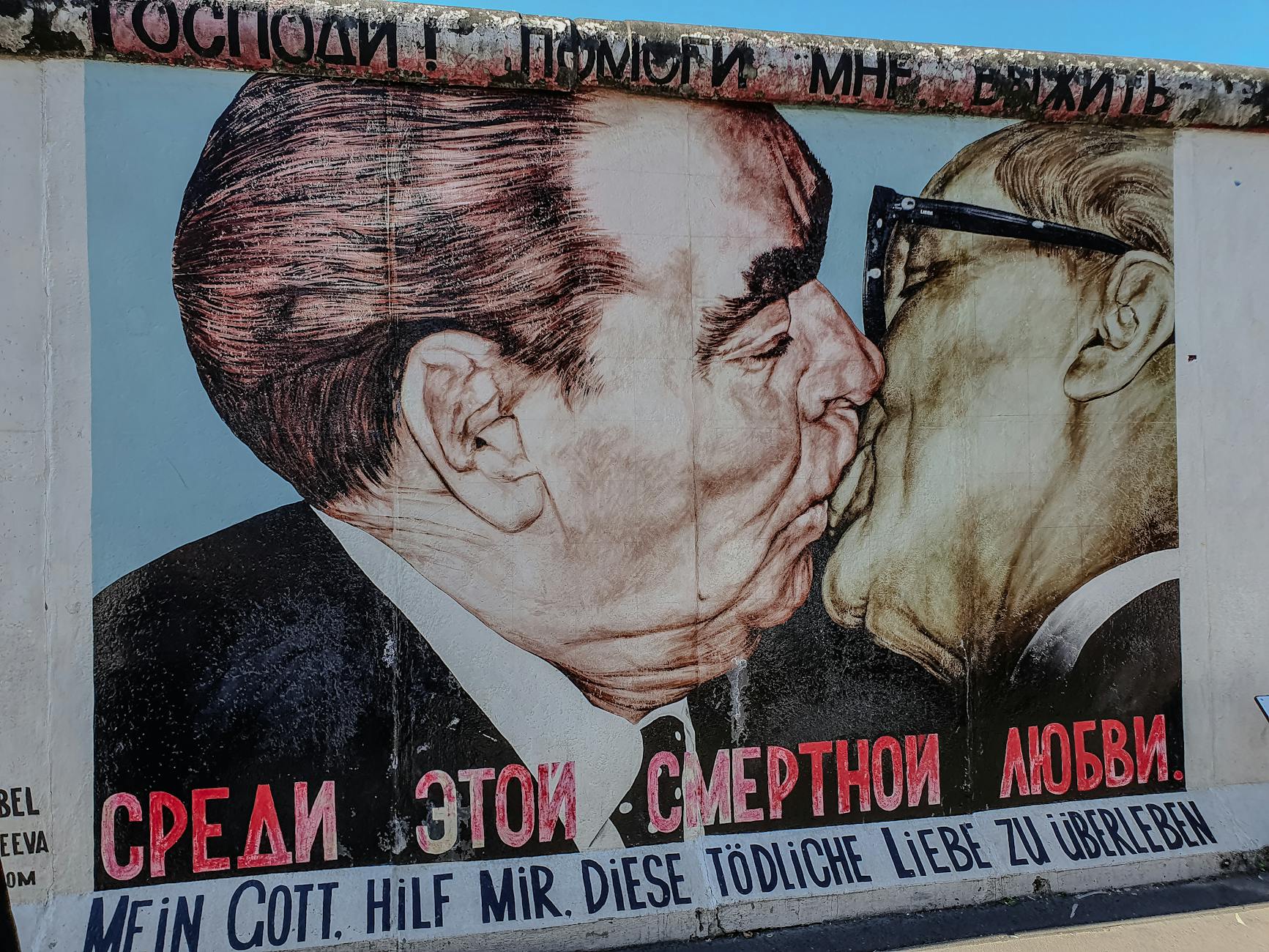
The East Side Gallery begins about two minutes’ walk from the north end of the bridge, and it is not a gallery in any ordinary sense — it is a 1.3-kilometre surviving stretch of the actual Wall, painted in 1990. Walking from the bridge along the Gallery is the single best way in Berlin to understand what the border did to a city at street level. Our Berlin Wall sites guide and the Wall timeline fill in the rest.
Things You Will Miss If Nobody Tells You
- Molecule Man — three 30-metre aluminium figures standing in the Spree just upstream, riddled with holes, leaning into each other. Jonathan Borofsky placed them at the point where Kreuzberg, Friedrichshain and Treptow meet, and they are best seen from the bridge or from a boat.
- The neon hands — a light installation on the bridge in which two figures play an endless game of rock, paper, scissors across the span. It is a joke about the two districts, and about two halves of a city, and it only reads properly after dark.
- The arcade — the covered walkway mentioned above, which most people walk straight past.
- The Gemüseschlacht — for years Kreuzberg and Friedrichshain have staged a mock summer battle on the bridge, throwing rotten vegetables at each other over the question of which district it belongs to. It has run on and off since the late 1990s and does not happen every year, so check locally rather than planning a trip around it.
What to Do on Each Bank
Friedrichshain, north
Turn right off the bridge and you have the East Side Gallery. Turn left and you are into the RAW-Gelände, a former railway repair yard now full of clubs, bars, a climbing wall inside a bunker and a Sunday flea market — scruffy, loud, heavily graffitied and one of the more honest bits of Berlin nightlife left in the centre. Warschauer Straße station, five minutes away, is the transport hub for the whole area and the jumping-off point for the techno clubs the district is famous for.
Kreuzberg, south
Off the south end you are at Schlesisches Tor, in the heart of SO36 — the eastern half of Kreuzberg, historically the punk and Turkish-German heart of West Berlin and still the loudest part of the district. Falckensteinstraße and Wrangelstraße run away from the bridge with kebab shops, bars and late-night everything. Twenty minutes’ walk west along the canal brings you to the Turkish Market on Maybachufer, which runs on Tuesdays and Fridays.
The two banks genuinely feel different, and that is not nostalgia — it is forty years of separate development that reunification has not fully sanded off. Crossing on foot at dusk, with the two districts visibly disagreeing about what a Friday night is for, is the best five minutes the bridge offers.
Crossing It: What the Five Minutes Are Actually Like
The bridge is around 150 metres long and takes about five minutes to walk end to end, less if you are not stopping. It carries a good deal of traffic — cars, a great many cyclists, and a continuous stream of people between two of the busiest transport nodes in east Berlin — so it is not a quiet contemplative crossing at any hour that most visitors will attempt it.
Use the arcade. The covered walkway running along the eastern side, behind the row of pointed arches, is the pedestrian route and it is far better than the exposed pavement: you get the arches framing the river in a series of neat rectangles, you are out of the wind, and you are not negotiating with cyclists. It is also where the photographs of the bridge’s interior are taken, and the light coming through the arcade in late afternoon is the best thing about the structure at close range.
Stop halfway. From the midpoint you can see Molecule Man upstream, the East Side Gallery’s back wall downstream on the left, the Universal building’s glass frontage on the right, and, on a clear evening, the TV Tower away to the north-west. The trains pass directly overhead, which is loud and, the first time, mildly startling.
With children, and with a pushchair
It is step-free the whole way across, wide, and railed, so it presents no difficulty with a pushchair or a wheelchair — unlike most of Berlin’s other landmark structures. The stations at either end are a different matter: check lift availability at Warschauer Straße and Schlesisches Tor before you commit, since the U1 viaduct stations are elevated and their lifts are not always in service. Our accessible transport guide covers how to check.
Is It Worth Going Out of Your Way For?
On its own, no — it is a bridge, and fifteen minutes covers it. But almost nobody comes here for the bridge alone, and that is the point: within a ten-minute radius you have the East Side Gallery, the RAW-Gelände, Schlesisches Tor, the Spree path towards Treptower Park and one of the densest concentrations of nightlife in Europe. The bridge is the hinge that all of it turns on.
Treat it as the anchor of an afternoon and evening rather than a stop. A reasonable plan: arrive at Warschauer Straße in mid-afternoon, walk the East Side Gallery, take the riverbank path for the photographs as the light drops, cross the bridge at dusk, and eat in Kreuzberg afterwards. That is a genuinely excellent Berlin day and the only money you will have spent is on the food and a transport ticket. Our Berlin at night guide picks up where that leaves off.
Getting There, and When
U1 or U3 to Schlesisches Tor for the Kreuzberg end; U1, U3, S-Bahn or tram M10 to Warschauer Straße for the Friedrichshain end. Both are in fare zone A — see the BVG ticket guide. Riding the U1 across the bridge is itself worth doing: the line runs on a viaduct through Kreuzberg, above the street, and it is the best cheap sightseeing in the city.
Go at dusk. Go on foot or by bike — the riverside paths on both banks are flat and connect the whole way to Treptower Park, which makes an excellent bike route. Avoid Friday and Saturday night if crowds bother you: Warschauer Straße at 1am is a genuinely chaotic place, and while it is not dangerous, it is not restful either. Our Berlin safety guide covers the area honestly.
Frequently Asked Questions
Is the Oberbaumbrücke free to visit?
Yes. It is a working public road and rail bridge, open at all hours, with no ticket, no barrier and no opening times. Crossing it on foot takes about five minutes.
Which districts does the Oberbaum Bridge connect?
Kreuzberg on the south bank and Friedrichshain on the north. From 1961 to 1989 that was the border between West Berlin and East Germany, and the bridge served as a pedestrian crossing point between the two.
Where is the best place to photograph the Oberbaumbrücke?
From the riverside path on the Friedrichshain bank or from the Warschauer Brücke, facing west about half an hour before sunset. You want the bridge side-on with a U-Bahn train on the upper deck. You cannot get the shot from the bridge itself.
Is the Oberbaumbrücke original?
Partly. The brick towers and arcades date from 1894–1896, but the central span was destroyed in April 1945 and the modern steel section between them was designed by Santiago Calatrava during the post-reunification restoration.
Can you walk across the Oberbaum Bridge at night?
Yes, and it is lit and well used. The neon rock-paper-scissors installation only works after dark, and the U-Bahn runs late — all night at weekends. The surrounding area around Warschauer Straße is very busy on weekend nights.
What else is near the Oberbaumbrücke?
The East Side Gallery is two minutes north, the RAW-Gelände five, and Schlesisches Tor and the SO36 half of Kreuzberg are immediately south. Molecule Man stands in the river just upstream. It is one of the densest clusters of things worth seeing in Berlin.
Related Berlin Guides
- East Side Gallery: Visiting the Painted Wall
- RAW-Gelände: Berlin’s Scruffiest Night Out
- Best Views in Berlin: 12 Viewpoints Ranked
- Berlin Wall Sites and Memorials
- The Turkish Market on Maybachufer
- Best Techno Clubs in Berlin
- Berlin by Bike
- Berlin Attractions and Tickets
Photo Credits
The Oberbaumbrücke from the Spree: Berlin Oberbaumbrücke lub 2024-10-10 by Lukas Beck, CC BY 4.0, via Wikimedia Commons.
The bridge towers from the road deck: Berlin, Oberbaumbrücke — 2019 — 4335 by Dietmar Rabich, CC BY-SA 4.0, via Wikimedia Commons.
Final Word
Most of Berlin’s famous structures ask for a ticket, a booking or a queue. This one asks for a ten-minute walk to the right side of the river and the patience to wait for a train. It is free, it is open all night, and it is more genuinely beautiful than anything you will pay €25 to stand on top of.
Cross it slowly, and think about what the water underneath it meant for twenty-eight years. A mock-medieval customs bridge that got blown up by a retreating army, walled off as an international frontier, then stitched back together with Spanish steel and handed to two districts who now throw vegetables at each other over who owns it — that is Berlin’s entire twentieth century in one crossing, and it costs nothing.