Berlin’s art calendar is built around two weekends. Gallery Weekend Berlin in early May opens the season — fifty-plus major galleries debut new exhibitions on the same Friday-to-Sunday window, free to the public, with private views rolling into broader access. Berlin Art Week in early September closes it — a five-day citywide festival with over a hundred institutional partners, major fair openings at Tempelhof Airport, and one Featured Night that pulls the entire scene into the same neighborhoods at the same time. If you care about contemporary art, these are the two times in the year worth scheduling a trip around.
This guide covers both events for 2026: Gallery Weekend May 1-3 and Berlin Art Week September 9-13. It also covers the broader Berlin gallery infrastructure those weekends showcase — the Mitte gallery district, the Potsdamer Strasse cluster, the König Galerie church, the Sammlung Boros bunker, and the emerging spaces in Wedding and Moabit. Whether you’re attending for a single exhibition or building a four-day art-focused trip, the Berlin gallery scene rewards planning.
Two Weekends That Define Berlin’s Art Year
| Event | 2026 Dates | Format | Cost |
|---|---|---|---|
| Gallery Weekend Berlin | May 1–3, 2026 | 50+ galleries, simultaneous openings | Free |
| Berlin Art Week | September 9–13, 2026 | Citywide festival, 100+ partners | Mostly free |
| POSITIONS Art Fair | September 10–13, 2026 | Major fair at Tempelhof Hangars | ~€22 day ticket |
| paper positions | April 30 – May 3, 2026 | Works on paper fair, Tempelhof | ~€16 |
| Featured Night (Art Week) | Thursday Sept 11, 2026, 6–10 pm | Citywide late opening | Free |
Gallery Weekend Berlin — May 1-3, 2026
Gallery Weekend Berlin is the more focused of the two weekends. Fifty top Berlin galleries — chosen by a curatorial committee, not by self-selection — open new exhibitions on the same Friday morning, with a stacked Friday-night private view program and broader public access through the weekend. About eighty distinct artistic positions are presented across the three days. The whole event is free.
The 2026 edition introduced a new “Perspectives” section, expanding the program beyond commercial gallery openings to include curated interventions across the city. James Turrell installed a major new light piece at max goelitz; Katherine Bradford presented a Berlin debut at Haverkampf Leistenschneider. The format works because all galleries open new shows simultaneously, meaning serious collectors and visitors can see fifteen to twenty exhibitions in a long weekend without traveling between cities or moving between unrelated event calendars.
How to plan three days: Friday is the marquee day with concentrated private views from 6-9 pm. If you can attend a private opening, do — galleries serve free wine, the artists and gallerists are present, and the social atmosphere is part of the experience. Saturday and Sunday are quieter, better for actually looking at the work. Galleries are clustered geographically — most can be visited on foot within their neighborhood, but moving between Mitte and Potsdamer Strasse will require U-Bahn.
Berlin Art Week — September 9-13, 2026
Berlin Art Week is broader, bigger, and more inclusive than Gallery Weekend — over 100 institutional partners spanning major museums, commercial galleries, project spaces, art fairs, and pop-up exhibitions. The 15th edition runs five days, with the marquee Featured Night on Thursday September 11 from 6-10 pm pulling most participating venues into extended evening hours simultaneously.
The format suits travelers who want to engage with Berlin’s contemporary scene at multiple levels. Major institutions (Hamburger Bahnhof, KW Institute, Berlinische Galerie, the Sammlung Boros bunker) program around the festival. Commercial galleries debut their autumn shows. Smaller project spaces in Wedding, Moabit, and Neukölln participate, giving visibility to the emerging scene that operates outside the gallery-district focus the rest of the year.
Plan at minimum two full days; three or four if you want to see the smaller spaces and attend the Featured Night properly. Some institutional programming requires advance ticketing (Sammlung Boros bunker tours sell out months ahead); other venues are free walk-in.
POSITIONS Berlin Art Fair — September 10-13, 2026
POSITIONS is the major commercial art fair that runs alongside Berlin Art Week. The 13th edition takes place at Tempelhof Airport’s Hangars 5 and 6 — 10,000 square meters of fair space inside the historic Nazi-era hangar complex, with 16-meter ceilings that allow ambitious large-scale presentations. About 30,000 visitors attended the most recent editions. Around 100 galleries from Germany and internationally participate.
Day tickets run about €22 with reduced and family options. The fair format is conventional — booths arranged in grid layouts, gallery teams selling work — but the venue is exceptional. The Tempelhof hangars themselves are worth experiencing whether or not you’re buying art. The fair includes a curated public program with artist talks and panel discussions.
The smaller paper positions Berlin fair runs in late April / early May concurrent with Gallery Weekend (April 30 – May 3, 2026 for the 10th anniversary edition), also at Tempelhof’s Main Hall. The focus is works on paper — drawings, prints, photography, original ephemera. Day tickets around €16. The two fairs are run by the same organization and offer complementary slices of the broader Berlin commercial art landscape.
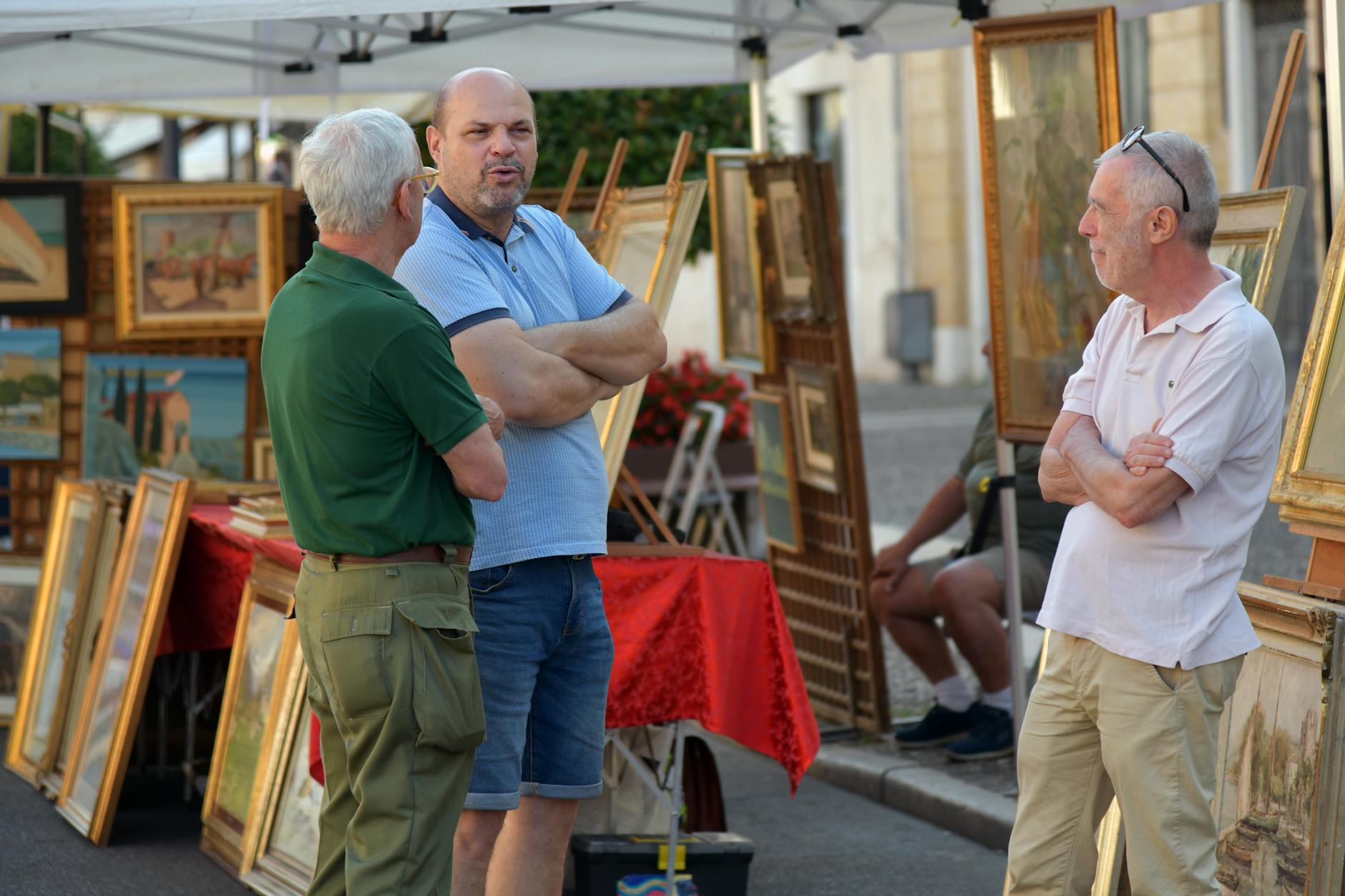
Berlin’s Gallery Neighborhoods
Mitte — Auguststrasse and the Historic District
The original post-Wende gallery district. Auguststrasse, Linienstrasse, and Brunnenstrasse form a walkable triangle anchored by the KW Institute for Contemporary Art (housed in a former margarine factory at Auguststrasse 69) and the Eigen+Art gallery. The neighborhood was where Berlin’s contemporary scene rebuilt itself in the early 1990s, and most of the city’s commercially important galleries have either anchored here or were founded here. Plan an afternoon — most galleries can be walked between in five to ten minutes. Pair with our Hackescher Markt guide for cafés and dinner options.
Potsdamer Strasse — The Power Cluster
If Mitte is the historic district, Potsdamer Strasse is where the international heavy hitters set up shop in the 2010s. Galerie Max Hetzler at Potsdamer Strasse 77-87, Esther Schipper, Sprüth Magers, Galerie Buchholz, and Thomas Schulte are clustered here, along with a dozen smaller galleries that opened to share the foot traffic. The neighborhood itself is genuinely strange — a wide street that mixes art galleries with adult-entertainment establishments, Turkish-German restaurants, and a few stranded mid-century apartment blocks. The Blain Southern legacy address still hosts important programming after the gallery’s closure.
Kreuzberg — König Galerie and the Brutalist Church
König Galerie operates from St. Agnes Church in Kreuzberg — a 1964-67 Brutalist masterpiece by Werner Düttmann, renovated as a gallery by architect Arno Brandlhuber in 2014-15 (the renovation won the Berlin Architecture Prize 2016). The combination of raw concrete, soaring volumes, and contemporary art makes for one of the most distinctive gallery experiences in Europe. Open Tuesday-Sunday 11:00-18:00; Mondays by appointment. The gallery also has a second space at the same complex for smaller exhibitions.
Wedding and Moabit — The Emerging Edge
The most interesting younger spaces in Berlin sit north of the central districts — Galerie Wedding (municipal, with rotating POW/UP/SOS curatorial programs), M+R Fricke on Beusselstrasse in Moabit, and a constellation of artist-run project spaces that change roster frequently. The scene rewards visitors who want to see what Berlin’s art world is actually producing right now, rather than what’s already been canonized. Most spaces are open afternoons Wednesday-Saturday; check websites before traveling because hours vary.
The Major Institutions
Hamburger Bahnhof — Nationalgalerie der Gegenwart
The contemporary art branch of Berlin’s national gallery, housed in a converted 19th-century railway station. About 10,000 square meters of exhibition space, with a permanent collection that includes Warhol, Lichtenstein, Beuys, and major works by post-war German artists. The temporary exhibition program is consistently strong. Open Tuesday-Sunday 10:00-18:00 (Thursday until 20:00). €14 standard ticket. Our full Hamburger Bahnhof guide covers the experience in depth.
KW Institute for Contemporary Art
The Mitte institution that inaugurated the Berlin Biennale in 1998 and remains one of the city’s most influential contemporary art venues. Housed in a former margarine factory at Auguststrasse 69, KW programs ambitious exhibitions of both established and emerging artists. Free entry on the first Wednesday of every month. €8 standard ticket. Open Wednesday-Monday 11:00-19:00 (Thursdays until 21:00).
Berlinische Galerie
The Berlin State Museum of Modern Art focuses on art produced in Berlin from 1870 to the present. The permanent collection covers Berlin Secession, Dada, Expressionism, post-1990 photography, and architecture archives. Less internationally famous than Hamburger Bahnhof but arguably more rewarding for visitors interested in Berlin specifically. Located in Kreuzberg. €10 standard.
Sammlung Boros — The Boros Bunker
The contemporary art collection housed inside a converted WWII bunker in Mitte. Guided tours only, 1.5 hours, in German or English, weekends primarily. €18 standard, €10 reduced. Book through boros-collection.com — tours sell out months in advance, especially around Gallery Weekend and Berlin Art Week. The experience is one of the most distinctive in European contemporary art: the building itself is brutalist concrete on a scale most visitors find disorienting, and the works are rotated from the Boros family’s larger private collection. No photography; no walk-ins.
How to Behave at a Berlin Gallery Opening
Openings are public events even when they feel insider — anyone can attend, no RSVPs are required, and the wine is free. A few unwritten conventions worth knowing. Arrive 7-8 pm rather than at the stated 6 pm start; openings in Berlin run late, and the social peak is usually around 8-9 pm. Dress casually rather than formally; the Berlin art world has consistently avoided the cocktail-attire culture of New York or Paris openings. Don’t push to meet the artist unless introduced — most artists prefer to talk to people they know during their own openings. It’s acceptable to take notes but not to photograph the work or the crowd. The gallery staff will tell you they accept written press inquiries; if you’re a journalist or writer, hand a business card to someone working the door.
A Three-Day Art Weekend Itinerary
Day 1 (Friday): Late afternoon at Hamburger Bahnhof. Dinner in Mitte. Evening private views in Auguststrasse / Linienstrasse — start at KW Institute and work outward.
Day 2 (Saturday): Morning at Berlinische Galerie. Lunch in Kreuzberg. Afternoon at König Galerie + a walk through the Kreuzberg gallery scene. Early evening on Potsdamer Strasse — Max Hetzler, Sprüth Magers, Esther Schipper.
Day 3 (Sunday): Pre-booked Sammlung Boros bunker tour. Lunch. Afternoon at the emerging spaces in Wedding/Moabit — pick three or four to visit. End with coffee at Café Kraft, Café Einstein, or one of the Mitte options near your hotel.
For the September trip, add a half-day at POSITIONS art fair at Tempelhof Airport. The fair occupies most of an afternoon if you walk it seriously.
Where to Stay for an Art-Focused Trip
Stay in Mitte if galleries are your priority. Hotels around Hackescher Markt, Friedrichstrasse, and the area around Oranienburger Strasse put you walking distance from KW and most of the Mitte gallery district. Kreuzberg works if you’re also interested in the broader contemporary scene — closer to König Galerie and Berlinische Galerie, easier access to the city’s more interesting restaurants and bars. Avoid the West Berlin hotel cluster (Kurfürstendamm area) unless you want long taxi rides between exhibitions. See our where to stay guide for full breakdowns.
Frequently Asked Questions
Are Berlin Art Week and Gallery Weekend the same event?
No. Gallery Weekend Berlin (early May) is a focused three-day commercial gallery event with about 50 galleries opening simultaneously. Berlin Art Week (early September) is a broader five-day citywide festival with 100+ partners including major museums, commercial galleries, and fairs. Both are worth attending; Gallery Weekend is more focused on commercial gallery openings, Art Week is more institutional and varied.
Is Gallery Weekend Berlin really free?
Yes. All participating galleries open new exhibitions to the public with free entry throughout the weekend. The Friday private views are also typically free to attend. The associated paper positions fair charges admission (~€16), but the gallery program itself is entirely free.
How far in advance do I need to book the Boros bunker?
For weekends during Gallery Weekend or Berlin Art Week, three to four months in advance. For regular weekends, six to eight weeks is usually sufficient. Tours run Saturdays and Sundays primarily, with limited weekday slots. Book through boros-collection.com.
What time do gallery openings start?
Most openings are officially scheduled to begin at 6 pm and run until 9 pm. In practice, arrival peaks between 7:30 and 9 pm. Galleries generally close their doors around 9-10 pm even if the social crowd continues outside on the street.
Can I visit Berlin Art Week without speaking German?
Yes — Berlin’s art world operates substantially in English, and almost all galleries provide English wall text, press releases, and gallery staff comfortable in English. The Featured Night programming is bilingual. Major institutions provide English audio guides.
What’s the dress code for an opening?
Casual but considered. Berlin’s art scene avoids both the formal cocktail-attire of New York and the conspicuous fashion of Paris. Most attendees wear black, dark jeans, well-cut basics. Avoid logos, casual sportswear, or overly formal dressing — both extremes will mark you as out of place.
Are the art fairs at Tempelhof ticketed separately?
Yes. POSITIONS and paper positions both charge day-ticket admission (~€22 and ~€16 respectively). Tickets are sold at the door and online. The fair programming is separate from the broader Berlin Art Week / Gallery Weekend gallery programming, though many visitors combine all in a single trip.
Final Word
Berlin is one of the three or four most important contemporary art cities in the world, and the two festival weekends are when the scene shows itself most fully. If you’ve been meaning to take the city’s art world seriously, both Gallery Weekend and Berlin Art Week are worth the trip — and either one beats almost any other European art event for the breadth of programming, the openness of the scene to outsiders, and the genuine pleasure of walking between fifty galleries on a single Saturday afternoon. Plan early, book the Boros bunker first, and let the rest of the trip unfold from there.