Nikolaiviertel: Berlin’s Reconstructed Old Town
Berlin's old town was built in 1987. What is genuinely historic here, whether the combined museum ticket pays back, and how long the quarter deserves.
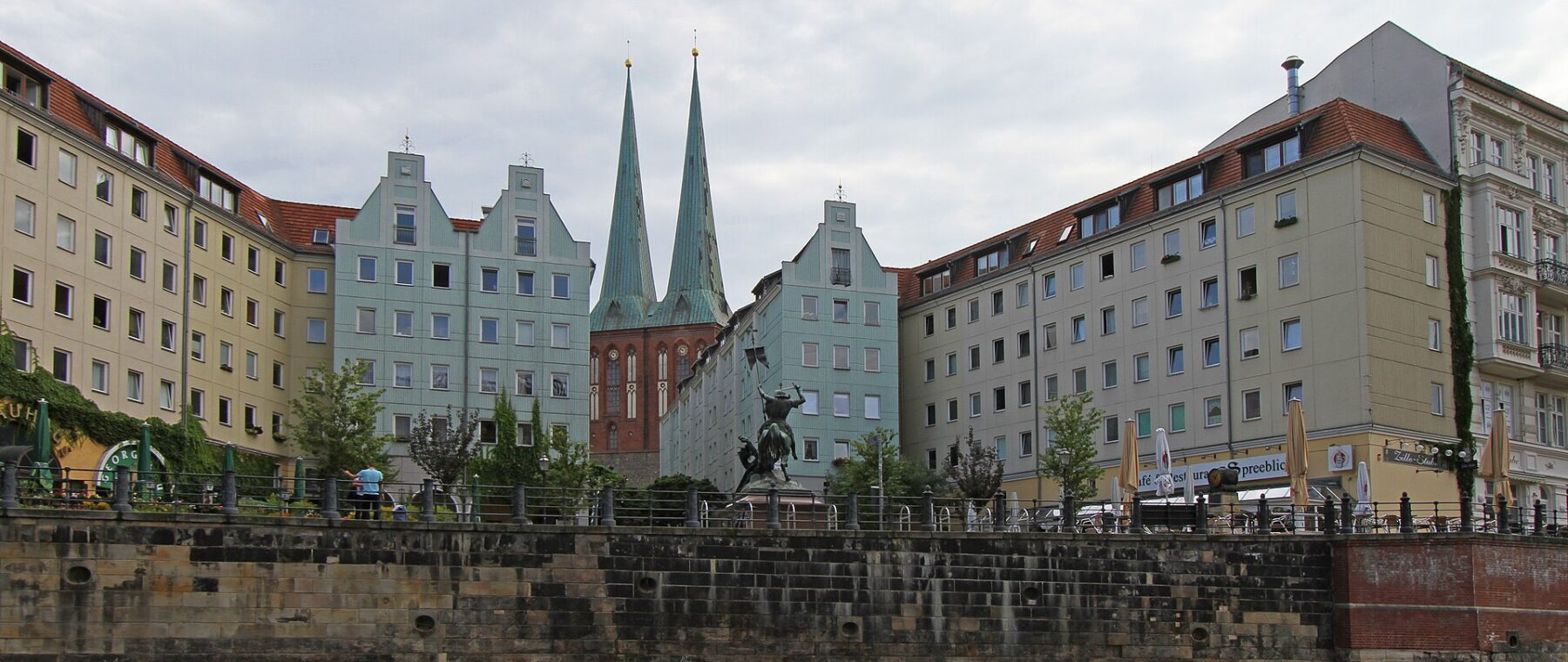
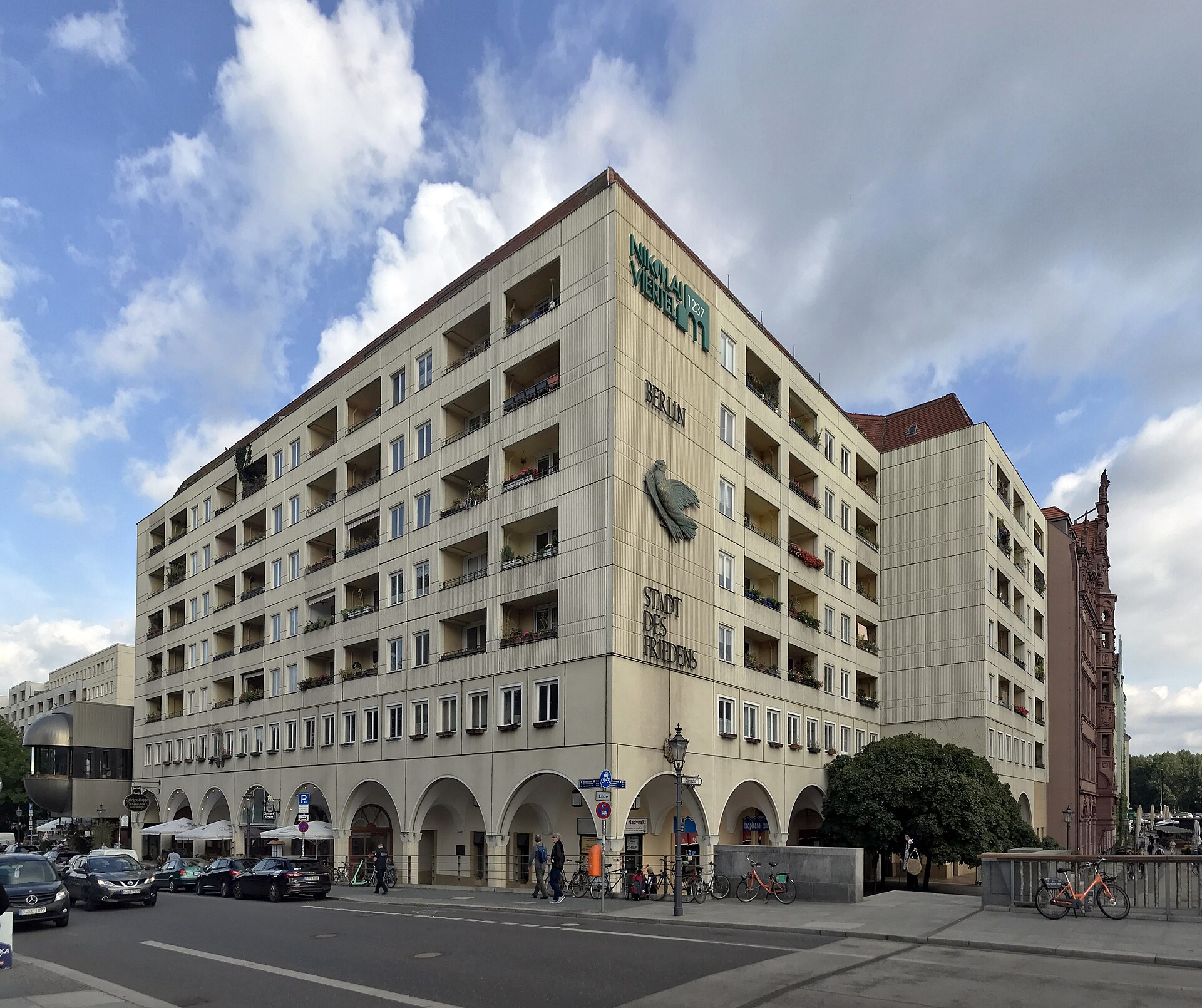
Walk in from the Spree and it looks like every German old town you have ever seen: cobbles, stepped gables, a twin-spired church, a bronze knight on a horse, tables under umbrellas. Then you notice that the gables are attached to six-storey blocks with balconies, that the windows are identical all the way along, and that one corner building carries the words Stadt des Friedens and a concrete peace dove. Nikolaiviertel Berlin is not a medieval quarter that survived. It is a medieval quarter that East Germany built from scratch in 1987, and knowing that is the difference between finding it charming and finding it fascinating.
This guide covers what is genuinely old here and what is not, the three museums and whether the combined ticket actually pays for itself, where to eat that is not simply charging for the cobbles, and how long the quarter deserves. Prices and hours were checked in September 2026; treat them as the right order of magnitude and confirm before you go.
Nikolaiviertel at a Glance
| What | Cost | Hours | Verdict |
|---|---|---|---|
| Walking the quarter | Free | Always open | 45 minutes is plenty |
| Museum Nikolaikirche | €7 single | Daily 10:00–18:00 | The one to do if you only do one |
| Museum Ephraim-Palais | €7 single | Tue–Sun 10:00–18:00, closed Mon | Depends entirely on the temporary show |
| Museum Knoblauchhaus | €7 single | Tue–Sun 10:00–18:00, closed Mon | Small, quiet, 30 minutes |
| Combined ticket | €15, two consecutive days | — | Only worth it for all three (see below) |
| Under 18s | Free | — | Reductions also apply |
What the Nikolaiviertel Actually Is
Built in 1987, for a birthday
Berlin’s oldest settlement really did stand here, on the eastern bank of the Spree, and the Nikolaikirche really is the city’s oldest surviving building. But the quarter around it was flattened in the Second World War and then left as open ground for four decades. What you walk through today was constructed by the GDR between roughly 1981 and 1987, for the city’s 750th anniversary — a state project to give East Berlin a historic centre to celebrate in, at a moment when West Berlin was mounting its own competing festivities across the Wall.
The architect, Günter Stahn, did something unusual for the period. Rather than build a museum-piece replica, he mixed genuine reconstructions of documented buildings with new blocks of prefabricated concrete panels — the standard GDR Plattenbau system — dressed in gables, arcades and pitched roofs so they would read as old from street level. People actually live in them. That is why the quarter has residents’ bicycles and window boxes as well as souvenir shops, and it is also why the illusion collapses the moment you look above the first floor.
The date on the wall
The corner block carries “NIKOLAIVIERTEL 1237” in large letters. That date is the first documentary mention not of Berlin but of Cölln, the twin settlement on the island directly opposite — modern Berlin adopted it as its own birthday, which is how 1987 came to be the 750th anniversary. It is a small thing, but it is a good illustration of how much of what looks ancient in this city is a decision made much more recently.
What is genuinely old
Three things, essentially. The Nikolaikirche itself, whose stone base goes back to around the 1220s–1230s. The Knoblauchhaus, a merchant’s house of 1760 that came through the war and is one of very few surviving bourgeois townhouses in central Berlin. And the façade of the Ephraim-Palais, a rococo building demolished in 1935 whose stonework was stored in West Berlin for decades and handed back for the reconstruction — so the front is authentic eighteenth-century material on a 1980s building, which is about as Berlin as a building can get.
The Nikolaikirche: Berlin’s Oldest Building
The church is now a museum rather than a working parish, run by Stadtmuseum Berlin. €7, open daily from 10:00 to 18:00 including public holidays — which makes it the useful one, because the other two close on Mondays.
Inside, the exhibition covers the history of the church and of Berlin’s beginnings, and the building itself is the main exhibit: you can see where the thirteenth-century granite base gives way to later brick, how much of the vaulting is post-war reconstruction, and how the interior was rebuilt from a burnt-out shell between 1980 and 1987. The twin spires that make it recognisable from the river are not medieval at all — they were added in the 1870s, during a Victorian-era restoration that gave a great many German churches the silhouettes people now assume they always had.
There are regular organ and chamber concerts in the nave, which is the best way to experience the space and is worth checking if you are here in the evening. It also participates in the city’s Long Night of Museums.
The Other Two Museums
Ephraim-Palais
The rococo corner building on Poststraße, sometimes called the most beautiful corner in Berlin — a claim that would carry more weight in a city with more competition. It hosts the Stadtmuseum’s temporary exhibitions on Berlin history and culture, which means the answer to “is it worth €7” depends entirely on what is showing when you visit. Check the current programme before you commit. The staircase alone is worth a look, and the building is open Tuesday to Sunday, closed Mondays.
Knoblauchhaus
A merchant family’s townhouse from 1760, furnished as a Biedermeier-era home — the Knoblauchs were a well-connected Berlin family and their house is one of the very few in the centre that came through the twentieth century structurally intact. It is small and quiet and takes half an hour, and it is the closest thing the quarter has to an authentic interior. If you have museum fatigue from Museum Island ten minutes’ walk away, this is a gentle, uncrowded antidote.
Does the Combined Ticket Pay For Itself?
Do the arithmetic before you buy it, because it is one of those tickets that quietly does not work.
- One museum — €7. Buy the single.
- Two museums — €14 in singles, versus €15 for the combi. The combined ticket costs you a euro more.
- All three — €21 in singles, versus €15. Now it saves you €6, and it is valid across two consecutive days, so you can split them.
So the rule is simple: the combi is worth it if and only if you are certain you will do all three, and realistically that means committing an afternoon. Most visitors do the Nikolaikirche and leave, which is a perfectly sensible choice. Our guide to the WelcomeCard versus the Museum Pass runs the same kind of maths across the city’s other bundles, most of which fail it.
Eating and Drinking in the Quarter
Be realistic about what this is: a small, pretty, entirely tourist-facing quarter in the middle of Mitte, where you are paying something for the setting. That said, the food here is more honest than the equivalent zone around, say, Checkpoint Charlie, and two or three places are genuinely worth sitting down in.
- Georgbräu — a brewpub with its own beer, long benches, and a terrace directly on the Spree. The terrace is the reason to come; on a warm evening it is one of the better places in central Berlin to sit with a litre of beer and watch the tour boats go past.
- Zum Nußbaum — a tiny, dark corner tavern that looks like it has been there since 1507. It has not. The original stood on the Fischerinsel, was destroyed in 1943, and this is a careful replica put up in 1987. The painter Heinrich Zille and his circle drank in the original, and the replica leans on that connection heavily, but it is a pleasant small room and the atmosphere is real enough even if the building is not.
- Zum Paddenwirt — the other traditional-looking pub, similar vintage, similar idea. Solid German plates, unremarkable, fine.
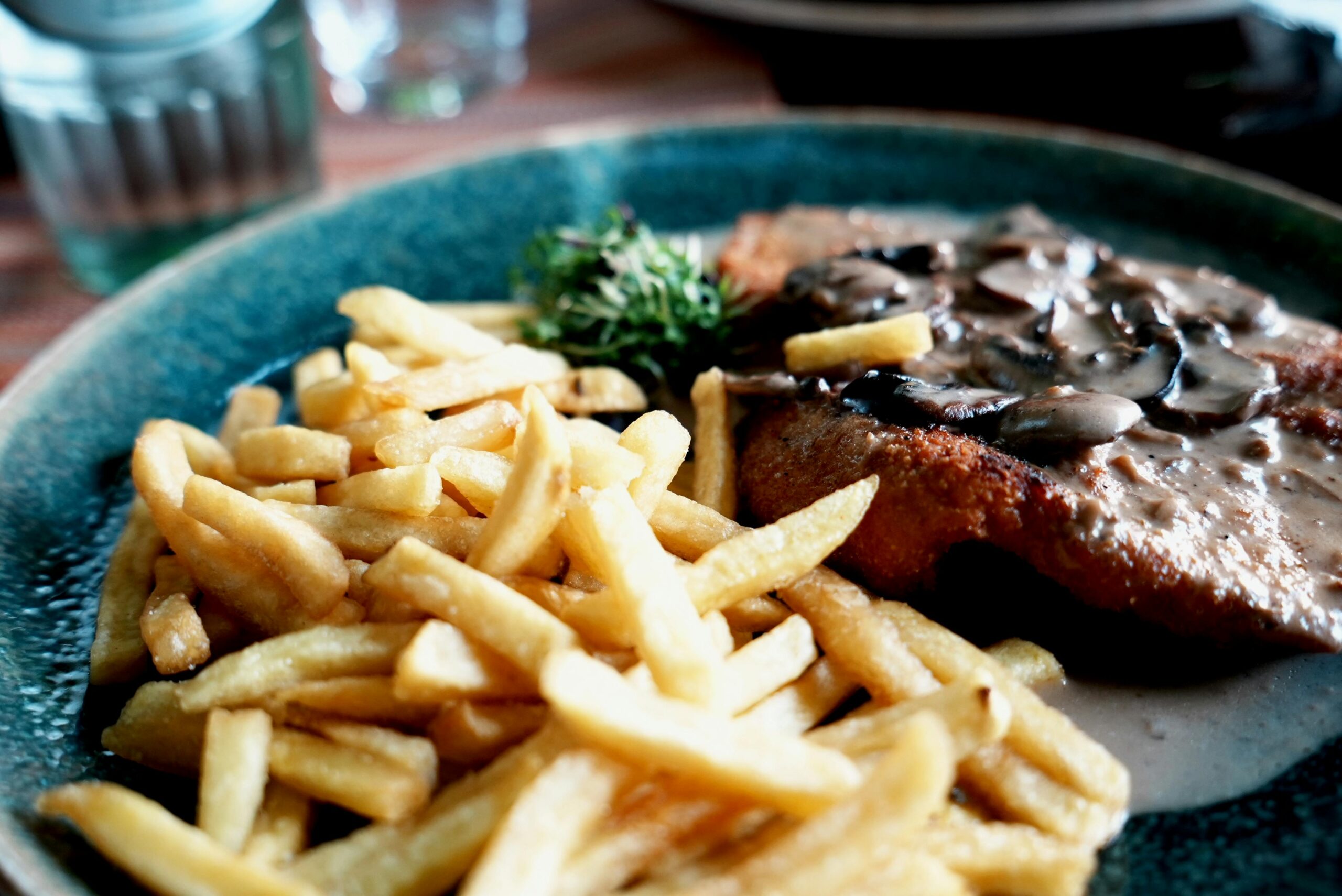
For anything beyond schnitzel and Eisbein, walk. Ten minutes gets you to Hackescher Markt or across the water into the streets behind the Fischerinsel, and the value improves immediately. Our guides to traditional German food in Berlin and cheap food in Berlin cover the alternatives.
What Is Next Door, and Worth Combining
The Nikolaiviertel’s best feature is arguably its address. Within a five-minute walk, in every direction, sit things that most visitors reach separately and tiredly on different days:
- The Rotes Rathaus — Berlin’s red-brick town hall, still the working seat of the city government, directly north across Rathausstraße. The ground floor and courtyard are usually open on weekdays and cost nothing.
- The Neptunbrunnen — the enormous 1891 Neptune fountain on the lawn between the Rathaus and the TV Tower, with four reclining figures representing the Rhine, Elbe, Oder and Vistula. Free, permanently open, and a far better photograph than anything on the cobbles.
- The Marienkirche — Berlin’s second-oldest church, on the far side of the fountain, with a medieval Totentanz fresco inside. Also free to enter.
- The Rathausbrücke and the Humboldt Forum — across the water to the west, and the natural continuation of any walk that starts here.
Strung together, that is a genuinely good ninety minutes of central Berlin that costs nothing beyond the museum you choose to enter. It is also the stretch that most itineraries skip in favour of walking twice as far along Unter den Linden. Our things to do in Berlin guide has the wider list.
The Argument the Quarter Is Part Of
Berlin has spent forty years arguing about how to fill the holes the war and the two states left in its centre, and the Nikolaiviertel was an early answer. The GDR’s own position was inconsistent: the same government that painstakingly rebuilt a medieval quarter in 1987 had dynamited the Stadtschloss, the Hohenzollern royal palace, in 1950, and put the Palast der Republik on the site. That palace of the republic was then itself demolished after reunification, and the Humboldt Forum — a modern museum behind reconstructed baroque façades — now stands where both once did.
So within a few hundred metres you can see a socialist state building a fake old town, a democratic state demolishing a socialist landmark, and a reconstructed royal palace containing a museum of world cultures. Almost nothing here is what it appears to be, and almost all of it is the result of somebody deciding which past the city should be allowed to display. Our reunification guide follows that argument through the 1990s.
Getting There and When to Go
U2 to Klosterstraße is the closest station, about three minutes’ walk. U5 and S-Bahn at Alexanderplatz put you seven or eight minutes away, and the walk from Museum Island across the Rathausbrücke takes about the same. Everything is in fare zone A — see our BVG ticket guide.
The quarter is at its best early in the morning, when the lanes are empty and the light comes off the river, and in the hour before sunset when the Georgbräu terrace fills up. Midday in July it is coach-tour territory and the charm thins considerably. In December there is a small Christmas market among the lanes that is one of the more atmospheric of the central ones precisely because the space is so tight — our Berlin Christmas markets guide has the circuit.
It rewards a rainy afternoon better than most of central Berlin, because the three museums, the church and two pubs are all within a two-minute walk of each other. That is a genuinely useful thing to know in a city where the wet-weather options tend to involve a train ride.
How Long Is It Worth?
Forty-five minutes to walk it and photograph it. Ninety minutes if you add the Nikolaikirche. Half a day if you are doing all three museums and eating here, which is a reasonable rainy-day plan and an odd choice on a sunny one.
What it does not justify is a special trip. The Nikolaiviertel sits inside a ten-minute walk of Museum Island, Alexanderplatz, the Rotes Rathaus and the Berliner Dom, and that is exactly how to use it — a pleasant twenty minutes of cobbles between two larger things, ideally ending on the Spree terrace. Our three days in Berlin itinerary routes through it on that basis.
And if reconstructed history bothers you on principle, it is worth remembering that a great deal of what visitors admire in central Berlin is reconstruction of one kind or another — the Berliner Dom’s interior, the Gendarmenmarkt, the Humboldt Forum’s façades. The Nikolaiviertel is simply more honest about it, largely because it never quite manages to hide the concrete.
Frequently Asked Questions
Is the Nikolaiviertel actually old?
Mostly no. The Nikolaikirche dates from the early thirteenth century and the Knoblauchhaus from 1760, and the Ephraim-Palais façade is genuine eighteenth-century stonework. Everything else was built by East Germany between 1981 and 1987, using prefabricated concrete panels behind historicist gables.
Is the Nikolaiviertel free to visit?
The quarter itself is a public neighbourhood — free, open at all hours, no ticket. You pay only to enter the three Stadtmuseum sites, which are €7 each or €15 for a combined ticket, and free for under-18s.
Is the €15 combined ticket worth buying?
Only if you will visit all three museums. Three singles come to €21, so the combi saves €6. Two singles come to €14, so for two museums the combined ticket actually costs you a euro more than buying separately.
What is the oldest building in Berlin?
The Nikolaikirche, whose stone base dates from around the 1220s or 1230s. It was gutted in the Second World War and rebuilt between 1980 and 1987, and it now operates as a museum rather than a parish church. The twin spires are a nineteenth-century addition.
How long do you need in the Nikolaiviertel?
Forty-five minutes to walk it, ninety with the Nikolaikirche, half a day if you do all three museums and eat here. Treat it as a stop between Museum Island and Alexanderplatz rather than as a destination in itself.
Where should I eat in the Nikolaiviertel?
Georgbräu for its own beer and the Spree terrace, which is the best seat in the quarter. Zum Nußbaum and Zum Paddenwirt for traditional German plates in small dark rooms. For better value, walk ten minutes towards Hackescher Markt.
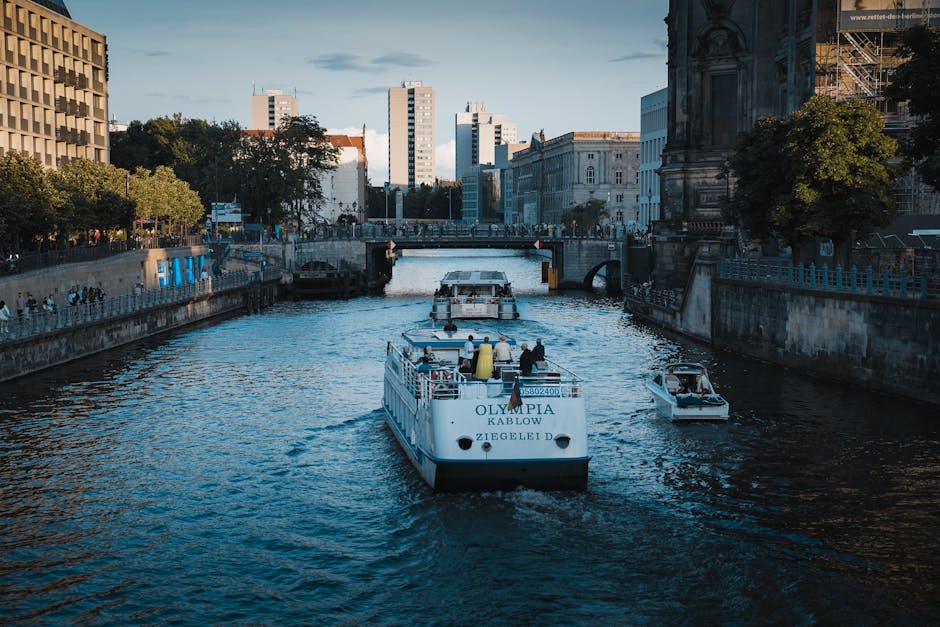
The prettiest view of the Nikolaiviertel is from the river, where the twin spires of the Nikolaikirche rise behind the old riverside houses. Several Spree cruises pass this stretch; our Berlin boat tours guide explains which trip to choose and where each one leaves from.
Related Berlin Guides
- Berlin Attractions and Tickets: What to Book and What to Skip
- Museum Island Berlin
- Alexanderplatz: What Is Actually There
- Berliner Dom: The Cathedral, the Crypt and the Dome Walk
- Traditional German Food in Berlin
- Berlin History and Culture Guide
- Rainy Day Activities in Berlin
- Berlin WelcomeCard vs Museum Pass
Photo Credits
The Nikolaiviertel from the Spree: Berlin-Nikolaiviertel-04-2017-gje by Gerd Eichmann, CC BY-SA 4.0, via Wikimedia Commons.
The GDR-era block on the Mühlendamm side: 2021-09-02-Nikolaiviertel-Berlin-Mitte by Gunnar Klack, CC BY-SA 4.0, via Wikimedia Commons.
Final Word
The Nikolaiviertel is worth an hour, and it is worth it for a reason that has nothing to do with the Middle Ages. This is a state’s attempt to manufacture a past for a city it had cut in half, finished two years before that state ceased to exist, and lived in ever since by ordinary Berliners with washing on the balconies. Read it that way and it becomes one of the more interesting hours in Mitte.
Practically: go early or late, do the Nikolaikirche and skip the combi ticket unless you are committed to all three, and finish on the Georgbräu terrace with the river going past. That is the version of this quarter that people remember.