Victory Column (Siegessäule): Climbing the Golden Else
285 steps, €4.50, cash only — what the climb is like, what you can see from the top, and the history the ticket does not mention.
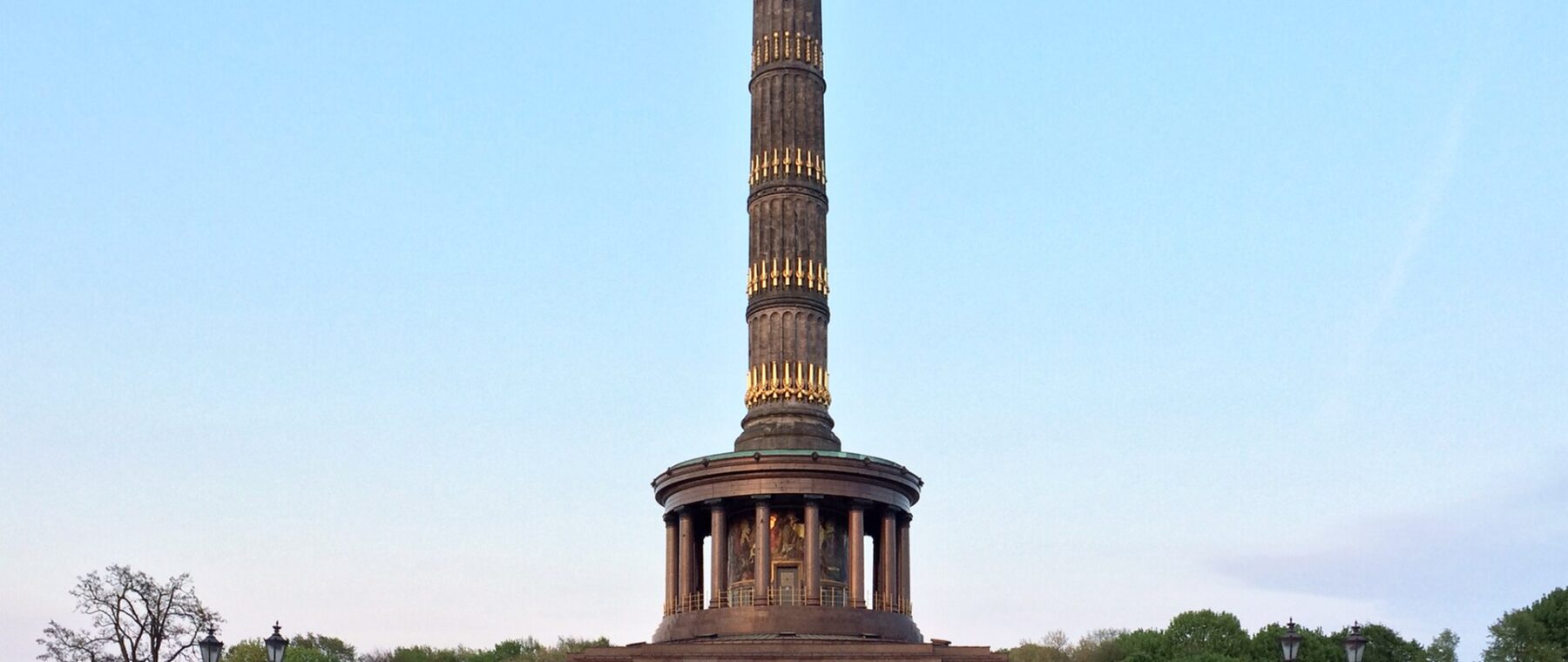
There is a golden woman with wings standing on a sandstone column in the middle of a five-lane roundabout in the Tiergarten, and Berliners have been calling her Goldelse — Golden Lizzie — since almost the day she went up. Type the name without the umlaut, as Siegessaeule Victory Column Berlin, and you will still find the right place, which is a small mercy given how many ways there are to spell it wrong. The monument costs €4.50 to climb, has 285 steps and no lift, takes cash only, and gives you the best view of the Tiergarten available anywhere in the city.
This guide covers what the climb is actually like, what you can see from the top, the monument’s genuinely uncomfortable history — it commemorates three wars and was moved to its present spot by the Nazis — and the one piece of practical advice that matters more than the ticket price. Costs and hours were checked in September 2026; treat them as the right order of magnitude and check before you travel.
Visiting the Siegessäule at a Glance
| Detail | What to expect |
|---|---|
| Adult ticket | €4.50 |
| Reduced | €3.50 (students, seniors, children) |
| Payment | Cash only — no cards |
| Steps | 285, spiral, no lift |
| Time needed | 30–45 minutes including the climb |
| Summer hours | Roughly Mon–Fri 09:30–18:30, weekends to 19:00 |
| Winter hours | Roughly 10:00–17:00 daily |
| Access | Four pedestrian tunnels from the kerb — never cross the roundabout |
| Accessibility | Not step-free; the tunnels have stairs and the column has no lift |
The Climb: 285 Steps, and What They Are Like
You buy your ticket at a small kiosk in the base, and then you go up a stone spiral staircase inside the column. It is narrow. It is dim. It has no landings to speak of and no lift, and because the stairwell is a single spiral only wide enough for one and a half people, you will spend part of the ascent flattening yourself against the wall while somebody comes down.
That said: 285 steps is not the Duomo and it is not St Paul’s. A reasonably fit adult does it in five to seven minutes without stopping, and there is a small gallery partway that lets you catch your breath. What it is genuinely not suited to is anyone with knee trouble, anyone carrying a small child, anyone with a pushchair, or anyone claustrophobic — the shaft is tight and there is no way to abandon the climb quickly if you meet a school group coming the other way.
At the top you emerge onto a circular open-air gallery directly beneath the statue’s feet, ringed with a mesh screen. The mesh is not intrusive to look through but it is intrusive to photograph through, and that is the honest trade-off of the whole visit: the view is excellent and your photographs of it will be slightly worse than your memory of it.
What You Can Actually See From the Top
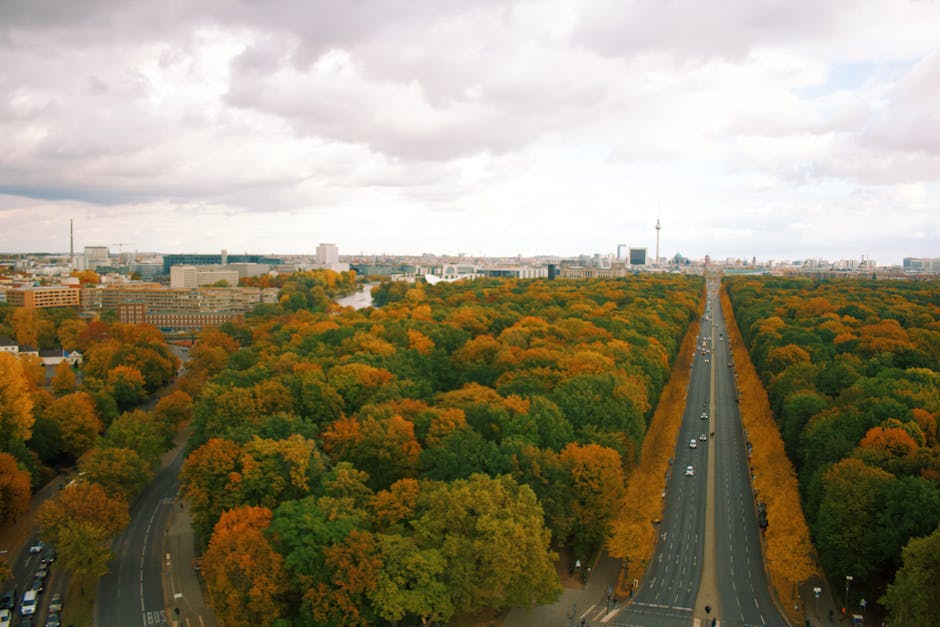
This is the Siegessäule’s real argument, and it is a strong one. From 51 metres up, at the exact centre of the Großer Stern, you are looking down the axes of a park design rather than at a random slice of city:
- East — the Straße des 17. Juni running arrow-straight to the Brandenburg Gate, with the Reichstag behind it and the TV Tower beyond that. This is the money shot and it is the reason to come.
- West — the same avenue continuing to Ernst-Reuter-Platz, with the Kaiser Wilhelm Memorial Church and the towers of the old West Berlin centre in the distance.
- North and south — the Tiergarten itself, an unbroken green field of mature trees running to the horizon in both directions. Nowhere else can you see how genuinely enormous this park is.
The comparison worth making is with the paid platforms elsewhere in the city. The TV Tower is roughly five times the price and, because you are standing inside the landmark, leaves it out of your photographs. The Siegessäule costs €4.50 and puts the Brandenburg Gate, the Reichstag and the Fernsehturm in a single frame. Our ranking of the best views in Berlin places it fourth overall, and it would rank higher if it had a lift.
The Bit That Catches Everyone Out: Cash and Tunnels
Bring notes and coins
The ticket kiosk takes cash only. Berlin has become much more card-friendly over the past few years, and that improvement has made visitors complacent about a habit that is still occasionally essential here. There is no cash machine in the base of the monument. If you turn up with only a phone, you will walk back to a bank on Hardenbergstraße and start again. This is comfortably the most common wasted journey on the whole list of central Berlin attractions.
Use the pedestrian tunnels
The column stands on an island in the middle of the Großer Stern, a large, fast, five-armed roundabout that carries a genuine volume of traffic. Four pedestrian tunnels run under the road from the kerb — that is the only way in and the only way out. Do not attempt to cross on the surface. People do try, and it is exactly as bad an idea as it looks.
The tunnels themselves have steps, which is worth knowing if you were hoping to reach the base of the monument without stairs. You cannot; there is no step-free route to the island. Our accessible Berlin transport guide covers what is and is not manageable elsewhere in the city.
What the Monument Is Actually For
Three wars, one column
The Siegessäule was designed by Heinrich Strack and unveiled in 1873 to commemorate Prussian victories in three wars: against Denmark in 1864, against Austria in 1866, and against France in 1870–71. Each of the original three drum segments of the shaft stands for one of them, decorated with gilded gun barrels captured from the defeated side — an act of triumphalism so literal it is almost quaint.
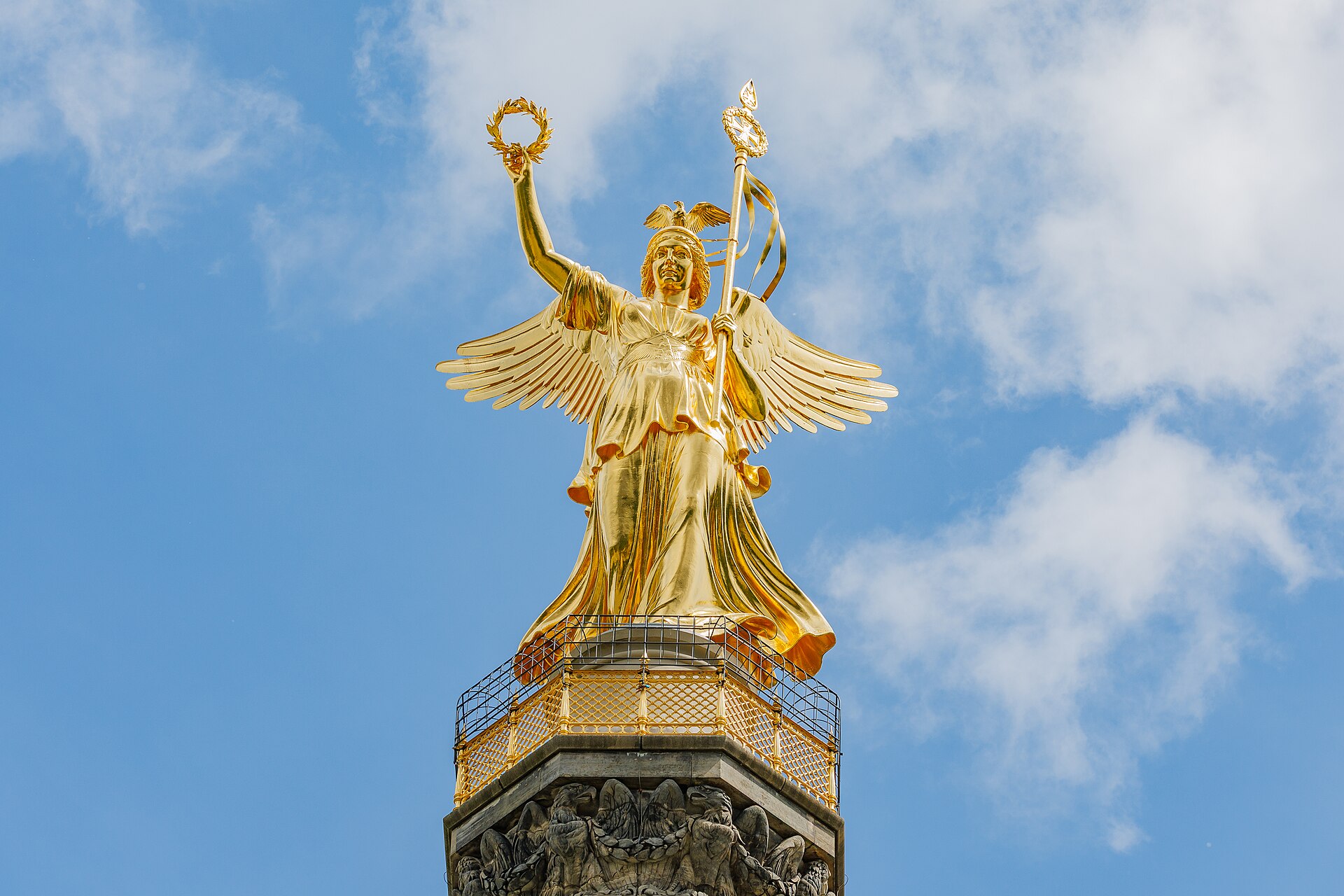
Friedrich Drake’s statue of Victoria on top is over eight metres tall and weighs something in the order of 35 tonnes. She holds a laurel wreath in one hand and a standard topped with the Iron Cross in the other, and her helmet carries an eagle. Berliners took one look at her in 1873 and nicknamed her Golden Lizzie, which tells you a great deal about the local relationship with official grandeur.
It has not always stood here
This is the part most visitors do not know, and it changes how the monument reads. The column was originally erected on Königsplatz, directly in front of the Reichstag. In the late 1930s the Nazi government moved the entire structure to its present position at the Großer Stern as part of Albert Speer’s plans to rebuild Berlin as the capital of a world empire, and while they had it apart they added a fourth drum segment, making it considerably taller than Strack designed it.
So the object you climb is not simply a Prussian war memorial. It is a Prussian war memorial that a later regime enlarged and repositioned to serve its own architecture of domination, and it survived the war that regime started while most of the city around it did not. That layering is very Berlin, and it is worth carrying up the stairs with you. Our guide to Nazi-era sites in Berlin covers the wider Germania plan and what remains of it.
The mosaic hall at the base
Inside the colonnaded drum at the foot of the column is a mosaic frieze by Anton von Werner depicting the founding of the German Empire. It is included in your ticket and takes five minutes. Most people walk past it on the way to the stairs, which is a pity — it is the clearest possible statement of what the whole monument was built to say.
When to climb
Mid-morning on a weekday is the quietest slot, and the light is on the eastern axis, which is the direction you came for. Late afternoon reverses that: the Brandenburg Gate falls into haze and the western view towards Charlottenburg picks up. There is no evening opening, so sunset from the gallery is not an option in summer — the column shuts long before the sun goes down. In December, when the sun sets around 15:50, it briefly is.
Avoid the days when the Straße des 17. Juni is closed for an event. During the Berlin Marathon, Christopher Street Day, the Fanmeile and New Year’s Eve the roads around the Großer Stern are shut and the monument’s opening becomes unpredictable. Our Berlin events calendar lists the dates that matter.
The Goldelse in Modern Berlin
The column has had a considerably better second life than its origins would suggest. Wim Wenders put angels on it in Wings of Desire in 1987, which is how most of the world outside Germany first saw it, and U2 filmed a video up there a few years later. Through the 1990s it was the physical centre of the Love Parade, when a million people filled the Straße des 17. Juni.
Today the avenue running east from the Großer Stern is where Berlin holds its biggest outdoor events: the Christopher Street Day parade finishes near here, the Fanmeile fills the road for major football tournaments, and the New Year’s Eve party stretches from the column to the Brandenburg Gate. Siegessäule is also, not coincidentally, the name of Berlin’s long-running LGBTQ+ city magazine — the monument was adopted as a symbol by a community that had every reason to reclaim it. Our LGBTQ+ Berlin guide picks up that thread.
Getting There and What Is Nearby
There is no U-Bahn or S-Bahn station at the Großer Stern itself, which surprises people. The realistic options are:
- Bus 100 or 106 to Großer Stern — the 100 is the famous cheap sightseeing route between Zoologischer Garten and Alexanderplatz, and it stops here.
- S-Bahn Bellevue (S5/S7) — about a ten-minute walk east through the park.
- S-Bahn Tiergarten (S5/S7) — about ten minutes west.
- Walk from the Brandenburg Gate straight down the Straße des 17. Juni — around 25 minutes, entirely flat, and a genuinely pleasant approach because the column grows in front of you the whole way.
Everything is in fare zone A; the BVG ticket guide covers what to buy. The column pairs naturally with a walk through the Tiergarten to Schloss Bellevue and the Soviet War Memorial, or with a bike ride — the park’s paths are flat, wide and shaded, and cycling is by far the best way to cover it.
Is It Worth €4.50?
Yes, with two conditions. Go on a clear day, because Berlin’s summer haze flattens the long axial views that are the entire point, and go only if 285 steps in a narrow spiral is something you will enjoy rather than endure. If either of those is a problem, the monument photographs beautifully from the ground and from the park, and you have lost nothing.
What you should not do is treat it as a substitute for one of the big paid platforms. It is not high enough for a panorama in the ordinary sense — it is a perfectly framed view of one avenue and one park, which happens to be a better thing than a hazy 360-degree grid. At €4.50 it is the best-value ticket in central Berlin by a wide margin, and it is one of the few attractions in the city where the queue, when there is one, is about ten people long.
Frequently Asked Questions
How many steps are there in the Siegessäule?
285, in a single narrow spiral staircase with no lift. Most reasonably fit adults manage it in five to seven minutes. There is a small gallery partway up where you can stop and let people past.
How much does it cost to climb the Victory Column?
€4.50 for adults and €3.50 reduced, as checked in September 2026. The kiosk is cash only and there is no cash machine at the monument, so bring notes or coins with you.
Is the Siegessäule wheelchair accessible?
No. The only way onto the traffic island is through pedestrian tunnels that have steps, and the column itself has 285 stairs and no lift. There is no step-free route to the base or to the viewing gallery.
Why was the Victory Column moved?
It originally stood on Königsplatz in front of the Reichstag. In the late 1930s the Nazi government relocated it to the Großer Stern as part of Albert Speer’s plan to rebuild Berlin, and added a fourth drum segment to the shaft at the same time, making it taller than its original design.
Can you see the Brandenburg Gate from the Siegessäule?
Yes — it sits directly on the eastern axis, about 1.5 kilometres away down the Straße des 17. Juni, with the Reichstag just behind it and the TV Tower further back. That single sightline is the best reason to buy the ticket.
Is the Siegessäule worth visiting?
For €4.50, on a clear day, if you are happy climbing stairs: yes, easily. It is the cheapest good view in central Berlin and the only one that puts the city’s three most recognisable structures in one frame. Skip it in haze, and skip it if stairs are a problem.
The easiest way to arrive is on bus 100, which circles the Großer Stern on its way between Zoologischer Garten and Alexanderplatz; from the top deck you see the column from every side before you get off. Our guide to hop-on hop-off buses in Berlin explains why the 100 is the best-value sightseeing ride in the city.
Related Berlin Guides
- Best Views in Berlin: 12 Viewpoints Ranked
- Berlin Attractions and Tickets: What to Book and What to Skip
- Brandenburg Gate: Visiting Berlin’s Landmark
- Berlin TV Tower Tickets: Which Tier Is Worth Paying For
- Nazi History in Berlin: The Sites That Remain
- Outdoor Activities in Berlin
- Berlin by Bike
- Free Attractions in Berlin
Photo Credits
The Siegessäule at the Großer Stern: Siegessaeule-Grosser-Stern-Berlin-Tiergarten-04-2018 by Gunnar Klack, CC BY-SA 4.0, via Wikimedia Commons.
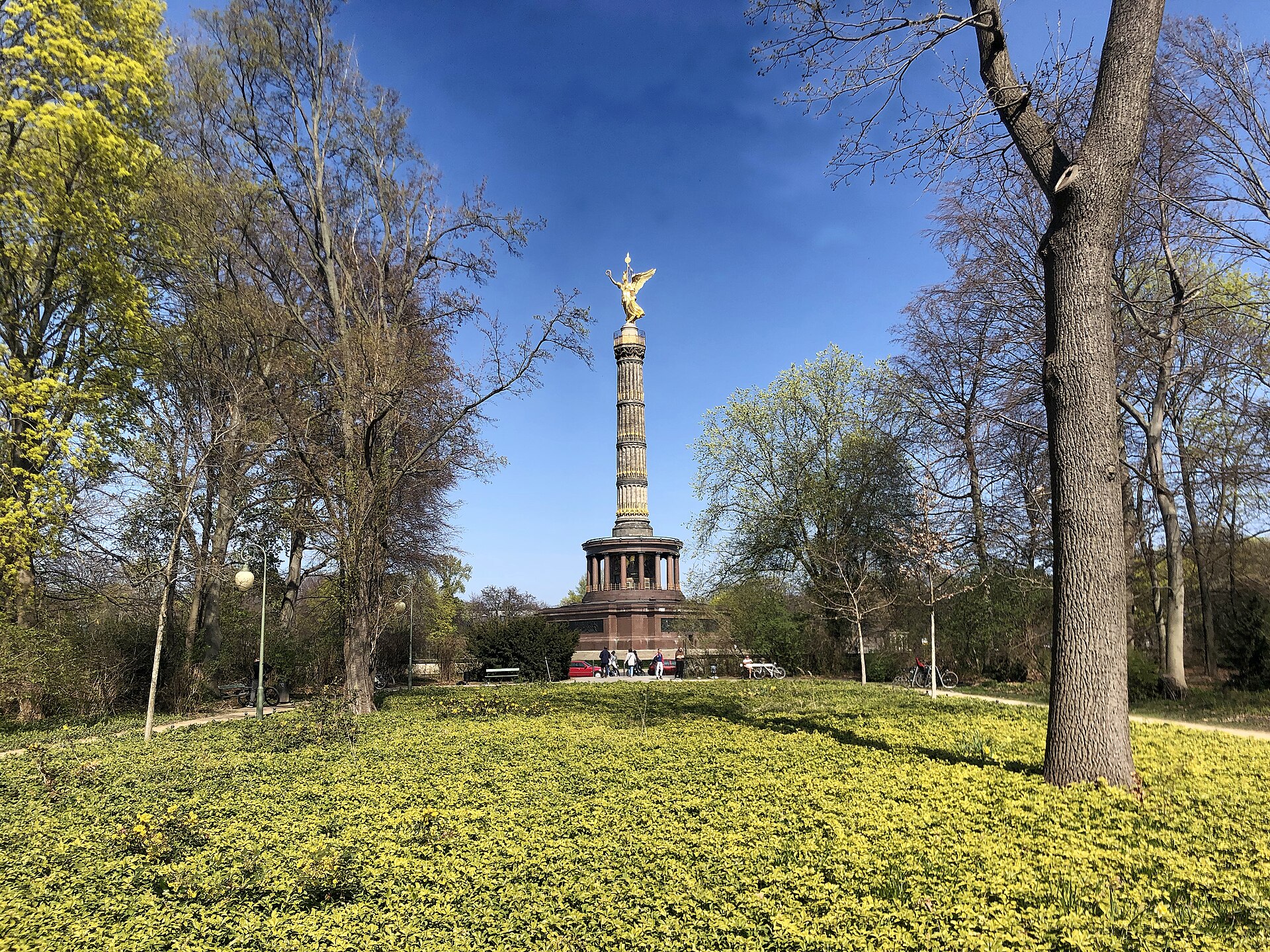
The column seen from the Tiergarten: Tiergarten in Berlin with the Victory Column in the background by Chris Alban Hansen, CC BY-SA 2.0, via Wikimedia Commons.
The Victoria statue: 2025-05-28 Stadtansicht Berlin; Siegessäule Großer Stern STP 5757 by Steffen Prößdorf, CC BY-SA 4.0, via Wikimedia Commons.
Final Word
Bring cash, use the tunnels, and go when the sky is clear. Those three things are the difference between the best-value ticket in central Berlin and a wasted walk across the Tiergarten.
And spend a moment at the bottom before you start climbing. A monument to three wars, enlarged and relocated by the Third Reich, that survived the destruction of the city around it and is now the emblem of Berlin’s LGBTQ+ magazine and the backdrop to its New Year’s Eve party — that is not a simple object, and the €4.50 buys you more than a staircase.